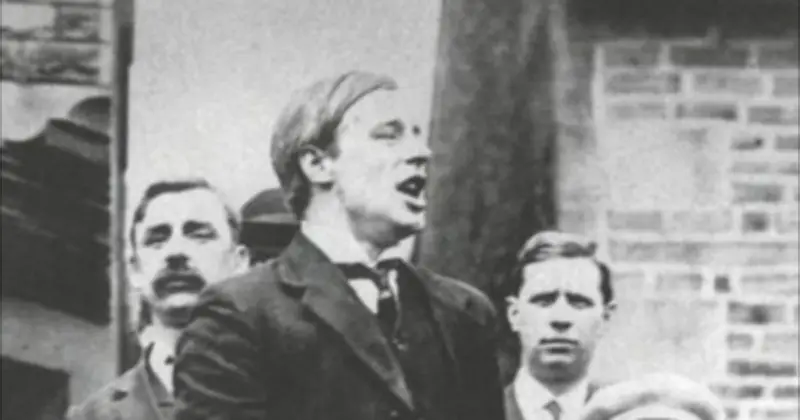
Victor Grayson, Britain's first revolutionary Socialist MP, vanished from his Piccadilly apartment on September 20, 1920, never to be seen again. His disappearance remains one of the most intriguing unsolved mysteries in British political history, yet it remains largely unknown to the public.
The Rise of a Firebrand
Born in poverty in Liverpool, Grayson showed exceptional promise as an amateur preacher and was supported by the Unitarian church to train as a minister. However, he fell into radical left-wing politics as a student and his firebrand speeches connected powerfully with younger audiences. At just 26, he shook the political establishment by winning the 1907 Colne Valley by-election for the Socialists in West Yorkshire, a shock to the Labour Party who had not wanted him as a candidate.
Grayson made powerful speeches on behalf of the unemployed, using incendiary language that got him expelled from Parliament multiple times. But he found the temptations of London seductive, with many willing to buy him drinks and offer companionship. He lost his seat and was declared bankrupt in August 1914, making him ineligible for Parliament.

Controversial War Stance and Secret Service Ties
Grayson's support for Britain's entry into the First World War was another mystery. Did he truly see the war as a struggle for freedom, or was he motivated by desperation for cash? He joined up and was wounded at Passchendaele. It is now believed he was taking money from the newly formed Secret Intelligence Service (SIS) to monitor left-wing groups, making enemies among both the Establishment and his former comrades.
In 1920, Grayson sought a political comeback by exposing Prime Minister David Lloyd George's abuse of the honours system, a scandal that led to the Honours (Prevention of Abuses) Act 1925. He accused Lloyd George of selling honours for between £10,000 and £40,000 and declared he would name the brokers.
The Disappearance
On September 20, 1920, Grayson walked out of his luxurious Piccadilly apartment and never returned. No body was ever found. His in-laws, who cared for his seven-year-old daughter Elaine, did not report him missing. The manageress of his building kept his rooms for a while before sending his belongings to his mother in Liverpool, also without alerting authorities. According to biographer Harry Taylor, reports of his disappearance took seven years to emerge, only surfacing when his brother called for an investigation in 1927.
Theories and Legacy
Historians have long debated what became of Grayson. Did he fall into the Thames drunk? Was he murdered by those he threatened to expose in the honours scandal, by former comrades disgusted by his betrayal, or on the orders of Lloyd George or his mistress Frances Stevenson? Some theories suggest he escaped to New Zealand or became an antique dealer in Kent. Many believe a secret Scotland Yard file holds the answer, but no evidence has ever been found.
Stephen May, author of the novel Green Ink (Swift Press, £16.99), which explores this story, says: "All we really have is guesses, conjecture, theories. All we have is fiction built around flawed characters colliding at this particular moment. Sometimes of course, that's all we need."