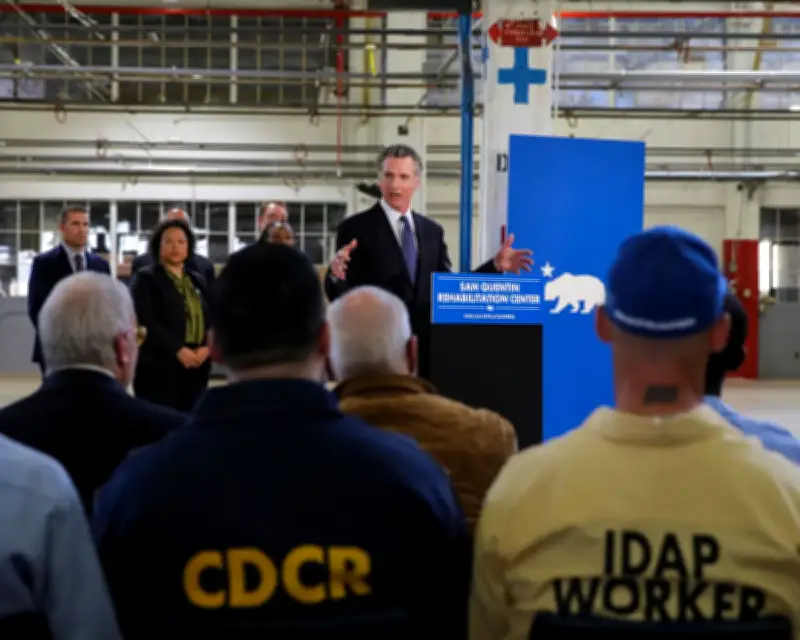
Gavin Newsom's decision to empty California's death row is a transformative moment in the US's death penalty history, freeing hundreds of people from the threat of execution and signaling a national shift away from capital punishment.
Newsom, who is seen as a potential presidential candidate, granted universal clemency to all death row inmates, a move that political observers say indicates that America's attachment to capital punishment is weakening and that opposing the death penalty is no longer a political liability.
Newsom's Unprecedented Clemency
Newsom's action stands in contrast to past political caution on the issue. In 1988, Massachusetts governor and Democratic presidential nominee Michael Dukakis saw his hopes of becoming president end after he reaffirmed his opposition to capital punishment in response to a question from CNN's Bernard Shaw.
Newsom, however, did not hedge his decision. He announced that "the people sentenced to death in California caused indescribable suffering to victims, their families, communities, and our state as a whole," but concluded that "the state cannot morally kill them."
He further stated, "Faithfulness to our values is measured by how we act when it is most difficult to uphold them," and that "we are stronger as a society when we reject state-sponsored killing."
Including the 'Worst of the Worst'
Newsom's clemency extends to individuals who have committed some of the most notorious crimes in the state. Among those benefiting are Richard Allen Davis, who kidnapped and murdered 12-year-old Polly Klaas in 1993, and Joseph Naso, known as the 'Alphabet Killer,' sentenced to death in 2013 for the killings of four women. Cary Stayner, convicted of the 1999 murders of four women near Yosemite National Park, is also included.
Newsom acknowledged that some have said he should not grant clemency to those who committed the worst crimes, but he argued that attempting to distinguish among crimes and offenders would "inadvertently create two classes of murder victims."
A Model for Other States
Newsom's abolitionism is seen as more complete than that of President Joe Biden, who in December 2024 did not spare the lives of three of the 40 people on federal death row. Newsom's decision has been praised as a model for governors in other death-penalty states, particularly those who oppose capital punishment.
Stanford Law School's Michael Romano described a Newsom universal clemency as a "cataclysmic decision for the death penalty," calling it the "most important declaration that has been made in modern American history, that executions are intolerable under any circumstances."