

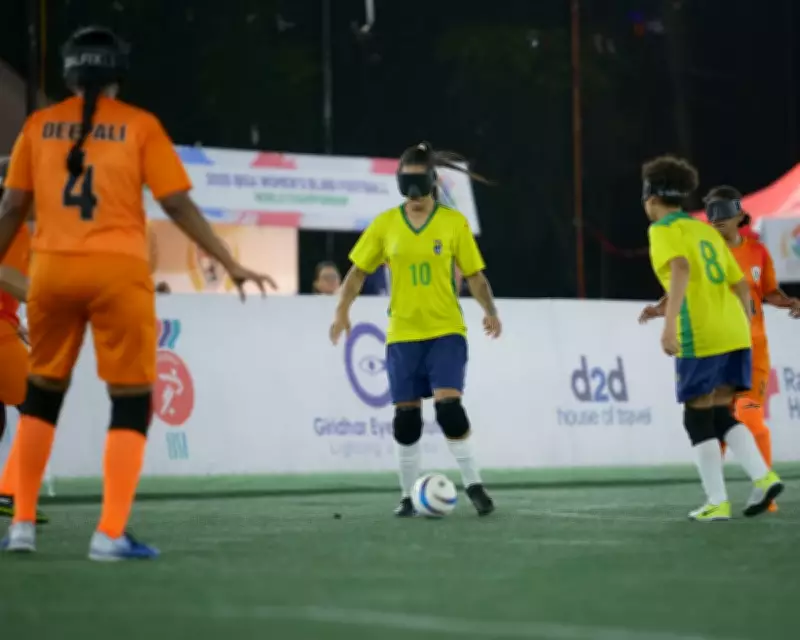
Brazil's Women's Blind Football Team Emerges as Pioneers in Global Sport
The Brazilian women's blind football national team, a squad that only came into existence in 2024, has already made a profound impact on the sport and its players' lives. At the 2025 World Championship in Kochi, India, the team secured a fourth-place finish, a remarkable achievement for a group assembled largely through video scouting due to the absence of a domestic league.
A Rallying Cry for Change
"We are the first, but we will not be the last." This powerful declaration, coined by midfielder Eliane Gonçalves, 39, has become the team's pre-match rallying cry. Gonçalves, who began playing just two years prior after losing her sight to retinitis pigmentosa, credits sport with pulling her through a difficult period. "When I started losing my vision, I was very lost. Everything was completely different," she explains. "Sport took me out of depression. It gave me a better perspective on life, new dreams."
In the tournament's opening match, Gonçalves scored the sole goal in a 1-0 victory over host nation India, a moment she never anticipated as a starter. Brazil advanced unbeaten to the semi-finals, where they faced reigning champions Argentina, losing 1-0. They then fell to Japan in the third-place playoff, but their fourth-place finish at a debut World Cup is widely regarded as a significant accomplishment.

Overcoming Historical Barriers
The formation of this team marks a pivotal shift in a sport long dominated by men. Wagner Xavier, an anthropologist at the University of Campinas who studies gender and sport, highlights the historical context. While men's national championships in blind football began in 1978, the women's national team was only officially established in 2025. Xavier attributes this 47-year delay to deep-seated gender and disability prejudices, which created a double barrier for women with visual impairments, resulting in a lack of investment and organised competitions.
"Football was built as a male space from its foundations," Xavier asserts, noting its structuring since the 19th century. "Women were considered assistants – in the sense of giving support and watching from the sidelines. They were the first fans, but they were there as supporting characters." This division, he argues, extended into public life and institutions, including sport.
The Players' Journey and Sacrifices
The team's goalkeeper, Lígia Nogueira, 27, is one of the few sighted players in the squad. Recruited after coach David Xavier observed her play without introduction, she had to adapt to a completely new role. In blind football, the goalkeeper is the only voice allowed in the defensive third, guiding players who cannot see her. "I thought I knew how to be a goalkeeper," Nogueira says. "But I had to learn from scratch. It's so much more than not letting the ball in." She jokes that she leaves matches more exhausted from talking than from saving shots.
None of the players received payment for their efforts. Nogueira balanced two university football teams, a physiotherapy degree, and national squad commitments, while Gonçalves left her job to focus on training, aware her window of opportunity was limited. In India, the team faced challenges such as overly spicy food, surviving largely on tuna after negotiations with hotel chefs. "We suffered," Gonçalves admits, "but it's part of it."
The Evolution of Blind Football in Brazil
Blind football has been practised in Brazilian schools for the visually impaired since the 1940s, often without proper equipment. Xavier recounts, "Around the 1990s the practice was happening, but many times without a specific ball. Stories from that period tell of balls wrapped in plastic bags to make the rattling sound." The men's game was formalised earlier, leading to five Paralympic gold medals for Brazil. A women's team emerged in 2009 but folded due to a lack of competitions. It wasn't until May 2022 that the confederation organised a first women's festival, bringing together 26 athletes, followed by training camps in 2024 and the World Cup.

Xavier believes the timing is crucial, with increased visibility for women players, such as Marta's accolades, and the upcoming Copa América in São Paulo in 2026. "If women's blind football had emerged in the late 1990s it would not have gone anywhere," he says. "But today with the visibility of women players, that passes through the minds of young women."
Beyond Results: A Legacy of Visibility
The impact of this team extends far beyond tournament standings. Xavier emphasises, "There is someone representing me – so there is a point of access. I could be there too. I could compete for a medal." The goal is for women with visual impairments to feel no shame in seeing themselves on the pitch. "I am here. I represent. I am visible. I am a respected athlete."
Gonçalves aims to continue playing as long as possible, hoping to leave the team more consolidated than she found it. She offers a message to others losing their sight: "Sport is here to embrace us. I hope it can do for someone else what it did for me."





