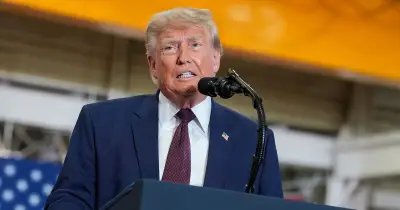
Donald Trump's messaging on the Iran conflict is failing to convince Americans or their representatives, as a symbolic House vote to end hostilities saw four Republicans cross party lines. The House voted 215-208 on Wednesday to direct the president to withdraw US forces from hostilities with Iran, the first such measure since Operation Epic Fury began on 28 February. Trump responded on Truth Social, calling the vote 'unpatriotic' and blaming 'Trump Derangement Syndrome'.
The four Republican defectors—Thomas Massie, Warren Davidson, Brian Fitzpatrick, and Tom Barrett—represent diverse ideologies. Massie, a libertarian-leaning constitutionalist, has opposed the war from the start. Davidson, a West Point graduate and former army ranger, initially voted against the war but later flipped. Fitzpatrick, a moderate former FBI agent, framed his vote as a matter of law. Barrett, who previously supported Trump, changed his mind due to economic pain in his constituency.
Despite the vote, the administration insists the war is over. Secretary of State Marco Rubio told Congress that Operation Epic Fury had 'concluded', and the US is now conducting only 'completely defensive' strikes. Yet gas prices average nearly $4.24 per gallon nationwide, and the Strait of Hormuz remains effectively closed, disrupting 20% of global oil flow. Trump's own Truth Social post describes 'final negotiations to end the War with Iran', contradicting claims of conclusion.

Public opinion reflects dissatisfaction. A May Economist/YouGov survey found 59% disapproved of Trump's handling of Iran, with only 31% approval. Two-thirds of Americans told Reuters/Ipsos that rising gas prices hurt their finances, and Moody's Analytics estimates the conflict cost US households $100bn in higher energy costs. In the Senate, four Republicans have broken ranks to advance a similar war powers measure, with a final vote pending. If passed, it would require Trump's signature.
The symbolic House vote may signal growing opposition. As the Strait of Hormuz remains closed and the war unpopular, Trump's insistence that the conflict is over—while simultaneously negotiating its end—is not resonating with Americans or their representatives.