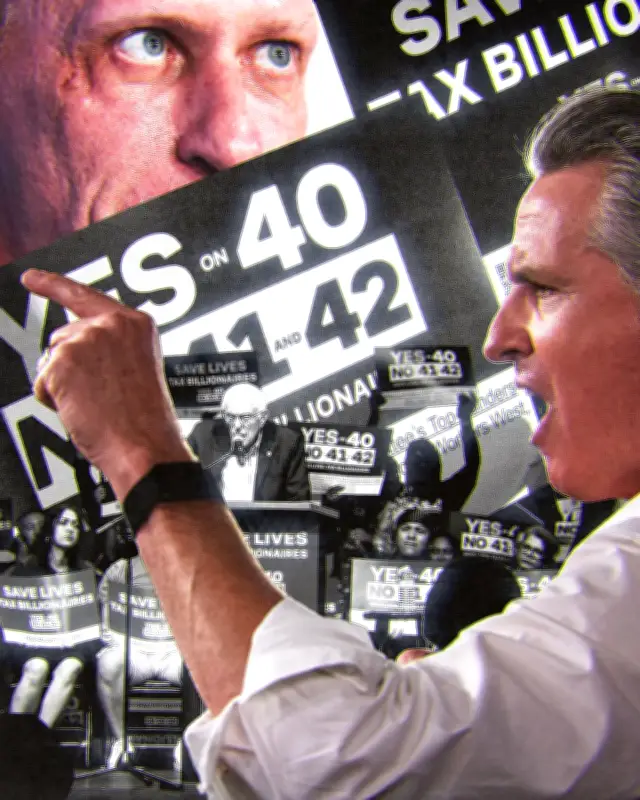
Tech billionaires have raised more than $340m to defeat Proposition 40, a one-time 5% wealth tax on California's billionaires that would fund healthcare and education. The opposition campaign is spending more than $1m a day to defeat the measure, according to state financial disclosures.
With the election less than a month away, those funds are being spent at a stepped-up pace. During the first 19 days of September, according to the most recent campaign filings, the opposition campaign plowed through at least $21.2m to fight the billionaire tax – surpassing $1m per day. Voters are being inundated with robotexts, mailers and advertisements that warn a tax on billionaires would “expose all Californians to higher taxes”, as one ad reads.
The ballot measure and its supporters
Californians will vote on the ballot measure, Proposition 40, in early November. If passed, it would require a one-time 5% tax on the state's billionaires, with the proceeds mostly funding healthcare programs, along with some education and food assistance. The measure has divided Democrats in the state, with some giving enthusiastic support and others rejecting the proposal because it's just a one-time levy and the bulk of it would only fund certain healthcare programs.
The state's major unions and progressive politicians like the Vermont senator Bernie Sanders and California congressman Ro Khanna back Prop 40. But both the Democratic and Republican candidates for governor, as well as organizations like Planned Parenthood Affiliates of California, a lobbying branch of the healthcare group, oppose it. Among its fiercest critics, however, are the tech billionaires it would most directly apply to.
The donors and their spending
The donors to the no campaign are a who's who of Silicon Valley, including the Palantir co-founder Peter Thiel, former Google CEO Eric Schmidt, DoorDash CEO Tony Xu, Stripe CEO Patrick Collison, crypto magnate Chris Larsen and several prominent venture capitalists.
The biggest donor, by far, is the Google co-founder Sergey Brin, who has contributed at least $102m to fight the tax, according to campaign finance filings. The runner-up is Schmidt, who has donated more than $42m. For comparison, the yes on 40 campaign has raised a total that's just shy of $33m, mostly from the healthcare union sponsoring the measure.
Proponents and opponents alike are casting the billionaire tax as a potential first step toward wealth taxes in more states. While those against the measure see it as populist contagion, those in favor connect it to the top issue of the midterms – affordability. And with California having more billionaires than any other state, Prop 40 is seen as setting the stage for more referendums on wealth inequality throughout the country.
“There's a lot of volatility among the electorate surrounding a pushback against Marie Antoinette and her tech friends,” said David McCuan, a political science professor at Sonoma State University who studies ballot measures. “And that's what the 'yes' forces are relying on.”
Recent polling on Prop 40 shows that it's favored to pass, but its lead has shrunk over the last few weeks as the opposition campaign has increased spending. A late-September poll by the University of California shows 45% of voters likely to vote yes on the tax with 42% voting no. Just a month earlier, the proposal enjoyed a 7% lead.
Countermeasures and opposition strategy
Complicating matters are two separate countermeasures that Prop 40's opponents successfully placed on the November ballot, Proposition 41 and 42. Prop 41 directly targets the billionaire tax, while Prop 42 is more of a general proposal to protect individuals from certain new taxes. If either of these measures receives more yes votes than Prop 40, they will stop the billionaire tax from taking effect – even if it passes.
“Props 41 and 42 have poison pills in them to destroy 40,” McCuan said. “And when voters are confused, when they are uncertain … it's much easier to get a no vote.”
Earlier this month, the campaign fighting the billionaire tax placed an ad on television, digital and streaming platforms across the state. It starts with quiet, foreboding music and the president of the California Medical Association, René Bravo, dressed in a white lab coat, saying: “The people pushing Prop 40 say it's supposed to improve healthcare. That's not true.”
The campaign has debuted similar ads saying teachers, carpenters and firefighters also oppose the wealth tax, saying it's “a dangerous experiment”.
The messaging around the campaign centers on how the tax would hurt “doctors, teachers, small businesses, working families and public safety”, without mention of the state's billionaires. The no on Prop 40 campaign calls it “an everyone tax”.
Likewise, the campaigns for the two measures that would pre-empt the billionaire tax argue these proposals promote transparency and have the backing of small businesses and taxpayers. One of the measures says its coalition includes retirees, blue-collar workers, seniors and veterans.
The three campaigns against the wealth tax, however, draw nearly all of their funding from Super Pacs loaded with Silicon Valley money, according to campaign finance filings. Since July, the committees opposing Prop 40 and supporting Props 41 and 42 have received a total of more than $297.8m, most of that from a Super Pac called Building a Better California.
The billionaires have found themselves in alliance with several healthcare, education, construction and public safety unions and associations. Governor Gavin Newsom has decried the billionaire tax, as have gubernatorial candidates, Xavier Becerra and Steve Hilton. Katie Porter, a former Democratic Congresswoman known for taking corporate executives to task, has become one of the main faces of the opposition campaign – writing op-eds, speaking at rallies and being quoted in ads and mailers.
The three campaigns are spending much of their fortunes on an army of consultants tasked with everything from lobbying politicians to working on media strategy. The consultants include the Republican-leaning law firm Nielsen Merksamer, known for fighting on behalf of tobacco companies, and the political consultancy PCI Campaigns, known for battling propositions that sought to repeal the death penalty and require condom use in pornographic films.
Planned Parenthood Affiliates of California is also listed as a paid contractor in campaign filings and has been one of the no campaign's most vocal endorsers.
State filings show that the campaigns donated tens of thousands to the California Democratic party, along with the Democratic parties of San Diego, Orange county and Los Angeles county. Despite the donations, all of these Democratic parties have backed the billionaire tax, urging a yes vote on Prop 40.
Opponents of the wealth tax have also explicitly targeted the Latino community, placing ads, articles and op-eds in Spanish-language news outlets throughout the state. One article in San Diego's El Latino is headlined: “No a la Proposición 40: Una Buena Idea, Mal Construida” (“No on Proposition 40: A good idea, poorly executed”).
When asked about the no on Prop 40's spending strategy and donations it has received from Super Pacs, a spokesperson for the campaign emailed a comment from Bravo: “The more Californians learn, the more they see Prop. 40 for what it is – a harmful tax scheme that permanently damages the state's budget and economy with zero accountability or safeguards to ensure funding actually improves care or lowers costs for patients.”
Brin and Planned Parenthood Affiliates of California didn't return requests for comment. The Building a Better California Super Pac declined to comment.
Yes on 40's strategy
Last week, Sanders, the progressive senator from Vermont, traveled to California to stump for Prop 40 alongside state politicians. The longtime advocate of wealth taxes announced to a crowded rally of supporters that the measure was “the most important ballot initiative in the country”.
“The whole country, and frankly people from around the world, are paying attention to what is happening here,” Sanders said to wild applause. “It is not easy running a campaign where you're going to be greatly outspent. But that is what you are doing, and the entire country is proud.”
The billionaire tax was first proposed late last year by the Service Employees International Union-United Healthcare Workers West (SEIU-UHW), which says the one-time tax is necessary because of huge federal healthcare funding cuts under Donald Trump's One Big Beautiful Bill Act. The union says the funding would preserve healthcare for 3.4 million Californians.
Since then, the campaign has garnered momentum through its partnerships with unions, community leaders and progressive politicians, including Khanna, a Democratic congressman who represents the district that includes Silicon Valley, the powerful California Federation of Labor Unions AFL-CIO, the California Teamsters union and the state's Democratic party. Besides the SEIU-UHW, one of the campaign's biggest donors is Saikat Chakrabarti, a former tech engineer who ran for Congress earlier this year but lost in the primary.
“A few controversial billionaires like Sergey Brin would rather spend millions to fund shady opposition campaigns than simply pay their fair share in taxes so millions of their fellow Californians don't lose their healthcare,” said Debru Carthan, a spokesperson for the yes campaign and vice-president of SEIU-UHW. “No amount of billionaire spending is going to intimidate us or turn us back.”
Instead of relying on more expensive traditional media, the yes campaign has turned to Instagram, Snapchat and YouTube to create viral moments and target younger audiences. Campaign finance disclosures show campaign expenditures have gone to consultants, mailers and social media ads.
“Dolly Parton could have died a billionaire and she didn't,” said an unnamed influencer in a yes on Prop 40 post last month. “And the one reason that she didn't is that she spent decades of her life giving away her money to charity and to philanthropy … There's a really simple question that I want to ask the billionaires of California: how much is enough?”
The no on Prop 40 campaign has also paid for ads on Google, Instagram, Yahoo, X and Taboola, according to campaign filings. It has additionally paid $3,000 for its Instagram posts to be amplified – a practice that gives an inorganic boost to social media.
“Billionaires are pouring hundreds of millions into deceptive commercials to confuse voters about Prop 40 because the truth is, they know that taxing the rich is popular,” said Lorena Gonzalez, president of the California Federation of Labor Unions. “We cannot let them buy our elections and choose who gets to live or die.”
McCuan echoes the idea that the vote on Prop 40 is bigger than this election. How voters come down on the ballot measure will signal whether the issue will spill over to more states and even nationally, he said.
“That is about testing the broader issue of wealth inequality and affordability in a wide-open presidential election in 2028,” McCuan said. “And if you're a zillionaire or on the no side, you want to nip this thing in the bud so it doesn't go to other places.”