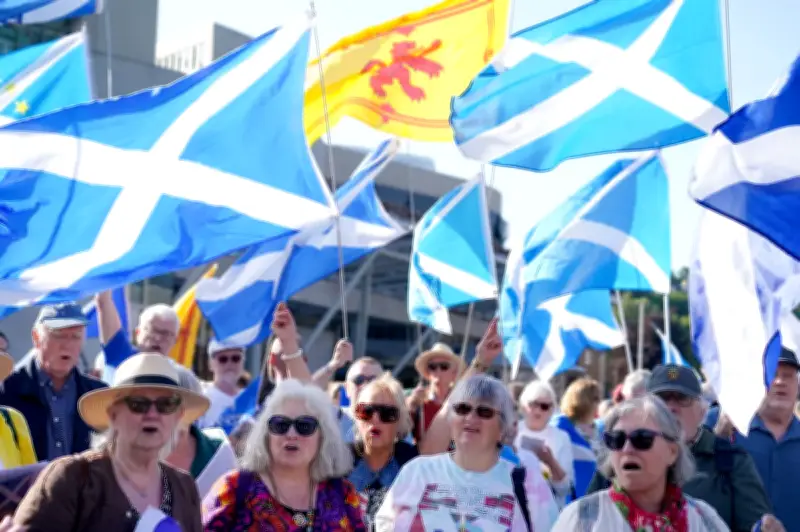
John Swinney has claimed the push for Scottish independence has “turned a corner”. Speaking ahead of his party’s conference in Aberdeen, the First Minister pointed to comments from the Prime Minister in the Commons that Scotland could have another vote on the issue should the people want it, and the agreement between the leaders of pro-independence parties in Wales, Scotland and Northern Ireland as proof the case has moved on.
First Minister's remarks
Within hours of his comments on the issue, Andy Burnham walked his position back, reaffirming his view that Scottish independence is “off limits”, while also refusing to budge as a result of the so-called Cardiff Agreement.
Speaking to the Press Association, the First Minister said: “The SNP’s got a very bold agenda to set out and to explain to the public at conference.
“But we’ve also, I think, turned the corner on the independence argument where we are now in a completely different situation, where there’s now much more widespread acceptance that the question of independence is going to have to be addressed again, and the strength of the SNP’s win in May has made that possible.”
Response to critics
Asked if his claims the case has moved on – despite Downing Street’s continued rejection – is because he has nothing to say to SNP members on the issue, the First Minister said: “I’ve got plenty to say to members.
“I think members should be very optimistic about where our strategy has got us, because by winning an election for a fifth term in office, the SNP Government that supports independence is in the lead of political debate in Scotland.”
Put to him that the Prime Minister – who told MPs Scotland could have another vote if there was consensus in the country – almost immediately walked back the comments, Mr Swinney said: “If we can’t take at face value what the Prime Minister says to the House of Commons without him going back there to change what he said in the House of Commons, I think we’re in a pretty poor position.
“I’ve got to take the Prime Minister at his word, because what I think Andy Burnham has said to the House of Commons is a different way of saying something else that he’s said – that he realises that Westminster and Whitehall doesn’t work.”
Polling perspectives
The totality of polling, the First Minister claimed, backed Scottish independence. However speaking to PA, Ipsos Scotland managing director Emily Gray said: “The public remain divided on independence, and there is no recent indication that has changed.
“But what we have found post-election was that just under half thought there should be another Scottish referendum in the next five years.
“I think independence is not going away, so even at the elections in May it was amongst the most important issues helping voters to make up their minds, so we shouldn’t forget in all of this that independence does remain an important issue with the Scottish public.
“Certainly at the moment you cannot say on the basis of the polling there is a settled will of the Scottish public in favour of independence, or indeed in favour of staying in the union. That has been pretty much 50/50 or within the margin of error.
“On the basis of recent polling, if there was a referendum tomorrow it would be too close to call, you would not be able to say confidently which way it would go.
“The big question now is how that might change, and what the threshold would be as well.
“The SNP way back when talked about 60% being in favour of independence being that threshold.
“But certainly at the moment there is not a settled majority of the public in favour of independence in Scotland.”