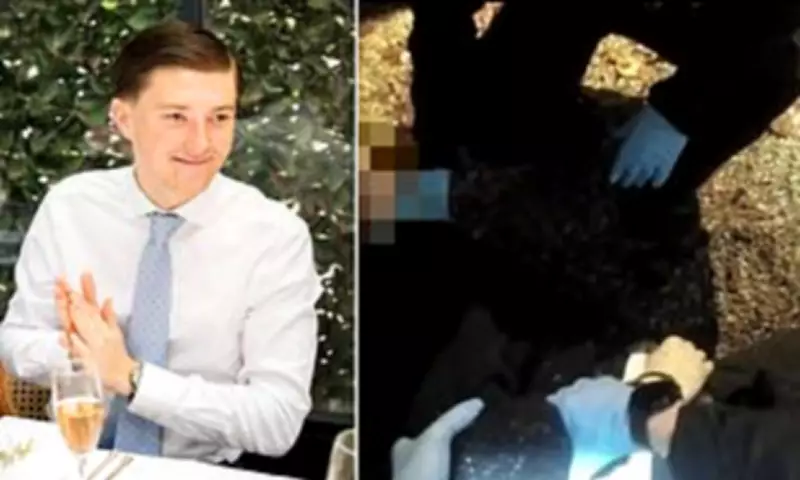
Police in the force whose officers handcuffed Henry Nowak as he lay dying felt 'controlled and pressured to be certain ways' during mandatory diversity training. More than 6,000 Hampshire and Isle of Wight Constabulary officers and staff were taught about racism, unconscious bias and the 'importance of being an ally'.
A survey following the course revealed one in seven participants (16 per cent) had felt 'controlled and pressured' to adopt certain ideas during the teaching. A similar proportion of 14 per cent thought 'mistakes would have been held against me', while one in five (20 per cent) feared being 'rejected for saying the wrong thing'. The results were in a report by the University of Reading which the force asked to survey officers and staff following the compulsory 'Inclusion Matters' course.
The study was revealed as the police watchdog faced pressure to investigate the officers who handcuffed the stabbed student in Southampton as he was dying. Shadow Home Secretary Chris Philp led calls for the officers who arrested the 18-year-old on bogus racism claims last December to face a full misconduct probe. Footage of the dying student gasping 'I've been stabbed' as he was pinned down by police who scoffed 'Don't think you have, mate', has prompted outrage.

The Independent Office for Police Conduct has spent six months since Mr Nowak's death examining the circumstances of the case. But the watchdog is not investigating the individual officers' conduct, instead treating them as 'witnesses' in its inquiry. Henry, a first-year student at the University of Southampton, was stabbed by Vickrum Digwa, 23, who falsely told officers that he had been racially abused and attacked.
Yesterday, Hampshire Police chief constable Alexis Boon has apologised to Henry's family for the student being handcuffed and arrested as he lay dying. Political outcry about the murder has centred on how officers dealt with Henry before his death. The case has prompted accusations that police equality guidance influenced the disparity in how Henry and his killer were initially treated.
Reform UK leader Nigel Farage suggested the public should feel 'pure, cold rage' and warned division will get 'far worse' if policing culture was not changed. But Prime Minister Sir Keir Starmer branded Mr Farage 'unforgiveable' for his remarks. Referencing Henry's family, who have urged politicians and the public against using the case to sow division, Sir Keir told the House of Commons: 'That's his (Mr Farage's) response to a father who has lost his son and asked for that not to happen.'
Sir Keir also condemned riots on Tuesday in Southampton following the case's conclusion, which led to the injury of 11 police officers and a police dog. The case has prompted comparisons from Conservative leader Kemi Badenoch with the murder of 18-year-old Stephen Lawrence in London in 1993, which led to an inquiry that found 'institutional racism' in the Metropolitan Police and other forces.
Meanwhile the president of the National Black Police Association has warned of an 'auto-correction' to policing in response to Henry's murder. Police Service of Northern Ireland (PSNI) officer Andy George told BBC Radio 4's Today programme: 'There's definitely lessons to be learned from the Henry Nowak case and if the IOPC sees through their thorough investigation that there are things that need to be done and changed – then certainly that's the time when things should be looked at.'
'For us to go forward and for the policing minister to say 'that needs to be corrected or looked into right now' – for us, when we've pushed for things that impact black communities or black individuals, we've never seen policing move as quick as what they're advocating for right now. So, I would say it is definitely an auto-correction – it's very swift, it's quick – I don't think it's as well thought-out as it should be. I think it's reactive to the current swell that we're seeing in social media and across different areas of public life at the minute.'

Lucy Rigby, chief secretary to the treasury, said today that it was a 'slur' on police officers working to keep the public safe to suggest that two-tier policing is taking place. But she added that it was the 'right thing to do' to look again at police equality guidance, telling Sky News: 'Really, fundamentally, I think that is a slur on the thousands of police officers that go out to work every day, putting themselves in harm's way to serve the public, to try and prevent crime, and to keep us all safe. So, I think that the suggestion, in light of that, that we have two-tier policing, which suggests at its heart that the police are on a sort of systemic basis pushing the interests of one group above another. I genuinely think is a slur on all those police officers that are serving this country day and night, seven days a week.'
Asked if it is possible the NPCC guidance to police has created an unequal system, she said: 'I think it's the right thing to do that that guidance is looked at, because the fundamental principle, as you know, that we have in this country is equality before the law.'