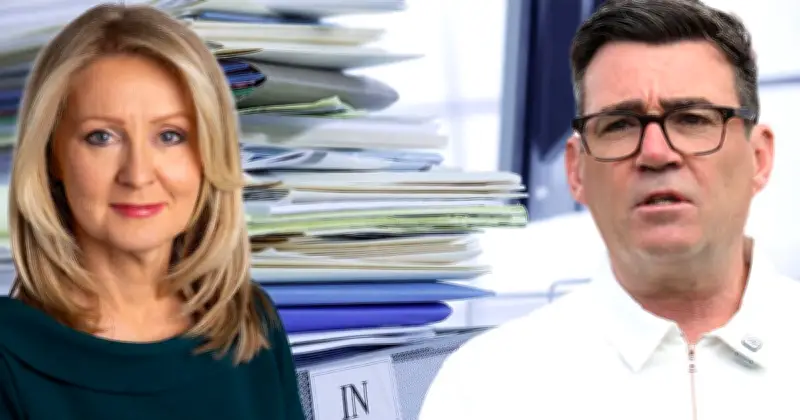
Andy Burnham has not yet entered Number 10, but according to Esther McVey, he has already demonstrated his unsuitability for the highest office. Writing in an opinion piece, the former Conservative minister argues that Burnham's impending premiership is fraught with problems, from a weak leadership style to questionable appointments.
A Bursting In-Tray
When Burnham becomes the seventh Prime Minister in 10 years on July 20, he will inherit a daunting agenda. McVey lists several pressing issues: a £15 billion defence black hole left by Sir Keir Starmer, an out-of-control benefits bill, early prisoner releases under Labour’s 2026 Sentencing Act, ongoing illegal immigration, the need to deport convicted child rapist Shabir Ahmed, and a puberty blocking trial starting in August.
Contradictory Promises
McVey highlights a contradiction in Burnham’s statements. He has pledged to adhere to Labour’s 2024 manifesto to avoid a general election, yet simultaneously claims to be setting new policy directions. “The two announcements are entirely incompatible,” she writes, asserting that Burnham must choose one or the other.

A Weak Leader
McVey accuses Labour of replacing one weak leader with another. “Labour is about to anoint as leader – without any scrutiny or test – a people-pleaser who will just seek to placate his backbenchers, cave in to his union paymasters and bend over backwards for his Manchester friends.” She dismisses his “Number 10 North” plan as a gimmick, calling it “all hat and no cattle.”
Questionable Appointments
Burnham’s ministerial team is also a source of concern. McVey notes that Starmer was brought down by cronyism, and Burnham is repeating the mistake by giving senior roles to convicted fraudster Louise Haigh and tax avoider Angela Rayner. She also points to confusion over cabinet posts, with Wes Streeting and Yvette Cooper both expecting the Foreign Secretary role, and a long list of potential chancellors including Ed Miliband, Pat McFadden, Shabana Mahmood, and Darren Jones.
Diversity Pledge
McVey criticizes Burnham’s response to female Labour MPs demanding 50% female appointments. “He should have told them it would be a government based on merit not Diversity, Equality and inclusion targets but People Pleaser Burnham would never do that.”
In conclusion, McVey states: “He’s not even in the job and he’s proving not to be up to the job and he’s storing up trouble through indecision, weakness and a lack of principle.”