Australian billionaires have turned on Labor's new $250 tax offset, slamming the no-strings-attached handout as unfair and vowing to donate the money instead. Critics say the policy ignores both wealth and age and does little to address intergenerational inequality despite being pitched as a cost‑of‑living measure.
More than 13 million Australians are set to receive a $250 Working Australians Tax Offset (WATO), to be paid annually to tax-paying workers from mid‑2028.
Billionaires Speak Out
Linfox founder Lindsay Fox, 89, who has a net worth of almost $6 billion, said he would likely qualify for the payment despite his vast wealth. 'I pay tax and if I am eligible that year I would rather give the $250 to a cause that helps the community rather than let the government keep it,' he told The Australian. 'I don't think the government handles money as well as the community. I don't think a lot of politicians understand that.'

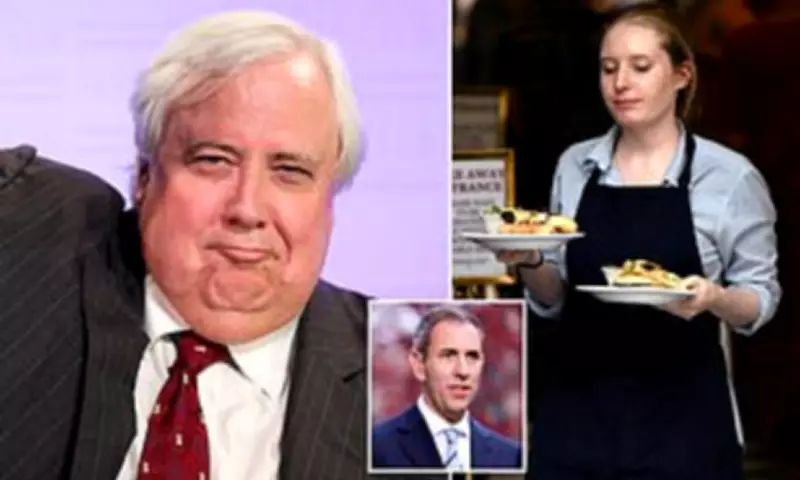
Mining magnate Clive Palmer, 72, also attacked the measure, arguing it undercuts Treasurer Jim Chalmers' claim that the Budget prioritises younger Australians. 'They say this (budget) helps intergenerational equity, yeah, it helps my generation,' Palmer, who has a net worth of over $20 billion, said. 'Anyone in my position who gets the WATO should give it straight to Foodbank. I'll give it straight to Foodbank to feed hungry Australians.'
Wealth Disparity Highlighted
Australia is now home to 188 billionaires, up from 170 a year ago, according to the 2026 Australian Business Network Rich List. The top 10 alone hold almost $210 billion in combined wealth, led by Gina Rinehart ($41 billion), Harry Triguboff ($34.1 billion) and Anthony Pratt ($30 billion). The ballooning fortunes stand in stark contrast to the government's latest cost-of-living relief measures.
The WATO, which Treasurer Jim Chalmers says is the 'biggest cost-of-living measure in this budget', will cost $6.4 billion in the first two years and equates to $4.81 a week. However, Australians won't see a cent of this until 2028. He said the government was 'creating space to return bracket creep' to workers with potential further tax cuts in years to come.
Economists and Critics Weigh In
Economics professor Richard Holden called for Labor to scrap the WATO, which he described as essentially a political bribe for already-stretched households. He called for the government to instead adopt Opposition leader Angus Taylor's plan to eliminate bracket creep forever by indexing income tax brackets to inflation. Taylor has also pledged to abolish the WATO if elected and repeal all of Labor's negative gearing and capital gains changes. 'Taylor wants to do what every economist worth their salt has been saying forever, we should index the tax brackets, the thresholds at which the various marginal tax rates kick into inflation,' Holden told the Daily Mail. 'That way there will be no bracket creep, there'll be no constant stealth tax rises and inflation won't beat away your earnings in the same way.' Holden said Chalmers was likely reluctant to implement Taylor's plan because it was expensive and would require him to cut spending.
Meanwhile, critics say the design of the tax offset excludes those most in need. Cassandra Goldie, the chief executive of the Australian Council of Social Service, said the government had made the 'wrong decision' to prioritise tax relief for workers over support for low‑income Australians outside the workforce. 'The WATO does not help the more than four million people on the lowest incomes in the country, including people receiving the $409 JobSeeker Payment, pensions and single parents without paid work,' she said. 'Around 30 per cent of adults' incomes are too low to pay income tax, and they are most in need with unemployment and cost-of-living rising.'
Greens senator Nick McKim accused Labor of favouring wealthier Australians. 'Jim Chalmers clearly has a different definition of 'ambitious' than millions of Australians,' he said. 'While most of us work harder trying to get ahead, the ultra-wealthy buy up assets, and their wealth grows in their sleep. This budget keeps on growing the gap between the 1 per cent and the 99 per cent.'

AMP chief economist Shane Oliver said Australia should rely less on income tax and more on consumption taxes to improve incentives and fairness in the long-term. He said the system was already highly progressive, with the top 20 per cent of taxpayers accounting for about 60 per cent of income tax paid. 'Ideally, any curtailment of tax concessions should be matched by lower income tax rates,' Mr Oliver said.