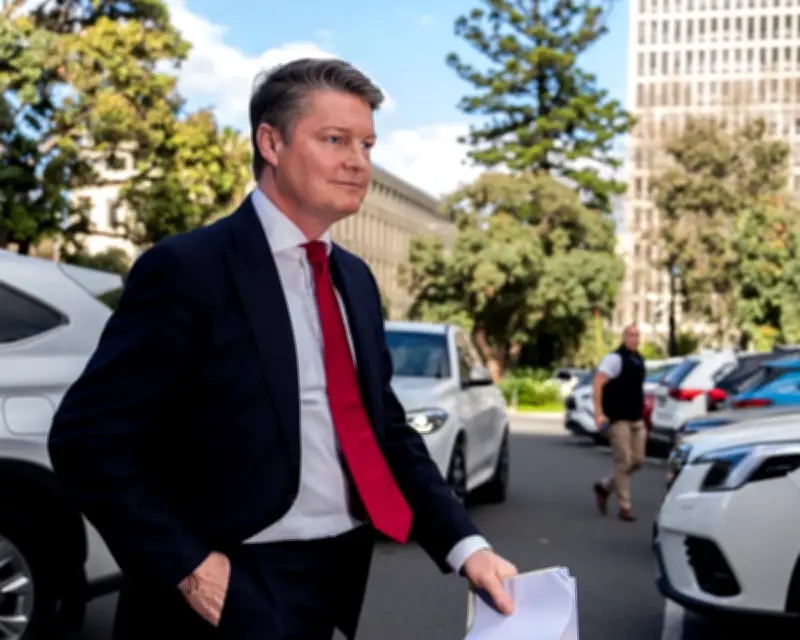
When Ben Carroll delivered his first speech as Victoria’s new premier, he said he wanted to make one thing clear: “I am not Daniel Andrews, I am not Jacinta Allan.” He then went on to outline his priorities: restoring integrity via a royal commission into the construction sector, eliminating wasteful spending of public money, rebuilding the relationship with the business community and making people feel safe.
Return of Labor’s right faction
“It sounded like a return to the Bracks-Brumby era for Labor,” says Stephen Donnelly, an electoral campaign consultant, podcast host and a member of Labor’s right. The two premiers led Victoria from 1999 to 2010 and were, like Carroll, members of Labor’s right faction. His election marks the first time since that era that Victorian Labor is being led by a figure from the party’s right, joining South Australia’s Peter Malinauskas and Chris Minns in New South Wales.
While Allan was never a progressive firebrand, she, like Andrews, emerged from Labor’s socialist left faction, which has traditionally placed greater emphasis on social issues and more interventionist role for government. The right, meanwhile, has generally been more economically focused and fiscally restrained, and within some sub-factions such as the Shop, Distributive and Allied Employees’ Association, known for being more socially conservative.
A ‘Kmart Keating’
Carroll joined the powerful SDA while working at Kmart through high school and university. It was no coincidence that his press conference on his first full day as premier was inside a Melbourne CBD Kmart alongside the SDA state secretary Michael Donovan, announcing workplace protection orders aimed at tackling abuse and violence against retail and hospitality workers. The union had grown increasingly frustrated by Allan’s slow progress on the reform. “We have wanted it faster than this, but we’re very pleased that the new premier is making it a priority matter in his first two days,” Donovan told reporters on Wednesday.
Yet Carroll is not politically aligned with the SDA. He belongs to the dominant grouping within Labor’s right aligned with the deputy prime minister, Richard Marles, and federal minister Sam Rae, once known as the “Cons”, after former Victorian senator Stephen Conroy. Carroll once worked for Conroy, whom he still regards as a mentor. But he’s not the only influential figure in the party’s right who’s had a lasting impact on him. Simon Crean first introduced Carroll to politics, giving him a tour of Parliament House in 1996, the same year he joined his local Labor branch. After university, Carroll became a staffer to former premier Steve Bracks, who publicly backed his leadership this week. And for decades he has maintained a close relationship with Bill Shorten.
Shorten is now vice-chancellor of the University of Canberra and no longer plays an active role in the Labor party. He says the pair spent years working closely because much of Carroll’s seat of Niddrie overlapped with his former federal electorate of Maribyrnong. He describes Carroll as “a Kmart Keating”. “He’s someone who’s very interested in the economy – not just spending money, but how it all fits together,” Shorten says. “He’s perfectly comfortable in boardrooms, but he also understands household budgets and the challenges facing small businesses.” Shorten says Carroll’s decision to centre his first speech on fiscal responsibility was telling. “He gets that you can’t just spend money, things have to stack up,” he says. But, he says, that should not be mistaken for social conservatism. “He’s not a conservative. I think he’s very grounded and in touch with people,” Shorten says. “And the Victorian people right now want a government that demonstrates restraint.”
Not a conservative shift?
Kos Samaras, a former Labor strategist turned pollster with Redbridge, agrees. Though he’s aligned with the left of the party, he says he “wouldn’t describe Carroll as conservative”. “He’s governed purely and principally by the community he grew up in,” he says. “Yes, these working-class communities are concerned about climate, but they’re also concerned about being able to feed their kids. They’ve probably got a view that some recreational drugs shouldn’t be illegal. It’s not a binary thing.” Both Shorten and Samaras are encouraged by Carroll’s plans to review the contentious Suburban Rail Loop project.
Samaras says it was telling that many of Allan’s remaining supporters came from the areas set to benefit most from the first stage of the project – the $34.5bn SRL East – while MPs from Melbourne’s outer suburbs shifted towards Carroll. “The right taking over isn’t necessarily about conservative versus progressive,” he says. “It’s a pivot back to Labor’s base.” Donnelly also cautions against reading the leadership change as an ideological contest. “If you think about what just happened in the Victorian Labor caucus room, it had nothing to do with ideology. The reason it happened was because MPs from the left split from their own faction – the right didn’t have the numbers to elect Carroll on their own,” Donnelly says. “And the number one reason MPs changed leaders was out of self-interest.”
Members of the left are also quick to dismiss suggestions that Carroll’s victory marks their faction’s demise. “We still have the numbers on the conference floor, in caucus, in cabinet, on admin committee, on the public office selection committee,” a senior Labor source aligned with the faction says. But with senior left figures Lily D’Ambrosio and Harriet Shing quitting politics at the next election – and further resignations expected – there is no doubt the balance of power within the faction is shifting.