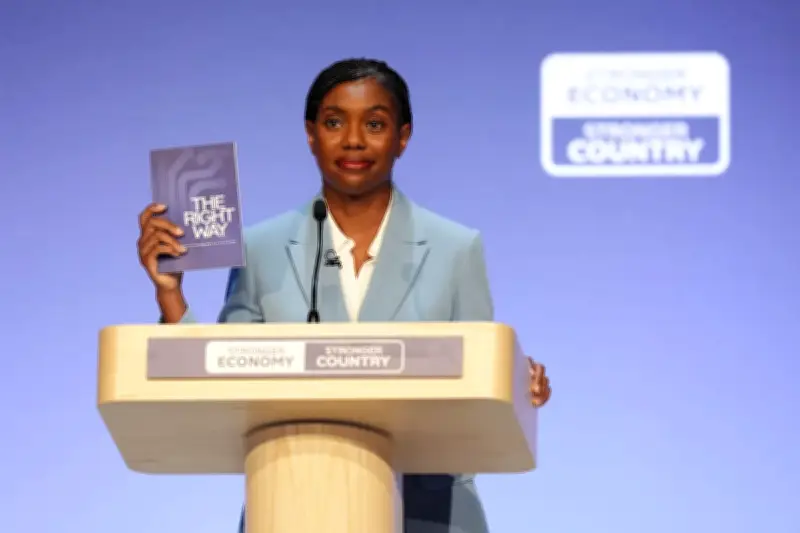
Kemi Badenoch has warned that “radical measures may be necessary” at the next election, as her shadow chancellor uses the Conservative Party conference to unveil his plan for “the most ambitious deregulation project in a generation”.
The Conservative leader released an almost 100-page document on the first day of her party’s conference in Birmingham, titled “The Right Way”. In it, she warned that “living standards have stalled” and added that “regulation has accumulated faster than anyone can remove it”.
Energy and Net Zero
Badenoch called for the UK to “restore domestic North Sea production”, saying that the country “should have energy that is cheap, abundant and secure”. She wrote that “net zero taxes, subsidies and system costs are estimated to make up around 40% of the cost of electricity in Britain”.
Restricting new licences to drill for fossil fuels in the North Sea, she claimed, was “devastating the country”. She described the document as her “opening bid”, adding: “There will be more to come.”
Badenoch continued: “The Prime Minister has appeared to rule out a general election before 2029. We shall see. We shall also have to see how much further our country will have deteriorated during that time, and what even more radical measures may be necessary to put things right.”
Conference and Policy Plans
Andy Burnham, the Prime Minister, has ruled out plunging the country into an early general election. Asked last month whether he was tempted to call an early poll, he told the BBC: “Not particularly. No, I’m not. I see all the speculation and it just races ahead. The media love to do that. No, no election any time soon.”
Holding up a copy of the new document on stage in Birmingham, Badenoch said her party would need “to be ready from day one, having already shown people what kind of government we are going to be”. She reflected on the decision to publish a policy statement in 1976, ahead of Margaret Thatcher’s 1979 victory, called The Right Approach.
“We governed for 18 years after that because we started with the right foundations – and we are going to do the same again,” she said. She earlier said: “When we win the next election, and we will, we are going to need to hit the ground running.”
Economic and Regulatory Plans
On Monday, shadow chancellor Andrew Griffith is set to unveil the party’s economic policies. “This will be the most ambitious deregulation project in a generation,” he is expected to say. “We will be more prepared than ever before. We will set out our plans line by line – every bill, every regulation, every chapter.”
To cut the price of a new build property, the Conservatives have planned to ditch the Future Homes Standard and housebuilding rules coming into force next year, which will mean developers must include low-carbon heating technology such as heat pumps or district heat networks in their designs.
Party researchers have pointed to a document published by Birmingham City Council in 2023, which found improved efficiency, heat pumps and comprehensive installation of solar panels could increase the cost of building a detached home by £30,789. The same document estimated the technologies could cut £2,715 from energy bills each year, effectively paying for themselves within roughly 11 years.
Abolishing the stamp duty tax on property purchases, which is already a Conservative Party policy, is thought to be part of the plan to push house prices down further. The Conservatives would also replace mechanisms known as section 106 and the Community Infrastructure Levy, which fund infrastructure when developers progress their building plans, with a single charge, in a bid to speed up the approvals process.
Environmental and Other Proposals
Abolishing Natural England and the Environment Agency, taking their functions into the Department for the Environment, Food and Rural Affairs (Defra), would also feature in a future Conservative Party manifesto. This would represent a “common sense for our countryside and the cost” at a time “of rocketing food prices, record numbers of farms closing and nature in decline”, shadow environment secretary Victoria Atkins said.
Elsewhere in Griffith’s plan is a proposal to scrap the extended producer responsibility, which was set up to make producers pay for the costs of managing packaging when it is thrown away. Removing it could lift a £1.5 billion burden from businesses, the Conservatives have said.
Griffith will say the UK’s “tax code is a cat’s cradle of complexity”, adding: “Because many of us have worked in business, we understand that time spent filling in a tax return or hanging on an HMRC helpline steals time away from your business, your family – the very reason you work so hard. So, as well as cutting taxes, tax simplification will be a mission for every treasury minister.”
He will also back plans to build a third runway at London’s Heathrow Airport. “We’re ‘all in’ for growth and we will legislate to sweep away the blockers to getting the infrastructure our country needs built,” Griffith will say.
Andrew Bowie, the shadow energy secretary, is expected to challenge a policy by the SNP to block the approval of nuclear power stations in Scotland. “The SNP’s Luddite approach is costing jobs in Scotland, harming our energy security and ending Scotland’s rich and powerful association with the nuclear industry,” he said. “If John Swinney and SNP ministers want to have a fight over any plans that would deliver thousands of jobs and protect energy security, then I say bring it on.”
Reactions from Opponents
Bridget Phillipson, the Labour Party’s chairwoman, has warned the Conservatives wanted to take the country “back to a politics that let so many people down over the past 40 years”. She also said: “The Tories had 14 years in government to grow our economy and help people get on the housing ladder, but they completely failed at every turn.”
Daisy Cooper, the Liberal Democrats’ Treasury spokeswoman, said: “No-one can take anything the Conservatives say on the economy seriously given their litany of fantasy-land financial pledges.” Reform UK Treasury spokesman Robert Jenrick said: “The Tories are once again copying our policies.” But he warned the Conservatives cannot match one of his party’s pledges to raise the personal allowance – the amount a person is allowed to earn before they start paying income tax – from £12,570 per year to £15,000. He claimed this was because the Conservatives “refuse to cut migrant welfare, net zero subsidies and the ballooning benefits bill”.