

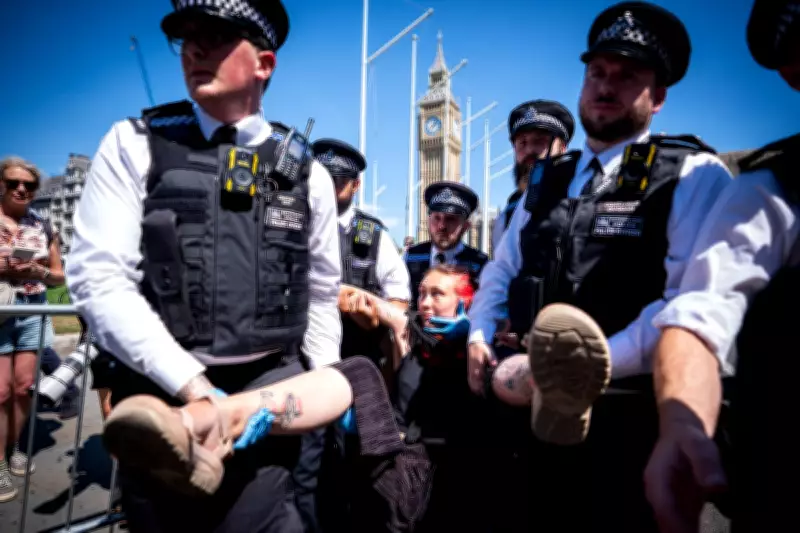
Police Raids on Peaceful Gatherings Raise Alarm Over UK's Civic Freedoms
The United Kingdom finds itself in concerning company when it comes to safeguarding civic liberties, as highlighted by recent police actions against peaceful protest groups. We should perhaps be grateful that some individuals remain passionate enough about global issues to engage in protest, yet the state's response suggests a troubling shift in tolerance.
Quaker Meeting House Raids: Pre-emptive Justice or Overreach?
On March 5, 2026, approximately fifteen concerned citizens gathered at the Quaker meeting house in Westminster for what participants described as a lesson in non-violent action. As they sat in a circle introducing themselves, police officers burst into the room, broke up the gathering, and arrested everyone present. Authorities confiscated phones and, in at least one instance, conducted a home raid seizing family laptops and hard drives.
This incident marked the second such raid on the same Quaker meeting house within a year. In the previous incident, twenty officers forced their way into a room where six young women were having tea and custard creams while discussing climate change and the humanitarian crisis in Gaza. A 25-year-old student journalist covering that meeting was held incommunicado for sixteen hours while her flat was searched.

Police justified both operations by claiming they had grounds to suspect crimes were being planned—a form of pre-emptive justice reminiscent of dystopian fiction. Yet a year after the first raid, no charges have been brought against any participants.
From Youth Demand to Take Back Power: The New Face of British Protest
The groups targeted in these raids represent a new generation of activism. Youth Demand—whose members were present during the first Quaker house raid—has since engaged in traffic-blocking demonstrations at Piccadilly Circus, demanding an arms embargo on Israel and an end to new oil and gas drilling. They maintain these actions were not what they were discussing when police intervened.
This month's raid focused on members of Take Back Power, a group formed after more headline-grabbing organizations like Just Stop Oil scaled back operations. Take Back Power's tactics have been described as distinctly British in their mild-mannered approach: they've smeared apple crumble and custard on a display case housing crown jewels, and tipped bags of manure at the foot of a Christmas tree in the Ritz Hotel lobby to draw attention to inequality.
More controversially, the group has organized supermarket actions where supporters "liberate" food to donate to local food banks—what they call redistribution but others might label shoplifting. Police cited potential planning of such supermarket activism as justification for breaking up the Quaker house meeting, though one attendee whose home was subsequently raided denies this was their purpose, describing it instead as a teach-in on non-violent protest.
Historical Context: From Suffragettes to Modern Dissent
Today's protest methods seem remarkably tame compared to historical precedents. The suffragettes recruited arsonists and bombers, targeting at least 32 churches and 31 railway stations when window-smashing no longer made headlines. Today, we erect plaques celebrating their tenacity and ultimate success.
Modern causes—from economic inequality and climate crisis to concerns about democratic representation and international conflicts—may not inspire such extreme measures, but they do motivate citizens to gather and discuss peaceful protest. The concerns of groups like Youth Demand and Take Back Power reflect widespread anxieties about contemporary society, and many would argue it's broadly positive that people care enough to engage.
Legal Framework and International Standing
The UK's approach to protest has drawn increasing scrutiny. The CIVICUS Monitor now rates the country as "obstructed" for civic freedoms, placing it among a small group of European democracies where protest rights are seen as under pressure. UN Special Rapporteurs have raised concerns about UK protest laws and counter-terrorism powers.

A new "cumulative disruption" clause in the Crime and Policing Bill would allow police to restrict protests based on the combined impact of repeated demonstrations—powers critics describe as broad, vague, and potentially sweeping up movements from Palestine solidarity to climate campaigns.
Starmer's Past and Present: From Human Rights Lawyer to Political Leader
Prime Minister Keir Starmer, often mocked for his professional background in human rights law, would be familiar with Lord Hoffman's words frequently cited by civil liberties lawyers. Hoffman acknowledged Britain's long history of people breaking laws "to affirm their belief in the injustice of a law or government," arguing that accommodating such protests "is the mark of a civilised community."
Hoffman advocated for an unspoken bargain: protesters should act with proportion, while police and magistrates should exercise restraint considering activists' conscientious motives. This case occurred barely twenty years ago, with the arguments celebrated by a rising QC involved—Keir Starmer himself. The contrast between that principled stance and current police practices raises questions about how far British attitudes have shifted in a relatively short time.





