

India's Transgender Community Faces 'Historical Erasure' Under New Legislation
Transgender rights activists in India are expressing profound distress over new legislation they claim represents a devastating reversal of decades of hard-won progress, effectively erasing their community from history. The recently passed amendments to India's primary transgender rights law introduce a requirement for medical verification of gender identity, a process many describe as a return to humiliating practices they believed were consigned to the past.
Painful Memories Resurface
Writer and transgender activist Revathi Reva vividly recalls the degradation she endured in the early 2000s when seeking a passport after her transition. "The doctor called male and female nurses into a room where I was completely stripped naked... they were touching my vagina to assess if I had transitioned. I was feeling so much shame at the time," Reva recounts. Despite facing stigma since identifying as a woman at age sixteen in 1984, Reva acknowledges significant improvements in trans rights, particularly following India's landmark 2014 Supreme Court ruling that legally recognized a third gender.
This progress makes the new legislation particularly shocking to activists. The amendments, passed in both houses of parliament with minimal discussion and amid opposition boycotts, fundamentally alter the 2019 Transgender Persons Act that was implemented in response to the Supreme Court decision.

Controversial Changes to Gender Recognition
The legislation replaces the principle of self-identification with a bureaucratic system requiring certification from a medical board followed by approval from a district magistrate. This represents a direct contradiction to the 2014 ruling, which explicitly stated that requiring medical procedures for gender recognition was both unethical and unlawful.
"I kept thinking: in a few hours, will I still be me?" says Rituparna Neog, former member of the National Council for Transgender Persons. "Who will I be? Someone else will decide about my identity?"
Government Justification and Community Response
The government claims the amendments are necessary to prevent abuse of benefits established under the 2019 law, such as quotas for improved access to jobs and education. "Fake cases have been increasing, where people are posing as transgender," said Byreddy Shabari, a member of the ruling coalition. Minister for Social Justice and Empowerment Virendra Kumar asserts the bill's "sole purpose" is to protect individuals who "face severe social exclusion due to their biological condition."
However, activists strongly dispute this characterization. Grace Banu, a prominent trans rights advocate for nearly two decades, states: "The 2019 bill was also problematic... We fought hard to move toward self-identification, but now this bill is again taking us backwards. They are recognising only certain identities... many identities are being erased from history."
Criminal Provisions and Community Concerns
The legislation introduces new criminal provisions targeting acts involving "coercion, deception or inducement" related to gender-affirming procedures. These vaguely worded sections carry sentences ranging from ten years to life imprisonment for causing bodily harm "through mutilation, emasculation, castration, hormone therapies" or "forced assumption of a transgender identity."
Critics argue this language could criminalize consensual care and community support systems that are vital for India's transgender population, who often face family abandonment. "In India, we have strong sociocultural support systems – chosen families that support each other. This bill erases those relationships and criminalises them," warns Banu.
Personal Impact and Broader Implications
For non-binary community organizer Vaivab Das, the legislation represents state intrusion into private identity: "This amendment bill is a bare throttling of the Constitution of India. I am not out to my family but under the sections that medicalise and criminalise my body, the police, the bureaucrat and the doctor will decide when this private information becomes a public conversation."

Trans-queer woman Rudrani Kumari describes the psychological toll: "From the moment this bill has been brought up in parliament, I have been having my anxiety pills every day." She notes that the 2019 law had begun creating visibility and possibility that now feels threatened.
Broader Pattern of Exclusion
Members of the National Council for Transgender Persons allege they were neither consulted nor informed before the bill's introduction. "We didn't know about it at all," Neog reveals. "The council is supposed to advise the government on transgender matters. It's shocking." Two council members have since resigned in protest.
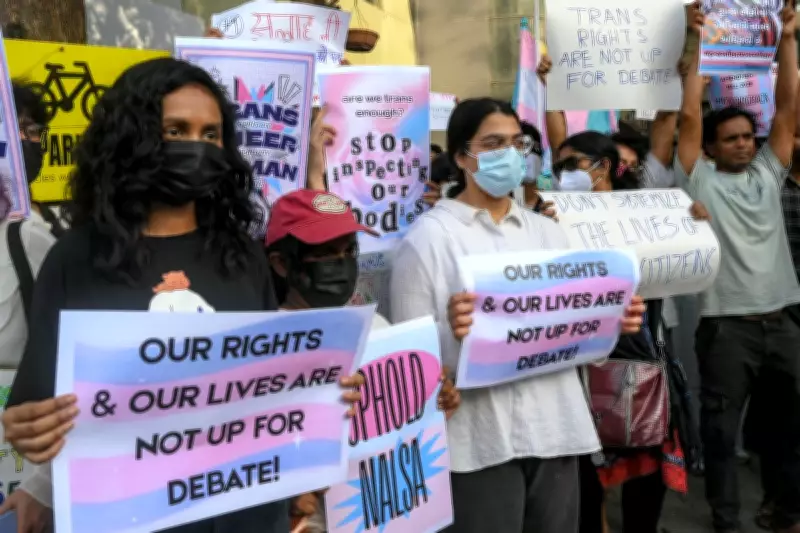
Activists describe a broader pattern of exclusion from policymaking, with officials demonstrating limited understanding of gender beyond binary frameworks. Across India, protests, press conferences, and online campaigns such as #RejectTransBill2026 have emerged, with civil liberties groups warning the amendments dilute protections rather than expand them.
Fragile Progress at Risk
Over the past decade, India's transgender community has carved out space in education, employment, and public life, supported by legal recognition following the 2014 judgment. However, activists emphasize this progress remains fragile and is now at serious risk. "They want us to give a newborn child our blessing, but they don't want to give me my employment rights," says Banu, highlighting the contradiction between cultural acceptance of transgender people's spiritual roles and denial of their basic rights.
The legislation's passage represents what many fear is a significant step backward for one of India's most vulnerable and marginalized communities, potentially returning them to what Reva describes as "the dark days of fear and humiliation" she experienced decades ago.





