

Australia's Hate Speech Legislation Triggers Arrests and Free Speech Concerns
Human rights activists across Australia have voiced strong criticism of Queensland's recently enacted hate speech law, which has already resulted in multiple arrests and ignited widespread fears of an intensified governmental crackdown on advocacy supporting the Palestinian cause. The Australian state took decisive action to criminalise specific pro-Palestine slogans in the aftermath of the deadly Bondi Beach shooting incident in Sydney last December.
First Enforcement Leads to Court Appearances
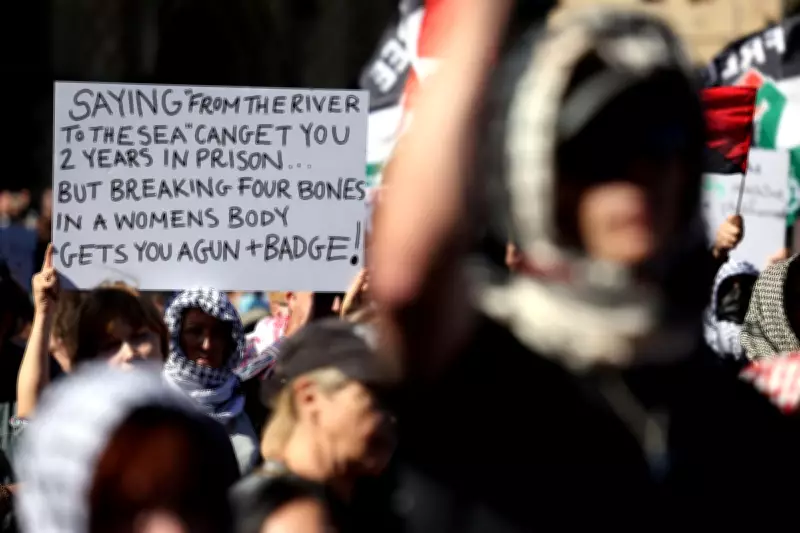
Earlier this month, authorities made the first enforcement of this controversial legislation when they arrested both a man and a woman for publicly using the phrase "from the river to the sea" during demonstrations. While police issued a formal caution to the 18-year-old woman involved in the incident, the 33-year-old man faces more serious consequences and is scheduled to appear in court next month to answer charges under the new legal framework.
The legislation also explicitly outlaws another contentious phrase: "globalise the intifada." Intifada, deriving from Arabic and meaning uprising or "shaking off," has been historically used by Palestinians to describe rebellions against Israeli rule in 1987 and 2000. However, many within Jewish communities interpret this terminology as a direct call to violence against Jewish people. Under Queensland's new law, any public display, distribution, or recitation of these prohibited phrases that could potentially "menace, harass or offend" members of the public carries a maximum penalty of two years imprisonment.

Legislative Response to Bondi Beach Tragedy
The legislation emerged directly from the national trauma following the Bondi Beach shooting, which tragically claimed fifteen lives and left forty people wounded during a Hanukkah celebration. This horrific attack prompted a comprehensive national response that included establishing a Royal Commission, implementing tighter gun control measures, and launching a legislative push to address growing concerns about extremism and antisemitism throughout Australian society.
In the immediate aftermath, Queensland distinguished itself as the first Australian state to explicitly ban pro-Palestine slogans through legislation. Meanwhile, both federal and state legislatures simultaneously passed various measures specifically designed to combat hate and extremism. The Combatting Antisemitism, Hate and Extremism Act, which raced through the New South Wales parliament in January, significantly enhanced penalties for existing offences, expanded restrictions on symbols deemed hateful, and introduced new powers affecting visa cancellations for individuals linked to proscribed groups.
Legal Experts Voice Constitutional Concerns
Aris Hussein, a senior lawyer at the Human Rights Law Centre in Sydney, strongly criticised the rushed passage of these laws during an interview with Al Jazeera, warning that they could be strategically deployed to suppress legitimate dissent and criticism of Israel's military actions in Gaza. "There are serious concerns the new laws could have a chilling effect on legitimate activism and protest, and unfairly impact peaceful protests and speech regarding Israel's actions in Palestine," Hussein explained. "While there's no place for antisemitism or racism in Australia, everyone has the right to criticise state conduct and hold public officials to account."
Prime Minister Anthony Albanese has vigorously defended the legislative measures, stating: "The terrorists at Bondi Beach had hatred in their minds but guns in their hands. This law will deal with both, and we need to deal with both. We want to ensure that Australia remains a society where everyone has the right to be proud of who they are."

Community Perspectives and Practical Implementation Questions
Supporters argue these measures are absolutely necessary to combat rising antisemitism. Jason Steinberg, president of the Queensland Jewish Board of Deputies, asserted that the laws would help Jewish communities feel safer following what he described as "unprecedented levels of hate, intimidation and fear." Steinberg previously told ABC News that the phrase "from the river to the sea" had been deliberately used to "intimidate kids and intimidate Jewish people in workplaces and on the streets," adding his interpretation that "The Jews will be exterminated. That is what that statement means."
Significant questions are now emerging about how these new laws will be practically applied and interpreted. Constitutional law professor Anne Twomey informed the Guardian that Australian courts would need to carefully determine whether using these phrases at protests "might reasonably be expected" to cause harm to members of the public, particularly within the context of peaceful rallies and demonstrations.
Civil liberties organisations argue this legal threshold will prove exceptionally difficult to interpret and enforce consistently. Michael Cope, head of the Queensland Council for Civil Liberties, warned that the offence could become "difficult and costly to detect, investigate and prosecute" while highlighting the genuine risk of complaints arising from simple "mishearings" during public events.
Political Opposition and Broader Protection Concerns
Opposition to the legislation extends well beyond activist circles. Senator David Shoebridge publicly criticised the Albanese government and Liberal Party for what he characterised as a decision to protect only one specific religion through these measures. "We know that hate touches all marginalised people," Shoebridge told Al Jazeera. "The same hateful ideology that led to the appalling Bondi shooting could also be weaponised against women, members of the Muslim community or LGBTQ+ Australians. This law was deliberately designed to not protect these vulnerable parts of our community, and that seriously undermines its legitimacy and utility."
The ongoing debate surrounding Queensland's hate speech legislation continues to highlight fundamental tensions between national security concerns, community protection, and the preservation of free speech rights within Australia's democratic framework.





