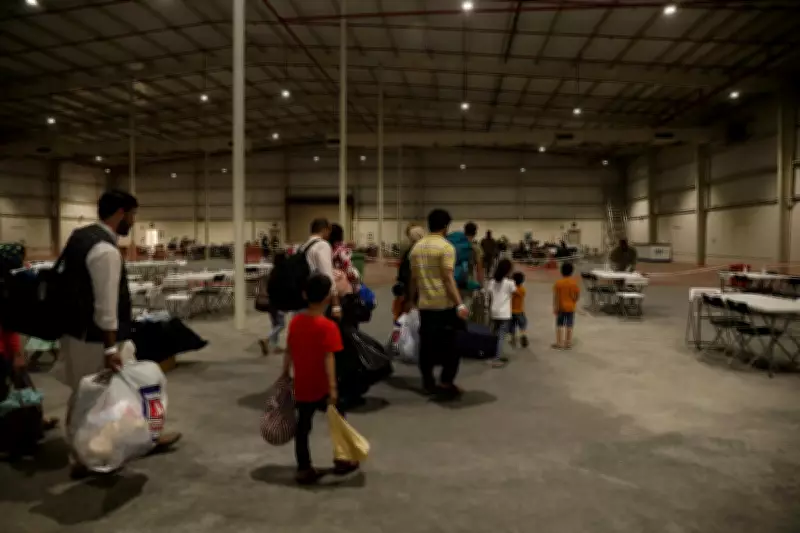
Afghan Allies Stranded in Qatar Face Impossible Decision
More than 1,100 Afghans and their families, who supported American war efforts, are currently stranded at Camp As Sayliyah in Doha, Qatar. They now confront what they describe as an impossible choice: return to Taliban rule in Afghanistan or be resettled in the Democratic Republic of Congo, a nation already grappling with severe humanitarian crises and ongoing conflict.
Family of U.S. Marine Among Those Trapped in Limbo
Retired U.S. Marine Corps Gunnery Sgt. Sean Jamshidi has revealed that his brother, Masoud, and his family have been waiting for over a year for a flight to the United States. Despite years of vetting and approval for entry, the Trump administration has effectively severed all pathways to the U.S. for these Afghan allies.
"The Taliban will kill him for what he did," Jamshidi stated emphatically during a press briefing. "Kinshasa won't kill him on Day One, but the State Department knows there's no community for him there, no legal status, and no real protection for him or for the children traveling with these families."

Jamshidi, who was previously deployed in the DRC, expressed grave concerns about forcing his family into the same humanitarian disaster he witnessed firsthand. "I saw the displacement camps, I stood in places where the United Nations have counted the dead," he recounted. "The Democratic Republic of the Congo is not a place where you send vetted Afghan allies and their children to live."
U.S. Policy Shift Leaves Allies in Peril
The United States resettled more than 190,000 Afghans who supported American war efforts between August 2021 and mid-2025. However, approximately 1,100 others were moved to Camp As Sayliyah in late 2024. The Biden administration had initially promised them a path to settlement in the U.S. following additional background checks, with the Qatari base intended as a temporary stopover.
This plan was abruptly upended when President Donald Trump suspended refugee admissions into the U.S. immediately upon taking office last year. This action stranded thousands of already-vetted refugees who had prepared for years for resettlement.
In a further blow, the Department of Homeland Security later threatened to cut off humanitarian protections for thousands of Afghans who fled following the U.S. withdrawal in 2021, citing alleged "notable improvements" in Afghanistan's national security and an increase in tourism.
Desperate Pleas from the Camp
The State Department announced in January that all residents at the Doha camp would be relocated to third countries by March 31. That deadline has now passed, leaving the Afghans in a state of heightened anxiety and desperation.
In a joint statement, the Afghans at the camp declared: "We were interpreters. We were members of the Afghan Special Operations Forces. We were medics, drivers, security guards, cooks, office staff on American compounds. Some of us are the wives, parents, brothers and children of those who served. Some of our family members wear the American uniform today, on active duty, while we sit here waiting."
They added a poignant plea: "We will say this plainly. We do not want to go to the Democratic Republic of Congo. It is a country in its own war. We have been in enough war. We cannot take our children into another one. We are not asking for charity. We are asking the United States to keep the promise it made to us."
Humanitarian and Strategic Consequences
The proposed relocation to the DRC raises severe humanitarian concerns. According to the United Nations, the Congo is already hosting over 600,000 refugees, mostly from the Central African Republic and Rwanda, and is grappling with an ongoing conflict with neighboring Rwanda that has displaced millions internally.
Shawn VanDiver, director of AfghanEvac, starkly summarized the situation: "You do not solve the world's No. 1 refugee crisis by dumping it into the world's No. 2 refugee crisis."

Former diplomat Anne Richard, who served at the State Department agency responsible for refugee resettlement during the Biden administration, rejected the notion that this plan constitutes genuine resettlement. "Resettlement requires a refugee's consent to move to a country that has agreed to receive them, where they can have legal status, safety and pathway to self-sufficiency," she explained. "Every one of those conditions is missing here. You do not have consent when the other option on the table is a government run [by the Taliban]. A decision made under duress is not a voluntary decision."
Threat to U.S. Credibility and Future Alliances
Advocates and former officials warn that abandoning these Afghan allies poses a critical threat to U.S. national security and international credibility. Kyleanne Hunter, CEO of Iraq and Afghanistan Veterans of America, cautioned that potential future allies will hesitate if U.S. obligations "have the shelf life of one administration."
"You cannot win a future war with partners who watched you abandon the last ones," she asserted.
Jon Finer, Joe Biden's former Principal Deputy National Security Advisor, echoed this sentiment, stating that U.S. allies are "less likely to rely on or trust us going forward." He added, "The idea we can go to those people in, God forbid, some future conflict ... is going to be badly compromised at this point."
The stranded Afghans, including hundreds of children and family members of active-duty U.S. service personnel, continue to wait in Qatar, their futures hanging in the balance as the Trump administration reportedly arranges a plan with the government of DRC President Felix Tshisekedi. Their plight underscores a profound moral and strategic dilemma for the United States, testing the nation's commitment to those who risked everything in support of its missions.