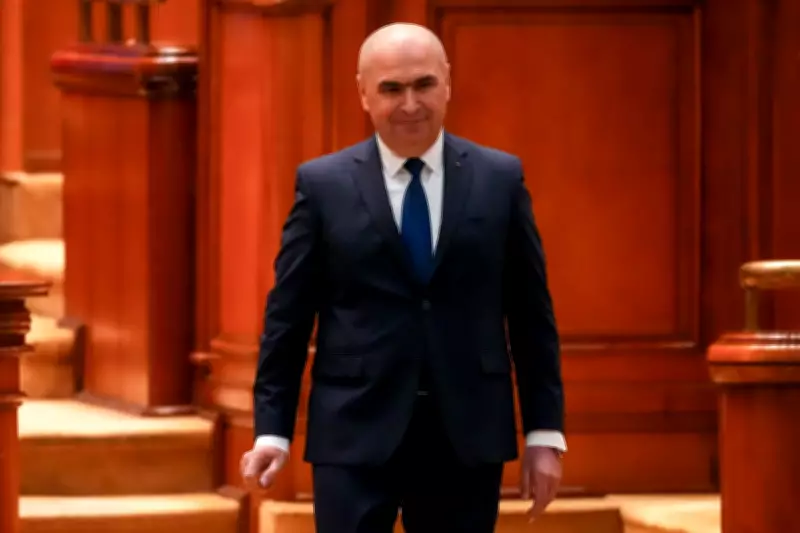
Romanian Prime Minister Ilie Bolojan is confronting a critical no-confidence motion in Parliament on Tuesday afternoon, as a former coalition partner aligns with a hard-right opposition party in an attempt to dismantle his pro-European government less than a year after it assumed office.
Motion Submitted by PSD and AUR
The joint initiative was launched last week when the leftist Social Democratic Party (PSD), which exited the coalition in late April, and the hard-right Alliance for the Unity of Romanians (AUR) formally submitted the motion to Parliament. This move has plunged the European Union member state back into political uncertainty. Lawmakers are currently debating the motion, with a vote requiring at least 233 votes to succeed. Both the PSD and AUR have separately asserted that they possess sufficient support for the motion.
Bolojan's Defense
Bolojan, a member of the centre-right National Liberal Party (PNL), described the motion as “cynical and artificial.” Speaking in Parliament on Tuesday, he remarked, “It seems to be written by people who were not in government every day and did not participate in all the decisions.” He added, “It is cynical, because it does not take into account the context in which we find ourselves. I assumed the position of prime minister, being aware that it comes with enormous pressure and that I would not receive applause from the citizens. But I chose to do what was urgent and necessary for our country.”

Background of Instability
Romania has experienced prolonged instability following the annulment of a presidential election in December 2024. The country is grappling with one of the highest budget deficits in the EU, rampant inflation, and a technical recession. When the governing coalition was formed last June, it prioritised reducing the budget deficit. However, the PSD frequently clashed with Bolojan over austerity measures, including tax hikes, public sector wage and pension freezes, and cuts to public spending and administrative jobs.
PSD's Criticism
PSD stated that Bolojan has “failed to implement any genuine reform” during his ten months leading the government, asserting that Romania requires a leader “capable of collaboration.” In response, Bolojan defended his record, claiming that his tough but necessary fiscal measures effectively “regained the trust of the markets in the Romanian government.”
Potential Aftermath
If Bolojan is ousted, the PSD would be essential for forming a pro-European parliamentary majority. The party has previously ruled out entering a government with AUR. George Simion, the AUR leader, declared on Tuesday that voters had “supported and wanted water, food, energy,” but had “received taxes, war and poverty.” He added, “We assume the future of this country, a future government and restore the hope of the Romanians. Romania must go back to the vote of the Romanians.”
Political Stalemate Expected
Cristian Andrei, a Bucharest-based political consultant, suggested that the crisis will likely lead to a stalemate. “No one has a majority, or a coalition, and it will take the president weeks to find such a majority and name a new prime minister, prolonging the indecision,” he said. “At this moment, there are two tentative options for a new Cabinet, both difficult to achieve; either a reshuffled coalition, without Bolojan, in the same formation, or a minority Cabinet led by PSD and satellites from populist parties like AUR or other small groups. A PSD-AUR official Cabinet is not a possibility today because the president will not endorse it.”
The prime ministerial position was scheduled to rotate from Bolojan to a PSD premier in 2027 as part of a power-sharing agreement. A general election is planned for 2028.