
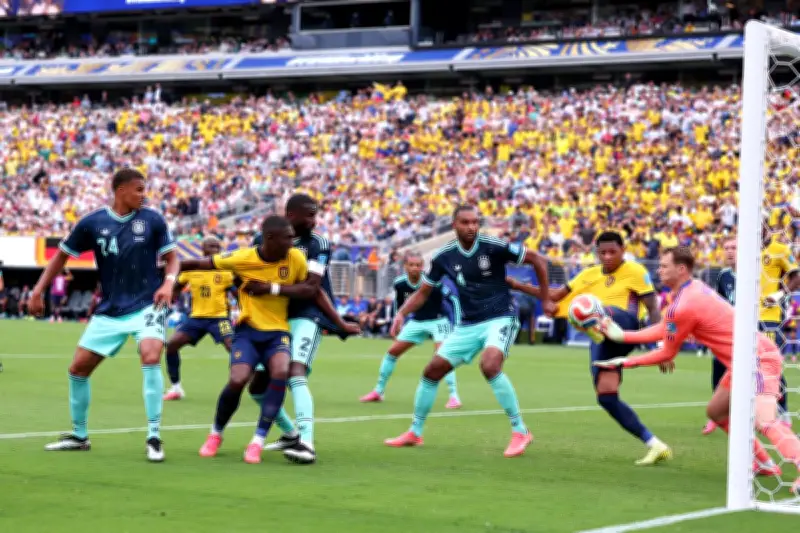
Julian Nagelsmann had questions to answer after Germany's defeat by Ecuador in their final World Cup group game. The 2-1 loss exposed a team trapped between its glorious past and an uncertain future, with the ghosts of 2014 and Jürgen Klopp dominating the debate.
"No, please, stop with this nonsense," snapped Nagelsmann when a television interviewer suggested Ecuador simply wanted it more. "They didn't want it more. I cannot tell any of my players that they didn't give it their all. That's far too simplistic." However, his players disagreed. "The difference today was that the opponent wanted to win more than us," said Joshua Kimmich. Substitute Deniz Undav added, "I had the feeling they wanted it more than us."
Mixed Messages and Unsettled Atmosphere
This minor disagreement is emblematic of Germany's current state: a team operating on multiple planes, lacking message discipline. Despite two wins in their first two games, emerging from the group stage for the first time since 2014, and a 7-1 victory over Curaçao—the biggest win of the tournament—things feel unsettled.
The malaise is encapsulated by two men: one inside the camp, one very much not. The second is Jürgen Klopp, highly visible as a pundit on German television. He had to apologize to Nagelsmann for a slip of the tongue suggesting the coach was in charge "for now." It is an open secret that Nagelsmann's job is one of the few that could tempt the 59-year-old back into coaching.
The 2014 Generation's Lingering Shadow
Half the 2014 World Cup-winning side is engaged in critically analyzing the current setup: Thomas Müller and Mats Hummels on Magenta, Per Mertesacker and Christoph Kramer on ZDF, Bastian Schweinsteiger on ARD, Toni Kroos on TikTok, Philipp Lahm in Die Zeit. This creates a constant noise that sets the weather around Nagelsmann's team.
German football has struggled to move on from its imperial era. Müller and Hummels were dropped in 2019 by Joachim Löw, only to be recalled after results declined. Löw survived the 2018 World Cup humiliation to lead Germany into an uninspiring Euro 2021. Kroos was persuaded out of retirement for Euro 2024. For a decade, the 2014 generation remained a break-glass option.
Manuel Neuer's Decline and Nagelsmann's Tough Calls
Manuel Neuer, at 40 the last survivor of 2014, represents the Germany that still wishes existed: immaculate, confident, innovative. But he is no longer best in class. His error against Real Madrid in the Champions League quarter-final was telling, and his inertia for Ecuador's winning goal showed a goalkeeper unable to control his six-yard box. Nagelsmann gambled by ending Neuer's international retirement and displacing Oliver Baumann—a gamble yet to pay off.
Nagelsmann played down dropping Neuer, shifting Kimmich to midfield, replacing Leroy Sané, or breaking up the Musiala-Wirtz partnership that lit up Euro 2024 but has not worked recently. For years, German football has engaged in existential angst about its identity. This team has talent but lacks rhythm and understanding, neither trusted at home nor feared abroad.
In the short term, Paraguay await in Boston on Monday, with France, the Netherlands, and Spain looming. Nagelsmann has big calls to make. Will this team lay its baggage to rest, or be remembered as a museum to itself?




