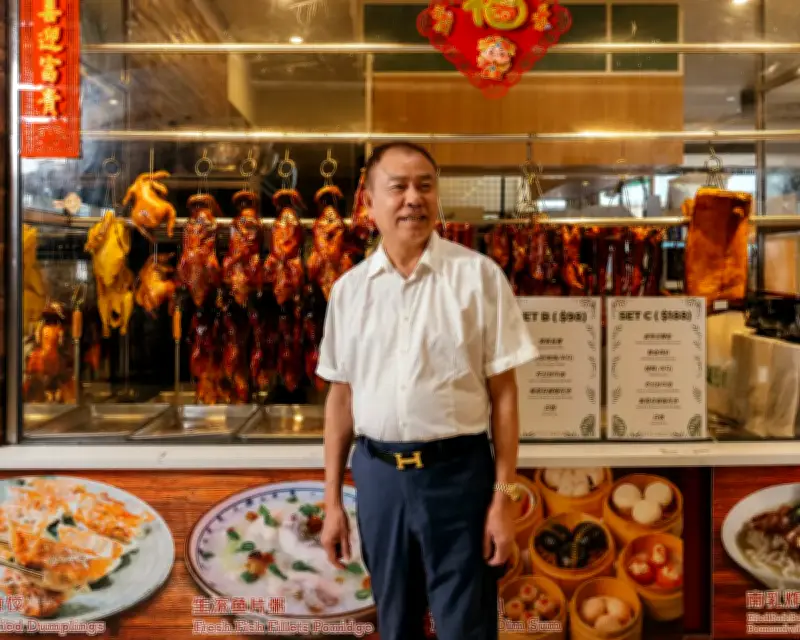
Racks of duck and golden roast pork hang outside Tom Zheng's restaurant in Melbourne's Box Hill Central shopping centre, flanked by hot custard pastry on one side and mounds of stuffed tofu on the other. But after almost 20 years operating Grain Asian BBQ, he is not sure he can continue.
"I'm close to closing my business. The labour costs are high, and the rent too," he says. Zheng says the "[financial] demands on tenants are incredibly harsh" and wants more support for small businesses, including subsidies, and better laws for tenants.
Zheng arrived in Australia the same year as the Tiananmen Square massacre in his homeland. "I didn't face political persecution … I was just poor," he says. He became an Australian citizen a year later and joined a wave of Chinese migrants who settled in Box Hill seeking opportunity and affordable housing. "China was poor and closed to the world. I wanted to see the world."
Marginal seats in Melbourne's east
Box Hill is one of several seats in Melbourne's eastern suburbs – along with Glen Waverley, Ashwood, Ringwood and Bayswater – that are essential to a Coalition victory in next month's state election. These are the electorates the Liberal party must win back if it is to gain the 16 seats it needs to govern in its own right. Labor holds them all by margins of between 3.3% (Glen Waverley) and 7.5% (Ringwood) on a two-party preferred basis.
Kos Samaras, a former Labor strategist who is now a director of polling group Redbridge, says the areas had been transformed from Liberal strongholds full of aspirational voters to denser, more diverse and more marginal seats thanks to "demographic churn" that has benefitted Labor. However, "we may see a correction this time round because of the unpopularity of Labor," Samaras adds.
This change has centred around the suburb of Box Hill, where almost half of constituents – 46.6% – have Chinese ancestry, with Ringwood, Glen Waverley and Bayswater not far behind with about a third.
Courting Chinese-Australian voters
"Politicians are trying to court Chinese Australians," says Assoc. Prof Jing Qi from RMIT University's Chinese Australian Studies Forum. Her analysis of the past two years of political messaging on Chinese social media platform RedNote has found politicians making an effort to engage Chinese-Australian voters by participating in cultural festivals and speaking on issues such as public safety and local infrastructure.
Policy announcements have been made on RedNote, such as the Coalition promising funds to build a childcare centre in Bayswater. Recently, videos and pictures of a large pothole in front of a Labor campaign sign in Box Hill went viral on the platform.
Law and order tops concerns
Zheng, who describes himself as a swing voter, has yet to decide who he will vote for. When the premier, Ben Carroll, visited Box Hill Central earlier this month, the small business owner raised issues about public safety. "I told him our community wasn't safe, we had thefts and incidents," he says.
According to Qi's research and outreach, public safety is one of the top issues for Chinese Australians. She says there is a lot of discussion of break-ins and robberies on social media. "There are incidents that have not been reported in mainstream media that have sparked a lot of community concern and debate."
Further east in Nunawading – within the electorate of Ringwood – crime is also on voters' minds. Leon Chan runs Minitown, a children's play centre. He has recently installed extra security measures and from his back yard he points out evidence of several attempted break-ins affecting neighbours. "I'm not even confident the police will come on time," if he reported an incident, he says.
Across Victoria, the state's crime rate, which factors in population growth, fell 3.8% in the 12 months to 30 June, with property crime decreasing in the same time period – although rates are still up significantly from the last election four years ago.
Infrastructure and economic management
Long-term Box Hill resident John West acknowledges he will probably vote for Labor, with good schools and hospitals his top concerns. He says the opposition's pledge to scrap the state's treaty with its First Nations people is "criminal". But West doesn't believe Labor deserves to be re-elected for a fourth consecutive term because of its economic management. "They have put us in debt," he says.
In recent election cycles, the Labor government has invested heavily in the area, with level crossing removals, its flagship Suburban Rail Loop (SRL) – an infrastructure project the Coalition has vowed to pause and review if elected – and the North East Link. Samaras says the party made a miscalculation that these seats could be a new heartland.
"This approach may have turned this part of Melbourne into a marginal seat environment that moves with the government of the day," Samaras says, but the soaring state debt – expected to reach $199bn by the end of the decade – has left a bitter taste in the mouth of some voters. "They can't fix potholes, they can't fix small things but they're spending billions on SRL and North East Link," says Chan. He doesn't think the infrastructure is worth the debt.
The Liberal candidate for Ringwood, Nick McGowan – who has given up his safe spot on the upper house ballot to run for the lower house – says he doesn't believe Labor's unpopularity will automatically translate into victory for him. "I think that if we get the opportunity, we have to show through our actions that we're true to our word, and that's the only way we're going to get to pick up seats in the east."