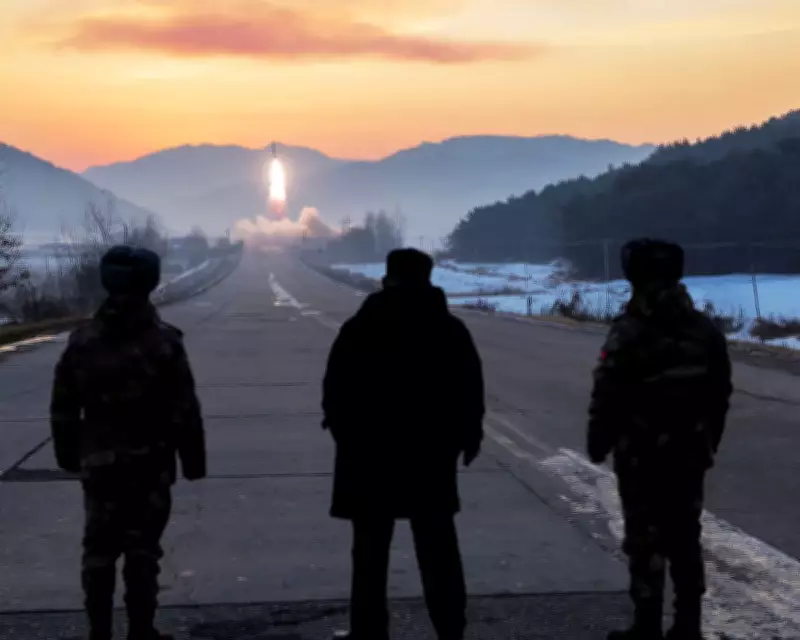
The head of the United Nations nuclear watchdog has issued a stark warning, stating that North Korea has made "very serious" progress in expanding its nuclear weapons capability. This development underscores the regime's ongoing efforts to bolster its arsenal as a means of ensuring its survival amidst international pressure.
Increased Activity at Yongbyon Nuclear Complex
During a visit to Seoul, Rafael Grossi, director-general of the International Atomic Energy Agency (IAEA), confirmed reports of a rapid rise in activity at North Korea's primary nuclear complex in Yongbyon. Grossi highlighted intensified operations at key facilities, including the 5MW reactor, reprocessing unit, and light water reactor. He noted that North Korea is believed to possess several dozen nuclear warheads, with estimates suggesting around 50, though experts remain sceptical about claims of miniaturisation for long-range missile deployment.
Expansion of Uranium Enrichment Facilities
A recent report from the Washington-based thinktank Beyond Parallel, part of the Center for Strategic and International Studies, indicates that North Korea appears to have completed a new building at Yongbyon intended for uranium enrichment. Satellite imagery suggests this facility is nearing operational readiness, which could significantly boost the country's capacity to produce weapons-grade material. This aligns with an IAEA assessment from June last year, which warned of similar developments.

The thinktank also pointed out that this suspected enrichment facility, along with another at Kangson near Pyongyang, has not been declared to international nuclear authorities. Such undeclared activities raise concerns about North Korea's potential to increase its nuclear stockpile beyond current estimates.
Historical Context and Diplomatic Stalemate
Since its first nuclear test in 2006, North Korea has developed what some experts describe as a workable nuclear capability, including intercontinental ballistic missiles (ICBMs) capable of reaching the United States mainland. Under the leadership of Kim Jong-un, who took power in 2011, the regime has accelerated its nuclear programme in defiance of UN sanctions, aiming to deter any threats of regime change.
Diplomatic efforts to curb North Korea's nuclear ambitions have largely faltered, following unsuccessful summits between Kim and former US President Donald Trump, as well as deteriorating relations with South Korea. In March, Grossi noted no "significant change" at the Punggye-ri nuclear testing site but emphasised its continued readiness for tests, labelling the programme a "clear violation" of UN resolutions.
Regional and Global Implications
South Korea's pro-engagement president, Lee Jae Myung, warned earlier this year that North Korea is producing enough material for 10 to 20 nuclear weapons annually while advancing its long-range missile technology. He cautioned that once North Korea secures a sufficient arsenal, it could pose a global threat by exporting nuclear capabilities beyond its borders.
Despite these warnings, North Korea has dismissed attempts at cross-border dialogue, maintaining its focus on nuclear expansion. The IAEA continues to monitor the situation closely, maintaining enhanced readiness to verify North Korea's nuclear activities as tensions persist in the Asia-Pacific region.