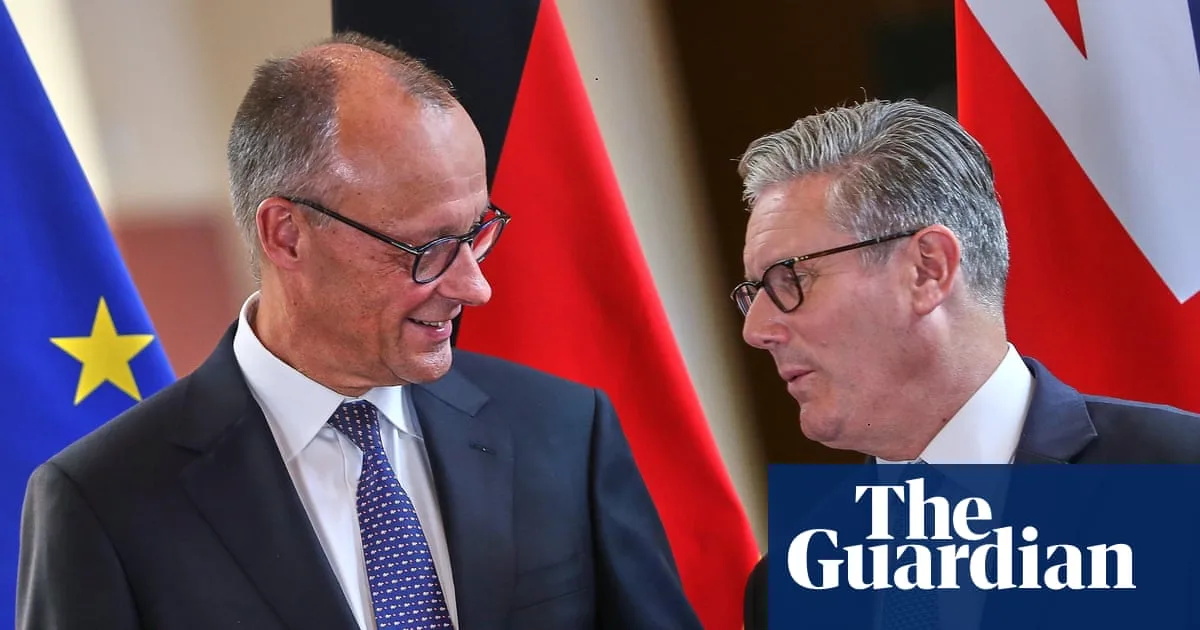
German Chancellor Friedrich Merz has called for a strategic alliance between the UK, Germany and France to tackle illegal migration and strengthen defence cooperation, despite expressing deep regret over Brexit. Speaking alongside Prime Minister Keir Starmer at a press conference in Stevenage, Merz announced the signing of the Kensington Treaty, the first formal pact between the UK and Germany since the Second World War.
The treaty, signed at the V&A Museum and followed by talks at Downing Street, covers mutual assistance on national security, joint defence procurement, a rail taskforce for a potential London-Berlin line, and expanded school exchanges. Merz described the agreement as overdue, stating that the UK's departure from the EU had highlighted the need for closer bilateral ties.
On migration, Merz proposed expanding a recent UK-France returns agreement into a trilateral pact with Germany to coordinate efforts against irregular migration. Starmer confirmed that Germany would amend its domestic law to allow authorities to seize boat engines and smuggling components destined for Channel crossings, closing a longstanding enforcement gap.
Both leaders stressed the urgency of stronger continental coordination amid threats from Russia and uncertainty over the US role in NATO. The treaty recognises Russia as the most significant direct threat to both nations and includes joint development of defence technologies such as Typhoon jets and long-range missiles.
Merz's call for a trilateral axis revives elements of the 'core Europe' vision proposed by his mentor Wolfgang Schäuble in the 1990s, now adapted to include the UK outside the EU. The move comes as the far-right Alternative für Deutschland gains ground in Germany, putting pressure on Merz to address migration and defence spending.