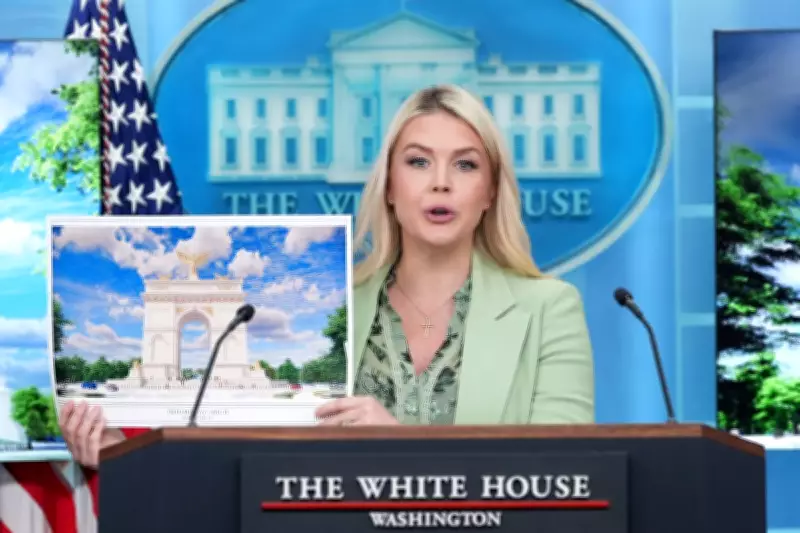
Trump's Triumphal Arch Plan Faces Federal Review Amid Legal Challenges
President Donald Trump's ambitious design for a monumental Triumphal Arch, intended to leave a lasting legacy in the U.S. capital, is undergoing a critical review by a key federal agency. The U.S. Commission of Fine Arts, whose seven members were appointed by the Republican president, is scheduled to hold a hearing and possible vote on Thursday, 16 April 2026, to assess the project's approval.
Architectural Vision and Controversial Details
The proposed arch would stand an impressive 250 feet tall, measured from its base to the torch held by a Lady Liberty-like figure at its summit. This height is symbolically intended to honour America's 250 years of existence, according to White House press secretary Karoline Leavitt. The structure would be adorned with gilded eagles flanking the top figure and four lions guarding the base, with the phrases "One Nation Under God" and "Liberty and Justice for All" inscribed in gold lettering on either side.
Planned for construction on a human-made island managed by the National Park Service on the Virginia side of the Potomac River, the arch would dramatically overshadow the nearby Lincoln Memorial, which stands at 99 feet tall. Trump has enthusiastically promoted the project on social media, declaring it "the GREATEST and MOST BEAUTIFUL Triumphal Arch, anywhere in the World" and a wonderful addition for Americans to enjoy for decades.

Legal Hurdles and Opposition
However, the arch is already entangled in litigation. A group of veterans and a historian have filed a federal lawsuit to block construction, arguing that it would disrupt the historic sightline between the Lincoln Memorial and Arlington House at Arlington National Cemetery. This legal challenge adds a layer of complexity to the commission's review process, casting uncertainty over whether approval will be granted.
Additional White House Projects Under Scrutiny
The commission's agenda also includes two other White House-related initiatives:
- Eisenhower Executive Office Building Paint Job: Trump has proposed painting the building's gray granite exterior white, citing aesthetic displeasure with its current colour. The White House contends that the building has been neglected and lacks visual cohesion with surrounding architecture. This plan is similarly subject to federal litigation.
- Underground Security Screening Centre: A 33,000-square-foot facility beneath Sherman Park is planned to screen tourists and visitors to the White House, aiming to enhance security and reduce wait times with seven processing lanes. Officials target an operational date of July 2028, six months before Trump's term ends.
Commissioners will review design plans for all three projects, with the arch and paint job being examined for the first time. The visitors' centre was previously discussed in March, and a separate oversight panel, the National Capital Planning Commission, has begun its consideration. It remains unclear if any projects will receive immediate approval on Thursday.
Historical and Architectural Context
The Eisenhower Executive Office Building, completed in 1888, is a National Historic Landmark and an exemplar of French Second Empire architecture. Originally housing the State, War, and Navy departments, it now accommodates offices for the vice president and the National Security Council. Trump's proposed alterations have sparked debate over preserving historical integrity versus modernising presidential legacies.
As these projects advance through federal review, they highlight Trump's persistent efforts to imprint his vision on Washington's landscape, amidst both support and significant opposition.