Trump's Private Troop Deployment Interest in Iran Sparks White House Denials
President Trump has privately expressed 'serious interest' in deploying US soldiers to Iran, according to military sources cited by NBC News. Insiders revealed that Trump has told White House advisors he will need troops on the ground to complete his 'vision' for a post-war Iran, which he hopes to control similarly to Venezuela.
Strategic Troop Deployment Plans
Unnamed US officials told the outlet that Trump is not focusing on a full-scale invasion of Iran, but instead would want a small contingent of troops deployed for strategic purposes. The conflict has so far involved only air and naval munitions, and deploying troops on the ground in Iran would mark the first time the US has done so since withdrawing from Afghanistan in 2021.
Trump is said to be emboldened by the speed and efficiency of his operation in Venezuela in January, which saw US forces capture President Nicolas Maduro and take control of its oil reserves. This week, the US leader said he 'must be' involved in picking late Supreme Leader Ali Khamenei's replacement after he was killed seven days ago, but said he would accept a non-democratic choice so long as they are amicable to the US and Israel.

White House Denials and Public Statements
The White House denied that Trump was planning on sending US soldiers to Iran, with press secretary Karoline Leavitt stating the report is 'based on assumptions from anonymous sources who are not part of the President’s national security team and are clearly not read into these discussions.'
'President Trump always, wisely keeps all options open, but anyone trying to insinuate he is in favor of one option or another proves they have no real seat at the table,' Leavitt added.
Despite these denials, Trump has publicly flirted with deploying US troops to Iran, telling the New York Post this week: 'I don’t have the yips with respect to boots on the ground.'
Escalating Conflict and Political Backlash
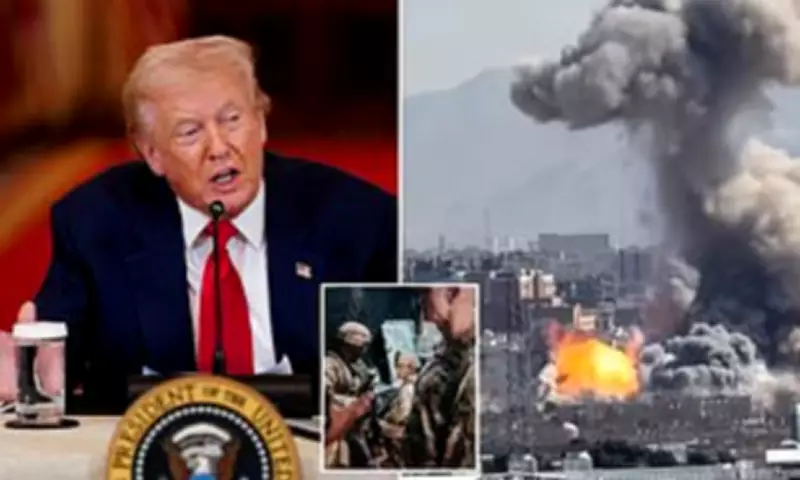
Hostilities in the Middle East threatened to spiral out of control on Friday as Iran launched a barrage of missile and drone strikes on its Gulf neighbors, before Israel fired a fresh wave of attacks on Tehran overnight. Central Tehran was rocked by a huge explosion Friday morning as the US-Israeli alliance dropped a payload on the Moqaddad base of the Revolutionary Guards.
The president has struggled to maintain support among his conservative base since launching strikes one week ago, with many supporters reacting with fury at reports he was considering deploying soldiers. Megyn Kelly, a leading figure on the right expressing opposition to war, reacted with disdain on social media, saying: 'I honestly can't believe we're doing this again.'
Military Buildup and Economic Impact
While the White House attempted to shut down reports that soldiers could be deployed, Trump has made no indications that he is looking to scale back the conflict. On Friday, the president said he was no longer interested in negotiating with Tehran, stating the only way for them to bring the war to a close was 'unconditional surrender.'
Trump also warned that the barrage of over 3,000 missiles and drones launched by US forces in the past seven days may only be the start, as he said he was preparing a mega-attack that he dubbed 'the big one.'
American B-2 and B-52 bombers arrived in the UK on Friday evening after Prime Minister Keir Starmer U-turned and allowed UK bases to be used by Trump, raising the specter of an imminent bombardment in Iran. The strategic bombers, costing up to $2 billion each, can carry out long-range missions without detection while carrying devastating missiles.
Sources have suggested that Saturday could be D-day for a new gigantic bombardment, exactly a week after America and Israel first attacked Iran as part of 'Operation Epic Fury.' Secretary of War Pete Hegseth said the use of British RAF bases will allow the US to 'dramatically' ramp up its strikes on Iran.

Economic Measures and Regional Strikes
Oil prices have skyrocketed since the start of the conflict, and are on track for their largest weekly jump since early 2020 when the Covid-19 pandemic hit. Treasury Secretary Scott Bessent said Trump was looking at 'unsanctioning' Russian oil to boost supplies, telling Fox Business on Friday: 'We may unsanction other Russian oil. There are hundreds of millions of sanctioned barrels of sanctioned crude on the water, and in essence by unsanctioning them, Treasury can create supply.'
The tit-for-tat strikes across the Middle East escalated Friday evening after Iran sent a barrage of retaliatory fire to a number of its Gulf neighbors. Attacks were launched at Iraq, Qatar, Saudi Arabia and Israel throughout the evening, striking oil facilities and airports while many were intercepted.
Nine out of ten drone attacks launched towards Qatar were intercepted, with the tenth striking an uninhabited area, the country's Ministry of Defense said, while also confirming no injuries were caused. Four drones heading towards the Shaybah oil field in Saudi Arabia were intercepted and destroyed over the Empty Quarter desert.
A network of Iranian-backed Shia factions, Islamic Resistance in Iraq, claimed it launched an attack on a US military base near Baghdad Airport 'in retribution' for the death of Iranian Supreme Leader Ali Khamenei.
Meanwhile, Israel and Iran have continued to exchange fire overnight, with the IDF confirming it had launched a fresh wave of attacks against 'terror targets' in the Dahiyeh District of Beirut, Lebanon. In Iran, the Mehrabad International Airport in Tehran was set ablaze after being hit by one of Israel's airstrikes, and explosions were reported across the capital.