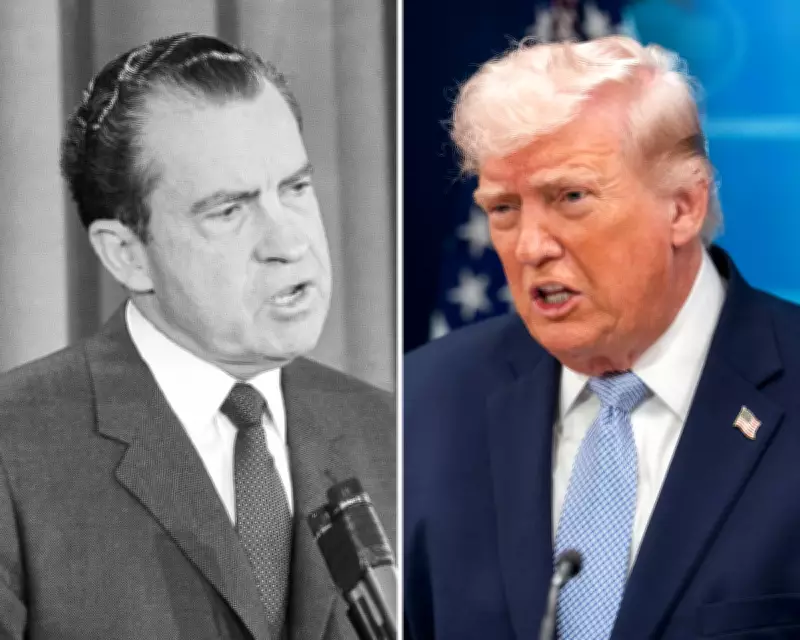
Trump's 'Madman Theory' Echoes Nixon's Iran Strategy
Donald Trump has openly expressed admiration for Richard Nixon, despite the latter's disgraceful exit from office. However, the current president has taken this homage to new heights by threatening to obliterate Iran's civilization, only to retreat when Tehran agreed to reopen the strategically vital Strait of Hormuz. This approach closely mirrors Nixon's 'madman theory' of diplomacy, a tactic designed to intimidate adversaries by projecting unpredictability and instability.
The Origins of Nixon's 'Madman Theory'
Nixon first articulated the 'madman theory' in 1968 during a beach walk with his future chief of staff, Bob Haldeman. He suggested that by making North Vietnam believe he was irrational and capable of extreme actions, including nuclear strikes, he could force them to seek peace. Nixon reiterated this strategy in later years, instructing aides to portray him as 'somewhat crazy' to Soviet officials, aiming to leverage fear for diplomatic gains.
In 1972, with the Vietnam War ongoing, Nixon even proposed using nuclear weapons against North Vietnam, a plan his national security adviser, Henry Kissinger, resisted. While this posturing led to a period of détente with the Soviet Union and arms-control treaties, its application in Vietnam resulted in a brutal bombing campaign during Christmas 1972. Critics argue the peace treaty that followed offered terms similar to those available before the escalation.

Trump's Application of the Theory
Trump's recent threats to 'end Iran's civilization' and 'send it back to the stone age' were followed by a ceasefire agreement, with Iran reopening the Strait of Hormuz. This strategic chokepoint, through which about 20% of global oil passes, had been closed since US and Israeli military strikes began on February 28. As part of the deal, Iran will charge $2 million per ship passing through, profiting from the reopening.
This outcome appears pyrrhic, reminiscent of Nixon's dealings with North Vietnam. With Iran resisting after weeks of bombardment, Trump, like Nixon, sought a way to avoid appearing weak. Apocalyptic threats may have provided an off-ramp, but at the cost of US credibility and renewed doubts about Trump's sanity and fitness for office.
Historical Parallels and Consequences
Ali Vaez, Iran programme director at the International Crisis Group, notes that Trump likely sought a 'master stroke' to declare victory without critics undermining his narrative. However, such tactics are rarely cost-free. By intimidating Iran into reopening the strait, Trump may avoid a ground invasion, which would be complex and costly, but he risks damaging America's reputation as a standard-bearer of civilized values.
Trump's use of Nixon's playbook is unsurprising, given their historical connection. In the 1980s, Trump wrote to Nixon expressing admiration, and Nixon later supported Trump during media attacks. Roger Stone, a Trump ally, even has a Nixon tattoo, highlighting this ideological link.
Reflections on Credibility and Legacy
As Trump navigates self-inflicted predicaments, he must consider how often he can rely on such tactics without eroding his credibility. Nixon's identity became intertwined with the 'madman' persona, ultimately exacting a high personal and political price. Trump may want to ponder this legacy, as similar infamy could await if he continues down this path, blending diplomacy with destabilizing threats in an increasingly volatile global landscape.