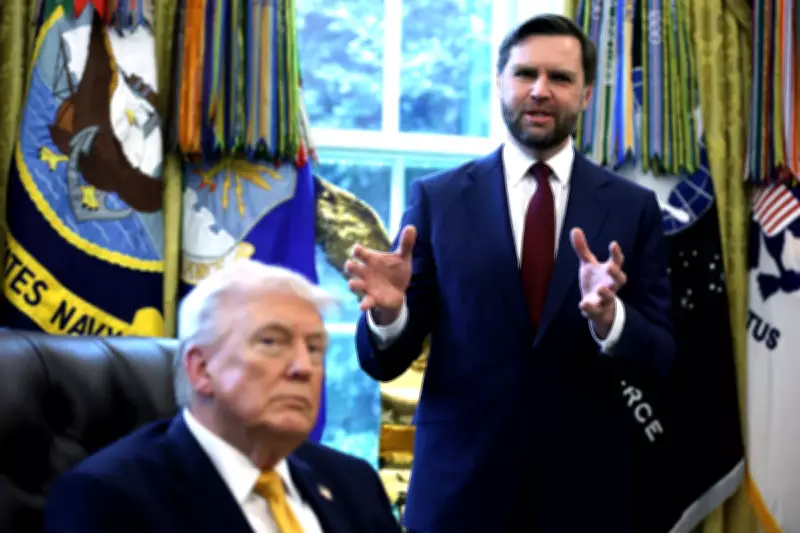
Trump's Premature Victory Declaration Masks Iran War Failures
Donald Trump has declared victory in the ongoing conflict with Iran, but the reality on the ground reveals a comprehensive failure of American foreign policy across multiple fronts. The United States' approach to Iran – whether through military engagement, peace negotiations, or nuclear weapons diplomacy – has culminated in the current catastrophic situation unfolding across the Middle East.
Failed Negotiations and Questionable Diplomacy
Vice-president JD Vance has officially announced the collapse of peace talks after just 21 hours of intense negotiations in Pakistan. A conflict spanning six weeks, with roots stretching back 47 years, was never likely to achieve a comprehensive sustainable settlement over a single weekend. However, the prospects for any meaningful breakthrough were severely undermined by Donald Trump's decision to dispatch two proven diplomatic failures to negotiate with Iran.
Steve Witkoff, an overly optimistic real-estate developer, and Jared Kushner, whose primary qualification remains being the president's son-in-law, represented the United States in these critical discussions. This move effectively marginalized the US State Department and Secretary of State Marco Rubio from their core foreign policy responsibilities, yielding no apparent strategic advantage.

Political Machinations and Strategic Missteps
The decision to have Vice-president Vance lead the delegation represented another serious misjudgment. While Vance could theoretically have brought considerable political authority to the Islamabad discussions as a potential future president with his own political base, he lacked personal incentive to rescue Trump from a predicament he had previously warned against. The practical limitations of the vice-presidential role made extended negotiations in Pakistan unfeasible.
There is growing speculation that Trump may have positioned Vance to shoulder blame for the near-inevitable failure of these talks. Domestic political pressures and bitter internal conflicts within the Republican party and the Maga movement have further complicated an already volatile situation. A skeptical Congress must soon decide whether to grant Trump expanded war powers, while potentially disastrous November elections loom large on the political horizon.
Weakened Position and Regional Consequences
The putative two-week ceasefire appears increasingly fragile, with devastating implications for regional civilians and the global economy. Israeli actions continue to undermine peace efforts, while Vance has summarily declared negotiations concluded and returned home with minimal compromise attempts.
America's motivation for pursuing a peace deal remains fundamentally weak because their negotiating position has deteriorated significantly. Any agreement would require compromise and concessions that Trump and his administration appear psychologically unable to make, as such admissions would resemble acknowledging defeat. Tehran currently holds most of the cards in this geopolitical game, primarily because Washington has played its hand poorly throughout this conflict.
Historical Context and Missed Opportunities
Before Trump was persuaded by Benjamin Netanyahu and reckless Republican sycophants in Congress to initiate this war, the Strait of Hormuz remained open to international maritime traffic. Gulf states were pursuing peace, prosperity, and stability, while Lebanon was not under virtual Israeli occupation – a situation that now creates additional intractable problems for Washington negotiators.
Most significantly, the Islamic Republic of Iran has survived the conflict and maintains a well-hidden stockpile of partially enriched uranium from which to potentially develop nuclear weapons. This reality fundamentally contradicts Trump's assertion that "regardless what happens we win." In truth, America has already lost this war, whether it concludes with some negotiated settlement or escalates militarily.

Strategic Implications and Future Prospects
In this asymmetric conflict, with Iran capable of holding the global economy hostage and terrorizing neighboring states, America cannot achieve victory on any conceivable basis – even through ground force deployment or attempts to forcibly open the heavily mined Strait of Hormuz.
Washington will eventually need to accept humbling conditions dictated by Tehran or withdraw forces entirely, leaving the resulting problems for Europe, China, and Gulf rulers to resolve. Such an outcome would represent a humiliation comparable to the evacuation of Saigon in 1975 or the retreat from Kabul in 2021.
Abandoned Diplomatic Pathways
One of the greatest tragedies of this situation is America's unilateral abandonment of two peaceful diplomatic agreements that could have achieved most, if not all, of Washington's current strategic objectives. The original Iran Nuclear Deal, formally known as the Joint Comprehensive Plan of Action, severely restricted Iran's nuclear program under close international supervision. During its implementation, Iran did not develop nuclear missiles.
Trump predictably dismantled this agreement during his first term, largely because it had been negotiated by the Obama administration. A more recent US-Iran agreement, brokered by Oman and ready for signature in late February, was abandoned when Trump decided military force represented a superior option. This assessment proved incorrect then and remains flawed now.
It is time for Trump to recall the wisdom of his hero Winston Churchill, who famously observed that "jaw-jaw is better than war-war." The current administration's failure to embrace this principle has led directly to the strategic debacle now unfolding across the Middle East.