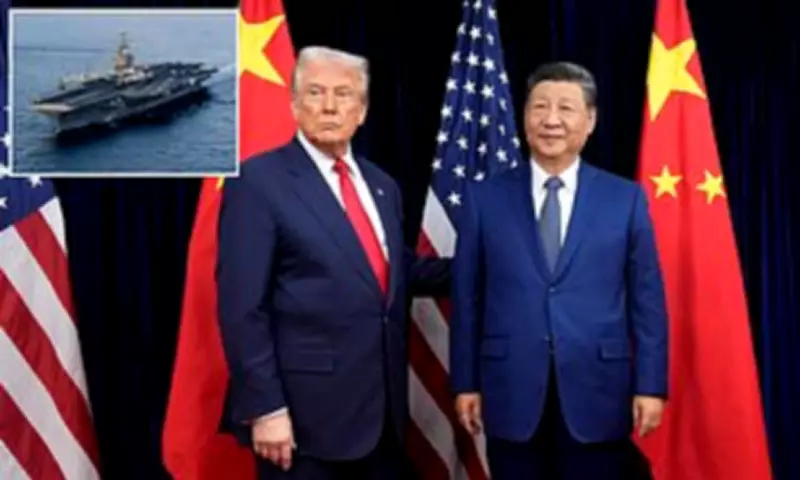
Trump Issues Stern Warning to China Over Alleged Iran Weapons Transfers
President Donald Trump has delivered a forceful caution to China following intelligence reports suggesting the country is preparing to send advanced air defense systems to Iran. The warning comes as delicate peace negotiations between the United States and Iran commenced in Islamabad, Pakistan, this past Saturday.
Intelligence Reports and Diplomatic Denials
Multiple US intelligence sources, cited by The New York Times and CNN, indicate that Beijing is orchestrating the shipment of shoulder-fired anti-aircraft missile systems, commonly known as MANPADs, to Tehran. These weapons are reportedly being routed through third-party nations in an effort to conceal their origin and circumvent international scrutiny.
In response to these allegations, a spokesperson for the Chinese Embassy in Washington issued a firm denial to CNN. "China has never provided weapons to any party to the conflict; the information in question is untrue," the spokesperson stated. "As a responsible major country, China consistently fulfills its international obligations. We urge the US side to refrain from making baseless allegations, maliciously drawing connections, and engaging in sensationalism; we hope that relevant parties will do more to help de-escalate tensions."

Trump's Direct Warning and Broader Context
Speaking to reporters outside the White House, President Trump left no ambiguity regarding the potential consequences for China. "If China does that, China is gonna have big problems," he declared. This stern admonition was delivered against the backdrop of nascent peace talks, which follow a fragile six-week truce established last Wednesday between the US and Iran.
Trump expressed confidence in the US position, regardless of the talks' outcome. "Regardless what happens, we win. We've totally defeated that country. And so, let's see what happens. Maybe they make a deal, maybe they don't. From the standpoint of America, we win regardless," he asserted, adding, "With all of that, let's see what happens, but from my standpoint, I don't care."
Strait of Hormuz Tensions and Military Developments
The president also announced his intention to reopen the strategically vital Strait of Hormuz, a critical global oil transit route. "We defeated their leaders. Their leaders are all dead. Now all we do is we'll open up the strait, even though we don't use it. Because we have a lot of other countries in the world that do use it, that are either afraid or weak or cheap," Trump remarked, while taking a swipe at NATO, stating, "I don't know what it is, but we were not helped by NATO that I can tell you."
This move comes amid heightened military activity. Iran issued a direct threat to attack US Navy ships in the Strait of Hormuz on Saturday, shortly after American warships, the USS Frank E Peterson and USS Michael Murphy, conducted a transit through the waterway for the first time since the conflict began. The transit was described as a freedom-of-navigation mission and occurred without incident, according to The Wall Street Journal.
However, Tehran subsequently warned Pakistani mediators that continued US vessel movement would result in targeting within thirty minutes, potentially jeopardizing the ongoing negotiations. Concurrently, US Central Command (CENTCOM) announced the initiation of operations to clear mines previously laid by Iran's Islamic Revolutionary Guard Corps in the strait. CENTCOM Commander Admiral Brad Cooper stated on social media platform X, "Today, we began the process of establishing a new passage and we will share this safe pathway with the maritime industry soon to encourage the free flow of commerce." He further revealed that additional forces, including underwater drones, would join the clearance efforts in the coming days.

Peace Talks and Delegation Details
The US delegation to the Islamabad peace talks is being led by Vice President JD Vance, accompanied by Special Envoy Steve Witkoff and Jared Kushner, Trump's son-in-law. The Iranian delegation is headed by Parliament Speaker Mohammad Bagher Qalibaf. Discussions are focused on advancing the ceasefire, which remains threatened by significant disagreements and Israel's continued military actions against Hezbollah, an Iranian-backed group in Lebanon.
The reopening of the Strait of Hormuz has been mandated by Trump as a component of the ceasefire agreement, adding a complex layer to the already tense diplomatic and military landscape.