Trump Hosts Right-Wing Latin American Leaders in Florida Summit
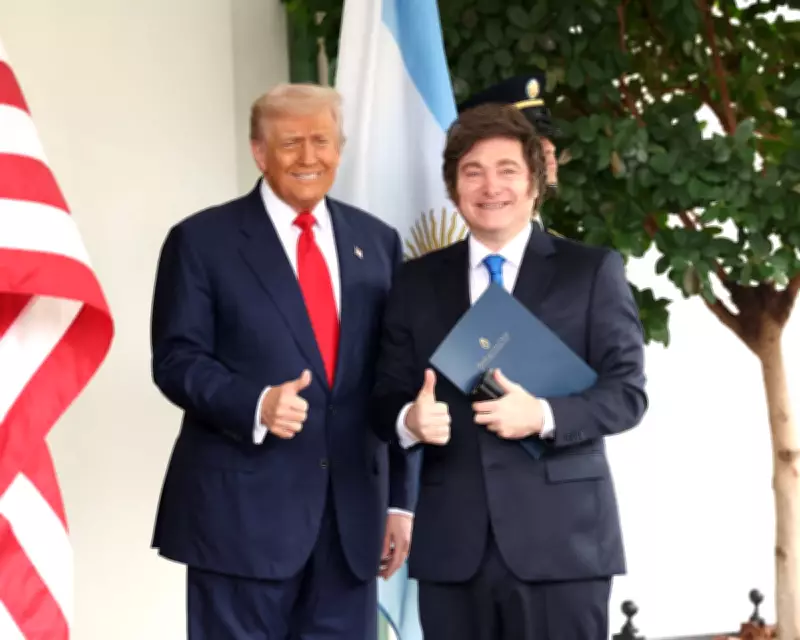
Donald Trump will welcome the leaders of at least ten Latin American nations to a golf resort in Miami this Saturday, as the US president intensifies his efforts to reshape America's influence across the region and counterbalance China's expanding footprint. Since his return to power last year, Trump has embarked on a dramatic and sometimes lethal campaign to, in the words of Pentagon chief Pete Hegseth, "reclaim our back yard."
Aggressive Regional Strategy
This crusade has included vows to "take back" the Panama Canal, airstrikes on suspected narco boats in the Caribbean and Pacific, overt interference in Brazil's judicial system, threats of military action in Mexico and Colombia, and the startling abduction of Venezuela's president, Nicolás Maduro. Additionally, Predator drones were deployed to assist in killing one of the world's most wanted drug lords, El Mencho, in Mexico.
Trump has also extended a multibillion-dollar bailout to Argentina's radical libertarian president, Javier Milei, and meddled in Honduras's recent election to support the eventual right-wing victor. He recently floated the idea of a "friendly takeover" of Cuba, as his administration seeks to choke the island's struggling communist regime by severing its oil supply, despite United Nations warnings of an impending humanitarian "collapse."

The 'Don-roe Doctrine' and Summit Agenda
Trump officials describe his "Don-roe Doctrine"—a modern revamp of the 19th-century Monroe Doctrine—as an attempt to diminish Beijing's regional presence and impose Washington's will through economic and military pressure. White House press secretary Karoline Leavitt stated that the invitation-only Shield of the Americas summit aims "to promote freedom, security, and prosperity in our region."
The guest list features right-wing presidents from Argentina, Bolivia, El Salvador, and Paraguay, but notably excludes the leftist leaders of Brazil, Mexico, and Colombia, three of Latin America's largest economies. Brian Winter, editor-in-chief of Americas Quarterly magazine, remarked, "This is the VIP level of the Latin America Trump Club—and this meeting really does seem to be conceived as a way to add a clear benefit to membership at that level."
Ideological Alignment and Security Focus
Winter noted the conclave would gather "ideological fellow travellers Trump likes to take photos with," with agenda items likely covering security, migration, and issues surrounding Venezuela and Cuba. Attendees include Paraguay's President Santiago Peña, Chile's ultra-conservative president-elect José Antonio Kast—who has promised a Trump-style immigration crackdown—and Ecuador's President Daniel Noboa, who recently highlighted joint anti-drug operations with the US.
On Thursday, Trump's influential aide Stephen Miller hinted at further collaboration, urging Latin American military leaders to use military force against drug cartels, which he called "the Islamic State and the al-Qaida of the western hemisphere." Winter explained that aligning with Trump offers domestic political advantages for right-wing politicians, as security is the top issue in Latin America, and the US provides unparalleled intelligence and firepower.
Criticism and Cautious Responses
However, Trump's strategy has sparked alarm and outrage in capitals like Brasília and Bogotá, where officials view actions such as Maduro's capture and the pressure on Cuba as violations of international law. Brazil's left-wing president, Luiz Inácio Lula da Silva, criticized the US approach, stating, "Cuba isn't going hungry because it doesn't know how to produce [food]... Cuba is going hungry because they don't want Cuba to have access to the things that everyone has a right to."
Despite this, criticism has been muted, with politicians reluctant to offend Trump. Even Colombia's outspoken left-wing president, Gustavo Petro, has softened his anti-Trump rhetoric and held a cordial meeting with him last month. Winter observed, "What's interesting—and somewhat surprising—is that at least so far, many countries are going along with this, whether out of convenience or fear."

Exposing Policy Limitations
Benjamin Gedan, director of the Stimson Center Latin America programme, argued that the summit's "ideological guest list" reveals the failure of Trump's "theatrical" doctrine and the White House's inability to engage with Latin America's key nations. "Brazil and Mexico comprise together more than half of the population in the region [and] more than a half of all economic activity... Throw in Colombia and you've got the two biggest South American countries. All [of them] completely on the outside of a US hemispheric policy—and this is the hemisphere the US supposedly dominates and [where it] demands pre-eminence," Gedan said.
Former US ambassador to Panama John Feeley, who has compared Trump's behavior to that of fictional mob boss Tony Soprano, acknowledged the profound impact of Trump's presidency on Latin America: "As a critic of him, I'm the first to admit there has not been a presidency since perhaps Kennedy that has had such a profound effect on Latin America, in so many spheres of activity. The effects are real."