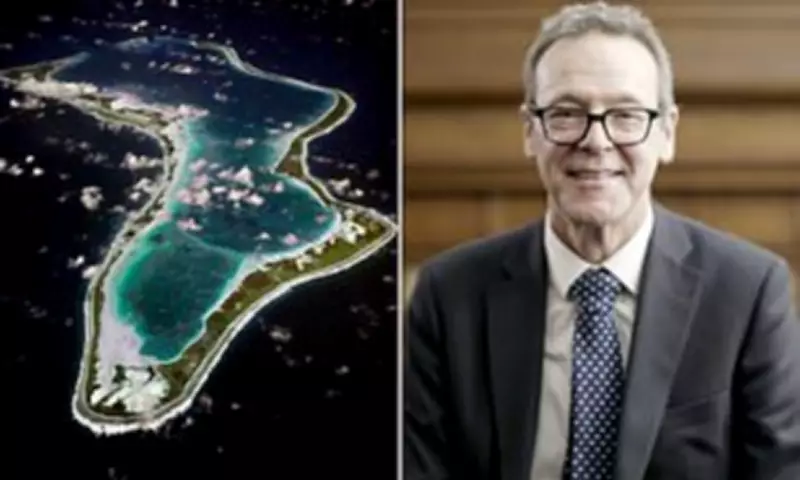
The Prime Minister was left with 'no choice' but to abandon his strategy to transfer the Chagos Islands back to Mauritius in the face of an 'openly hostile' Donald Trump, according to the former Head of the Diplomatic Service. Lord Simon McDonald, who led the Foreign and Commonwealth Office from 2015 to 2020, declared that the contentious plans will now be placed 'into the deep freeze' for the foreseeable future.
Strategic Military Base at the Heart of the Dispute
Lord McDonald warned that it could take many decades to resolve the future of the islands, which are currently under British sovereignty as the British Indian Ocean Territory. He described the entire situation as 'a hangover from the end of the Colonial era' that has persisted for over half a century.
While UK government officials have indicated that Keir Starmer's proposal to return the islands and lease back the land containing the strategic UK-US military base at Diego Garcia has not been 'abandoned altogether', the controversial handover faces indefinite delay. The plan, which was anticipated to feature in the King's Speech in May, has been shelved because there is insufficient parliamentary time to advance legislation and the United States has withdrawn its crucial backing.

Trump's Dramatic Reversal on the Deal
Without American support, the government's intentions are effectively stymied indefinitely. Donald Trump, who initially supported the arrangement that would see the UK pay up to £101 million annually to lease Diego Garcia, completely reversed his position as relations between the two allies deteriorated over Middle Eastern policies. In January, the former president denounced the plan as an 'act of total weakness'.
'The government had no other choice,' Lord McDonald explained to the BBC. 'The UK had two objectives. One was to comply with international law. The second was to reinforce the relationship with the United States but when the President of the United States is openly hostile the government has to rethink so this agreement will go into the deep freeze for the time being.'
International Legal Obligations and Colonial Legacy
Speaking on Radio 4's Today programme, the former senior civil servant emphasized that once the government submitted to the legal process of the International Court of Justice (ICJ), it became 'bound by the outcome of that process'. In 2019, the ICJ recommended that Chagos should be returned to Mauritius, setting in motion the current chain of events.
'Everything that has happened now and also under the Conservative government as well as the Labour government is a consequence of that ICJ judgment,' he stated. While acknowledging there is a 'mood to disregard international law' led by the United States, Russia, and China, Lord McDonald asserted that the UK has always defined itself as a nation that respects and upholds international law.
Geopolitical Realities and Future Prospects
Lord McDonald predicted there would be 'no change' to the islands' status while Mauritius 'were in no position to take them over by force or would even try because they are over 1200 nautical miles away with no navy to speak of'. He added: 'I think the status quo will persist.'
The former diplomat provided historical context, explaining that for over two centuries, successive powers administered the Indian Ocean as one unit. At independence, decolonisation rules dictated that the entire unit should become independent as one new country. 'The Brits - to help the US - carved out the Chagos archipelago to allow the Americans to build this absolutely vital base at Diego Garcia. The Mauritians were never happy about that,' he noted.
Lord McDonald, who sits in the Lords as a Life Peer and serves as Master of Christ's College, Cambridge, suggested negotiations would continue 'in a low key way' because 'the President has already changed his mind more than once on this issue so it is possible he will change his mind again. If he doesn't then there will be a new president in 2029.'

Legal Requirements and Government Position
To enact any Chagos legislation, the United Kingdom, which has controlled the islands since the early 19th century, requires a formal exchange of letters from the United States as a legal necessity. Any eventual agreement would see the UK formally cede sovereignty while signing a lease for Diego Garcia to maintain the crucial military installation.
A government spokesperson reiterated the strategic importance of the base: 'Diego Garcia is a key strategic military asset for both the UK and the US. Ensuring its long-term operational security is and will continue to be our priority - it is the entire reason for the deal. We continue to believe the agreement is the best way to protect the long-term future of the base, but we have always said we would only proceed with the deal if it has US support. We are continuing to engage with the US and Mauritius.'