Trump's Confession on Iran War Direction Sparks Republican Alarm
In a stunning admission that has sent shockwaves through Washington, President Donald Trump has openly confessed he does not know whether the ongoing war in Iran is winding down or ratcheting up. This revelation, made during a rare White House briefing on Monday, has plunged Republican messaging into disarray as the conflict enters its second month with no clear resolution in sight.
A President Without Answers
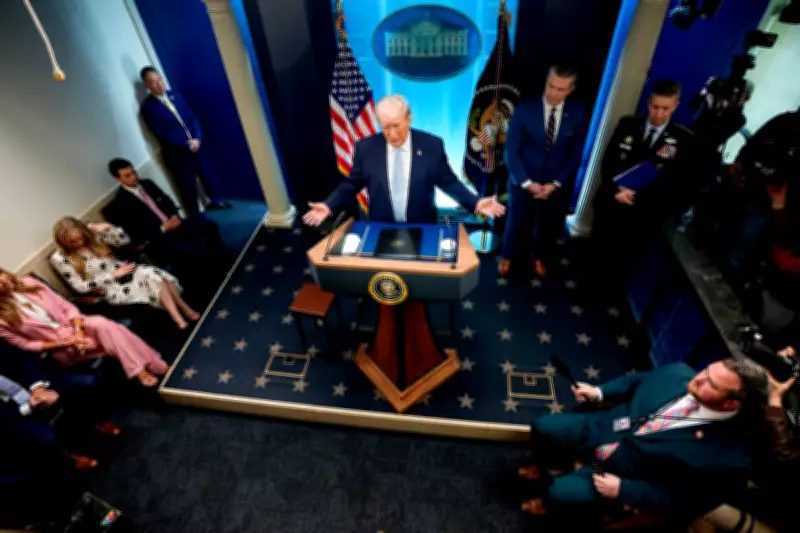
For weeks, Americans have been demanding a straightforward answer to a simple question: when will the Iran war end? As gasoline prices soar beyond $4 per gallon nationwide, the public's patience is wearing thin. President Trump gathered with top defense officials including Pete Hegseth and CIA Director John Ratcliffe in a packed briefing room, where he delivered a rambling account of the situation.
Just 24 hours after issuing an expletive-laden Easter morning threat to Iran's government, Trump doubled down on his vow that American forces would soon expand targeting of civilian infrastructure such as bridges and power plants. However, when pressed by a reporter to clarify whether the conflict was de-escalating or escalating, the president offered a startlingly candid response.

"I can't tell you. I can't tell you. I don't know," Trump admitted, creating an immediate communications nightmare for his administration and congressional Republicans who must now explain this uncertainty to constituents.
Escalating Threats Amid Strategic Confusion
Despite his confusion about the war's direction, Trump issued fresh ultimatums to Iran. He vowed that the U.S. military would "decimate" every bridge and power plant within the country if Iranian authorities failed to meet extended deadlines for reopening the Strait of Hormuz to global oil and natural gas shipping.
This contradictory stance—threatening massive escalation while admitting uncertainty about basic strategy—has left the White House in an increasingly difficult position. Iranian officials have repeatedly rejected ceasefire proposals and show no signs of capitulating to American demands, leaving Trump's administration with a failing strategy it seems unwilling to modify.
Polling Reveals Deep Public Skepticism
The president's admission comes amid growing public doubt about his administration's war planning. A recent CNN/SRSS poll found that six in ten American adults question whether the White House possesses a coherent strategy for winning the conflict and withdrawing U.S. forces.
Trump's habitual deflection of questions about military plans, once dismissed as strategic secrecy, now appears to many Americans as evasion. "Somebody said, 'Oh, he doesn't have a plan.' I have the best plan of all, but I'm not going to tell you what my plan is," the president insisted during Monday's briefing, doing little to reassure skeptics.
Economic and Political Fallout Intensifies
The human and economic costs continue mounting. Thirteen American service members have died since hostilities began, while gasoline prices have jumped more than $1 per gallon nationwide in recent months. This surge comes at an especially difficult time for congressional Republicans, who already faced significant electoral challenges before the conflict began.
Having previously claimed his administration was reducing prices faster than the Biden administration did post-pandemic, Trump now confronts the reality of having increased energy costs for every American. Economists warn that sustained high energy prices could trigger cascading effects throughout the economy if not resolved promptly.
Even before U.S. strikes commenced on February 28, inflation and persistently high food and energy prices presented nagging problems for Republicans approaching midterm elections. With no apparent end to the war, the president risks extending these economic pressures through primary election season this spring and summer, further complicating Republican electoral prospects.

A Search for Exit Strategy Yields Nothing
The president's apparent search for an off-ramp from the conflict has thus far proven fruitless. Congressional Republicans, already criticized by allies for failing to effectively communicate their governance record, now face additional challenges explaining a war strategy their own leader cannot articulate.
Monday's remarks will likely reinforce public perceptions that Trump lacks a viable plan to conclude hostilities. As the White House struggles to project confidence and direction, the administration finds itself trapped between escalating threats and admitted uncertainty, with no clear path forward in a conflict that shows no signs of resolution.