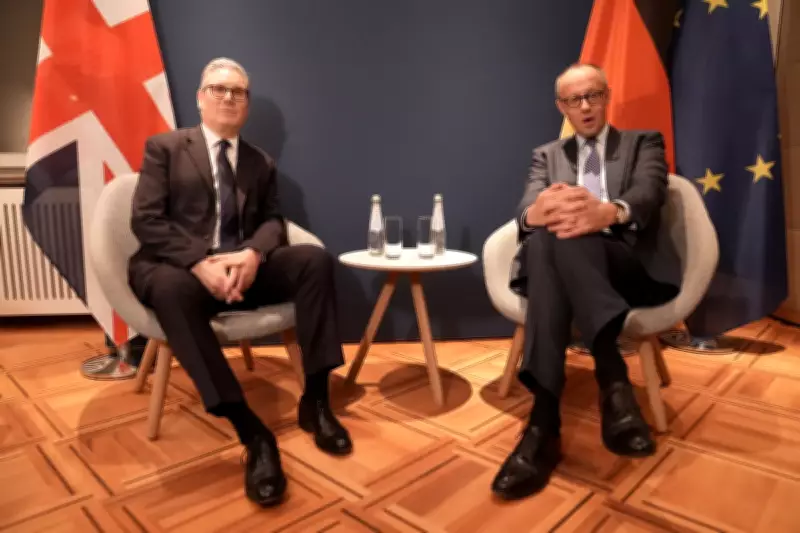
Prime Minister Sir Keir Starmer has delivered a stark declaration on the interdependence of British and European security during a high-profile bilateral meeting with German Chancellor Friedrich Merz at the Munich Security Conference. The leaders convened against a backdrop of global instability, with Chancellor Merz characterising the current climate as a "world in trouble."
Mutual Security Dependence Emphasised
In a firm statement, Sir Keir Starmer articulated the foundational principle of shared security interests. "There is no UK security without European security. There is no European security without UK security," the Prime Minister asserted. "Consequently, we must collaborate closely together." This sentiment underscores a strategic pivot towards reinforced European cooperation under the current UK administration.
European Unity Beyond the EU
German Chancellor Friedrich Merz echoed this call for solidarity, broadening the definition of European partnership. "We face a world in trouble, and it is now crucial to maintain European unity, which includes the United Kingdom. It is not solely about the European Union," Merz stated. He explicitly mentioned Norway and extended the scope to Canada, noting its increased willingness to cooperate with European nations.

Focus on Ukraine and Transatlantic Ties
Earlier discussions at the conference involved Ukrainian President Volodymyr Zelensky and various European leaders, centring on efforts to resolve the ongoing conflict with Russia as the four-year mark of the full-scale invasion approaches. The future of transatlantic relations also dominated the agenda, particularly in light of strains emanating from the White House of US President Donald Trump.
The American delegation, led by Secretary of State Marco Rubio, highlighted a "new era in geopolitics" prior to the summit. Although Prime Minister Starmer was seated beside Secretary Rubio during the Ukraine meeting, the US official arrived after journalists had departed for the private session to commence.
Broad International Participation
Leaders from France, Denmark, NATO, the European Council, the European Commission, and other nations participated in the gathering. This meeting was framed as an extension of December talks in Berlin, where European leaders outlined conditions for any potential peace agreement with Russia, including security guarantees supported by the United States.
Another round of US-mediated negotiations between Ukraine and Russia is scheduled for the following week, aiming to broker an end to the protracted war.
Starmer's Upcoming Address and Strategic Vision
Sir Keir Starmer is set to address the conference on Saturday morning, engaging in a moderated conversation titled "Principled and pragmatic: wielding power in a world in disarray" alongside European Commission President Ursula von der Leyen. He is anticipated to advocate for Europe to reduce its excessive reliance on Washington, signalling a shift towards greater strategic autonomy.
Context of Transatlantic Uncertainty
The Munich Security Conference occurs at a pivotal moment, with the United States' commitment to NATO facing significant scrutiny. Recent tensions have been exacerbated by President Trump's threat to annex Greenland from NATO ally Denmark. Furthermore, US Vice-President JD Vance's criticisms last year regarding free speech and immigration policies in European countries, including the UK, have contributed to a notable deterioration in transatlantic relations.
This summit highlights the complex geopolitical landscape where European and UK leaders are navigating security challenges, reinforcing alliances, and addressing the evolving dynamics of global power structures.