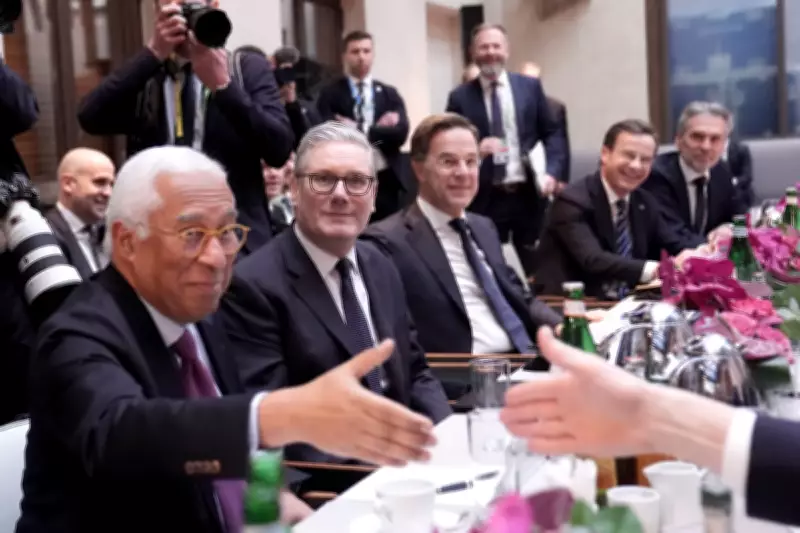
Prime Minister Sir Keir Starmer engaged in crucial diplomatic talks with Ukrainian President Volodymyr Zelensky and US Secretary of State Marco Rubio during the prestigious Munich Security Conference. The high-stakes meeting brought together key European and transatlantic leaders to address the ongoing conflict between Ukraine and Russia, as the four-year anniversary of Vladimir Putin's full-scale invasion approaches.
High-Level Discussions on Ending the War
The Munich Security Conference served as a critical platform for advancing efforts to resolve the devastating war in Ukraine. German Chancellor Friedrich Merz formally opened the session with a special welcome for President Zelensky, setting the tone for substantive dialogue. Leaders from France, Denmark, NATO, the European Council, and the European Commission joined the discussions, demonstrating unified European commitment to supporting Ukraine.
This gathering represented an extension of previous talks held in Berlin during December, where European leaders established specific conditions for any potential peace agreement with Russia. These conditions notably included security guarantees that would require backing from the United States, highlighting the complex geopolitical landscape surrounding the conflict.

Transatlantic Relations Under Scrutiny
The future of transatlantic cooperation emerged as a central theme throughout the conference, particularly as Europe contends with increasing antagonism from Donald Trump's administration in Washington. US Secretary of State Marco Rubio, leading the American delegation, referenced a "new era in geopolitics" prior to his arrival in Munich, signaling shifting dynamics in international relations.
Prime Minister Starmer was seated adjacent to Secretary Rubio during the Ukraine meeting, although the American politician had not yet arrived when journalists departed the room for private discussions to commence. The conference occurs at a particularly sensitive moment, with growing questions about America's commitment to NATO and transatlantic partnerships.
European Unity and Diplomatic Engagements
Following the Ukraine session, Sir Keir met separately with German Chancellor Friedrich Merz and French President Emmanuel Macron at the bustling Hotel Bayerischer Hof. Chancellor Merz humorously remarked, "I hope you don't mind about the European flag," as the three leaders posed for photographs before a backdrop of national flags prior to their private discussions on summit sidelines.
During his scheduled address to the conference on Saturday morning, Prime Minister Starmer is expected to advocate for Europe to reduce its excessive dependence on Washington. He will participate in a moderated conversation titled "Principled and pragmatic: wielding power in a world in disarray" alongside European Commission President Ursula von der Leyen, further exploring Europe's strategic positioning.
Broader Geopolitical Context
The Munich Security Conference unfolds against a backdrop of significant transatlantic tensions, exacerbated by former President Trump's recent threat to acquire Greenland from NATO ally Denmark. Chancellor Merz acknowledged that "a divide" has emerged between continents as he called for a "new trans-Atlantic partnership" during his opening remarks.
Relations between the United States and European nations have deteriorated dramatically following criticism from US Vice-President JD Vance regarding free speech and immigration policies in various European countries, including the United Kingdom. These developments have created a challenging diplomatic environment that leaders must navigate as they work toward conflict resolution in Ukraine.
Additional US-brokered negotiations between Ukraine and Russia are scheduled for the coming week, building upon the discussions initiated at the Munich summit. The conference serves as a critical diplomatic forum for coordinating international responses to global security challenges while addressing fundamental questions about the future of Western alliances in an increasingly complex geopolitical landscape.