
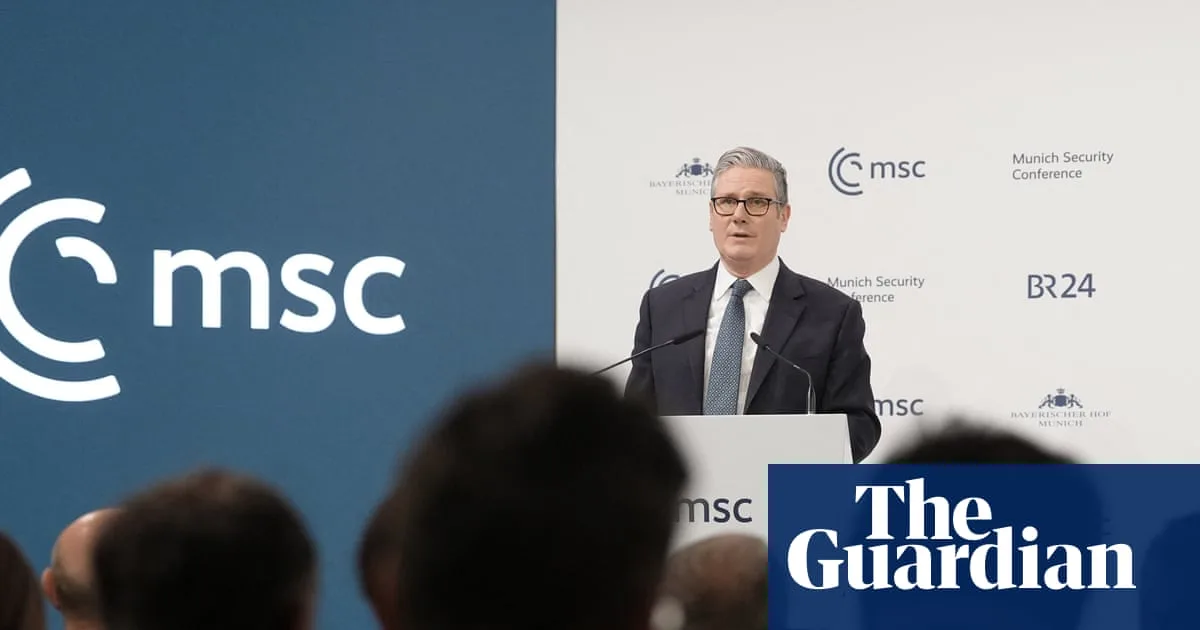
Prime Minister Keir Starmer has called for a closer UK defence relationship with Europe, emphasising the urgency of greater cooperation on procurement and manufacturing. Speaking at the Munich Security Conference, he declared that the UK is no longer the nation of the Brexit years and must integrate more deeply with European allies to counter the long-term threat from Russia.
Starmer outlined plans for a European Defence Mechanism, an intergovernmental body open to all European democracies, to finance joint procurement and assets. He noted that the UK and France are keen to reopen talks on UK membership of the EU's Security Action for Europe rearmament scheme, after discussions stalled over entry costs.
The Prime Minister stressed that European nations must take primary responsibility for their own conventional defence, arguing that fragmented industrial planning and procurement have led to gaps and duplication. 'Our economies dwarf Russia's more than 10 times over, yet too often this adds up to less than the sum of its parts,' he said.
Starmer insisted that closer UK-EU defence ties would not weaken the UK-US relationship or NATO, which he described as 'the most effective defence alliance we have ever known.' He called for generational investments to move from overdependence to interdependence, and urged European leaders to be honest with their electorates about rising defence costs.
In a swipe at political extremes, Starmer warned against 'peddlers of easy answers' who are 'soft on Russia, weak on NATO,' and said their future would lead to 'division and capitulation.'




