
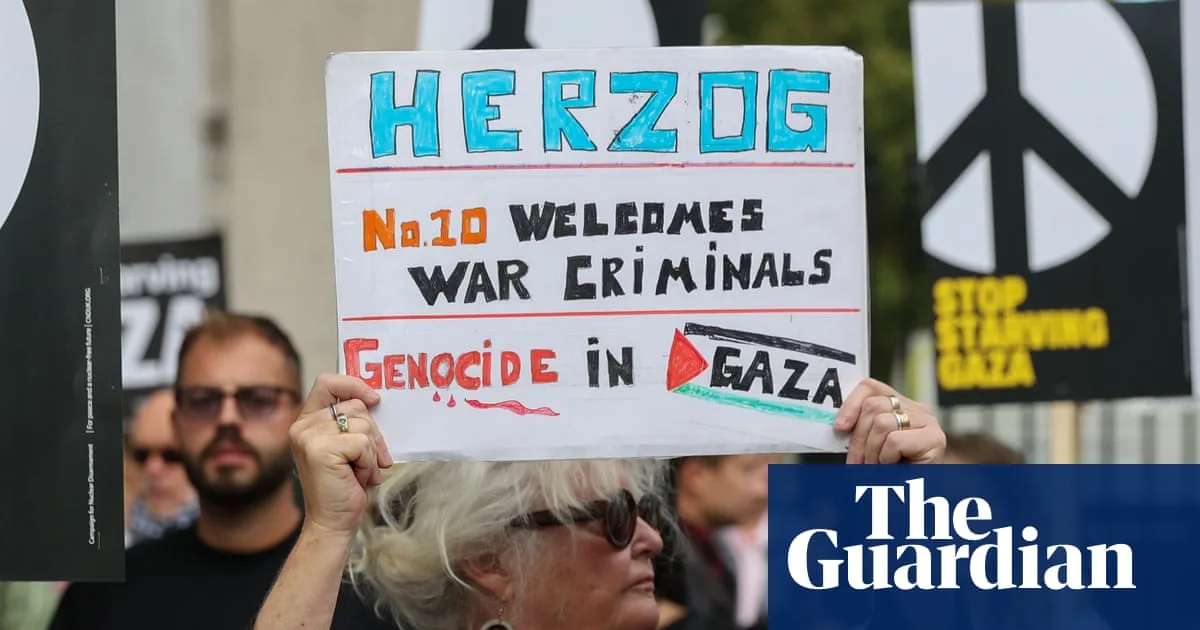
The meeting between Sir Keir Starmer and the Israeli president, Isaac Herzog, in London has been described as a missed opportunity, with both leaders holding competing visions for Israel’s security and Palestinian self-rule. Downing Street had hoped the encounter would at least allow the two men to listen to each other and possibly secure help for the evacuation of injured children from Gaza, as well as openings for young Palestinians to study in the UK. But according to the former Middle East minister Alistair Burt, the two men probably spoke past each other at Number 10.
Starmer continues to advocate a two-state solution, with Hamas excluded from government, Palestinian elections held within a year, and a reconstituted Palestinian Authority as a partner for peace. Herzog, who once shared that vision, has lost faith in Palestinian self-rule since the 7 October 2023 attack on Israel. He argues that Israelis, until hostages are released and Hamas neutralised, are in no psychological or emotional state to contemplate such a solution.
The disagreement was evident in their responses to the recent Israeli strike on Hamas leaders in Doha. Starmer condemned the attack as a violation of Qatar’s sovereignty, while Herzog described it as an important and correct decision. The health minister, Wes Streeting, pressed Herzog on how Israel could achieve its stated aim of clearing Palestinians from Gaza without committing war crimes or ethnic cleansing, but the Israeli president offered no clear answer, insisting only on continuing to target Hamas wherever it operates.
Herzog rejected the UK’s distinction between Hamas and a reformed Palestinian Authority, and is said to be backed by the US state department, which recently denied visas to the entire Palestinian Authority delegation to the UN General Assembly. However, new Ipsos Mori polling suggests Israel’s methods have significantly damaged its reputation. Among the UK public, 75% believe Israel has gone too far in Gaza, and 44% support UK recognition of Palestine as a state. The poll also found that the Israeli government was considered most responsible for the war, at 23%, ahead of Hamas at 20%.




