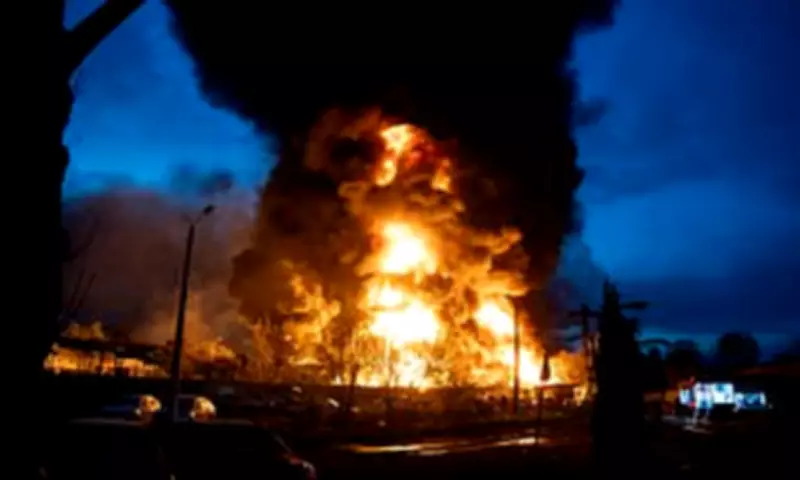
The Russian Defence Ministry has issued a stark warning to European nations, publishing a detailed list of what it describes as 'potential targets' across the continent. This provocative move comes in direct response to European countries ramping up drone production for Ukraine, following a massive overnight Russian aerial assault that killed at least fifteen civilians and injured ninety others across Ukrainian territory.
Escalating Threats and Overnight Carnage
Russia launched a devastating barrage overnight, deploying 324 drones and three ballistic missiles in its largest such attack in nearly two weeks. Ukrainian air defences managed to intercept 309 of the drones, but the onslaught still caused significant destruction and loss of life. Among the victims was a twelve-year-old boy in Kyiv, where four people were killed. In the southeastern city of Dnipro, three more lives were lost as Russian strikes hit two universities, damaging academic buildings, dormitories, and nearby homes, with the blast wave shattering over a thousand windows.
The attacks followed a brief ceasefire over the Orthodox Easter weekend, marking a sharp return to violence. Russia also fired a powerful FAB-1500 glide bomb, weighing 1.5 metric tons, at the central part of Sloviansk before dawn on Wednesday. The blast completely destroyed a children's sports facility that was a well-known city landmark.

European Facilities Named as 'Potential Targets'
In a statement laden with menace, the Russian Defence Ministry declared that the European decision to increase drone production for Kyiv represents a 'deliberate step leading to a sharp escalation of the military-political situation across the entire European continent.' The ministry warned that these actions are 'increasingly drawing these countries into a war with Russia' and that any attacks on Russia involving European-manufactured drones would have 'unpredictable consequences.'
The published list explicitly names branches of Ukrainian drone-producing factories located in the United Kingdom, Germany, Denmark, Latvia, Lithuania, the Netherlands, Poland, and the Czech Republic. It also includes factories producing components in Germany, Spain, Italy, the Czech Republic, Israel, and Turkey. 'The European public should not only clearly understand the true causes of the threats to their security but also know the addresses and locations of "Ukrainian" and "joint" enterprises producing drones and components for Ukraine on the territory of their countries,' the ministry stated.
This threat was made even more explicit by Dmitry Medvedev, the hawkish deputy head of Russia's Security Council, who posted on social media: 'Russian Defence Ministry's statement must be taken literally: the list of European facilities which make drones and other equipment is a list of potential targets for the Russian armed forces. When strikes become a reality depends on what comes next.'
Ukrainian Retaliation and Diplomatic Push
Ukraine proceeded with its own long-range drone attacks in response. The Russian Defence Ministry reported that its air defences intercepted 85 Ukrainian drones overnight. Ukrainian drones targeted an industrial facility in Sterlitamak, a Russian city approximately 1,300 kilometers east of the Ukrainian border. Radiy Khabirov, governor of the Bashkortostan region, confirmed that several drones were shot down, with debris starting a fire at one facility and claiming one life. In a separate incident in Russia's Krasnodar Krai region, a Ukrainian drone attack killed two children, aged five and fourteen.
President Volodymyr Zelensky, in a post on Telegram, emphasised the urgent need for air defence missiles, stating, 'Every day we need air defence missiles - every day Russia continues its strikes.' With no plans announced for further US-mediated talks with Russia, Zelensky embarked on a whirlwind diplomatic tour, visiting three European capitals in 48 hours to secure promises of further military and financial support.

His efforts yielded results. Germany and Ukraine agreed on a defence package valued at 4 billion euros, while Norway pledged 9 billion euros in assistance. Italian Premier Giorgia Meloni, after meeting with Zelensky in Rome, noted, 'Italy in particular is very interested in developing joint production, especially in the area of drones, a sector in which we know well that Ukraine, in recent years, has become a leading nation.'
Strategic Developments and Ongoing Conflict
Zelensky is championing joint weapons production agreements and pushing for the European Union to expedite a promised 90 billion euro loan. He is also asking European countries to contribute to a fund for purchasing American-made weapons, particularly the Patriot air defence system. Defence leaders from about fifty nations held an online meeting on Wednesday, chaired by German Defense Minister Boris Pistorius and British Defense Secretary John Healey, with NATO Secretary-General Mark Rutte in attendance. Ahead of this meeting, Britain announced it would send 120,000 drones to Ukraine this year, its largest delivery of such weapons to date.
Despite the challenges, Ukraine's war effort has shown recent momentum. According to Western officials and analysts, Ukrainian troops have disrupted Russia's spring offensive, aided by drones and ground robots. Long-range strikes have also impacted Russian oil exports and manufacturing. Ukraine's top military commander, Oleksandr Syrskyi, reported that last month Ukrainian forces recaptured nearly 50 square kilometers of territory and hit 76 Russian targets, including 15 oil refining facilities.
However, significant hurdles remain. The conflict in the Middle East is draining stockpiles of advanced air defence missiles that Ukraine desperately needs, and Kyiv's financial resources are running short. NATO chief Mark Rutte cautioned, 'We cannot lose sight of Ukraine' amid other global conflicts. Ukrainian Defence Minister Mykhailo Fedorov revealed the staggering scale of recent Russian attacks: between November and March, Russia launched 27,000 Shahed-type drones, nearly 600 cruise missiles, and 462 ballistic missiles at Ukraine.
After more than four years of full-scale invasion, Ukraine has developed battle-tested drone interceptor expertise and groundbreaking air defence technology. Yet, it lacks the financial capacity to scale up production to levels that would secure a decisive advantage, making continued international support more critical than ever as the conflict enters a new phase of heightened threats against European infrastructure.