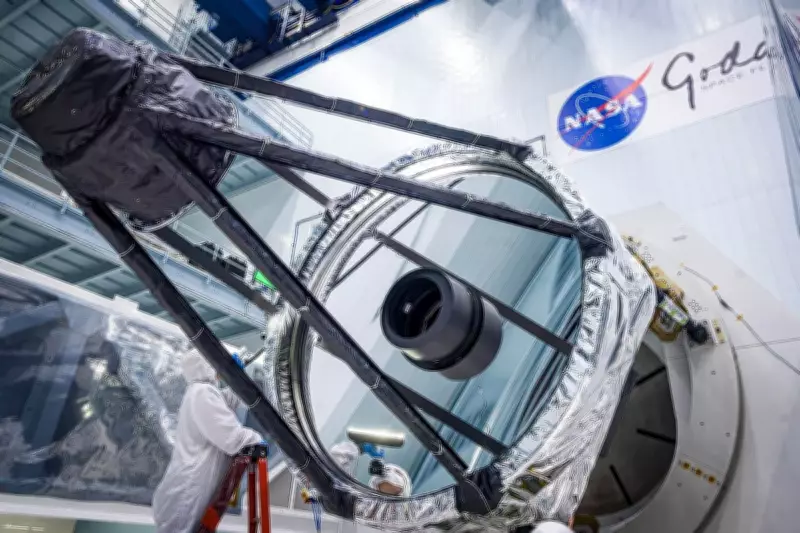
The Nancy Grace Roman Space Telescope is poised to transform our understanding of the universe with its unprecedented capabilities. However, proposed budget cuts by the Trump administration could jeopardize the science behind this ambitious project and future missions.
A New Era of Cosmic Exploration
When it launches later this year, the Roman Space Telescope will enable scientists to study 100,000 exoplanets, hundreds of millions of galaxies, billions of stars, and rare cosmic phenomena never before observed. Its field of view is at least 100 times larger than the Hubble Space Telescope, and it can block starlight to directly image exoplanets that might harbor life. Operating 930,000 miles from Earth, the telescope will capture images so large and detailed that no existing screen can display them fully. It could launch as early as September, ahead of its May 2027 schedule, and remains within its $4.3 billion budget.
Budget Cuts Threaten Science
The Trump administration's proposed budget would slash NASA's science budget by 46% from 2026 levels, according to The Planetary Society. This would cancel over 50 science missions, including a dozen astrophysics projects. The cuts extend beyond science, with overall agency funding reduced by 23% to prioritize the Artemis program for lunar exploration by 2028. The Artemis II mission's success has bolstered support for spaceflight, but scientists argue that cutting science undermines long-term goals.

Impact on Key Missions
The Mars Sample Return mission, critical for searching for extraterrestrial life, faces cancellation again after being terminated in 2026. This mission would return rock samples from Mars that may contain signs of life, aiding future Artemis and Mars missions. The Lunar Reconnaissance Orbiter, which has mapped the moon since 2009, also supports Artemis by identifying landing sites. Dr. Barrett Caldwell of NASA's Indiana Space Grant Consortium emphasized that human spaceflight relies on robotics and machine learning from science missions, calling the cuts illogical.
Political and Scientific Reactions
Planetary Society's Casey Dreier described the cuts as an "extinction-level event" for NASA science. NASA Administrator Jared Isaacman sought to reassure the public, stating that science remains fundamental and that the agency can "do more with less." However, similar cuts were rejected by Congress for fiscal year 2026, and over 100 lawmakers have called for increased science funding. Representative George Whitsides deemed the budget "dead on arrival."
Bill Nye, The Science Guy, called the cuts "a mistake," noting that U.S. leadership in space requires leadership in science. Since last spring, over 10,000 STEM doctoral experts have left the U.S., and the country's global science ranking has declined. Despite workforce reductions, NASA's science missions remain vital, including the asteroid-hunting NEO Surveyor. The future of the Roman Telescope and other projects hinges on congressional action to restore funding.