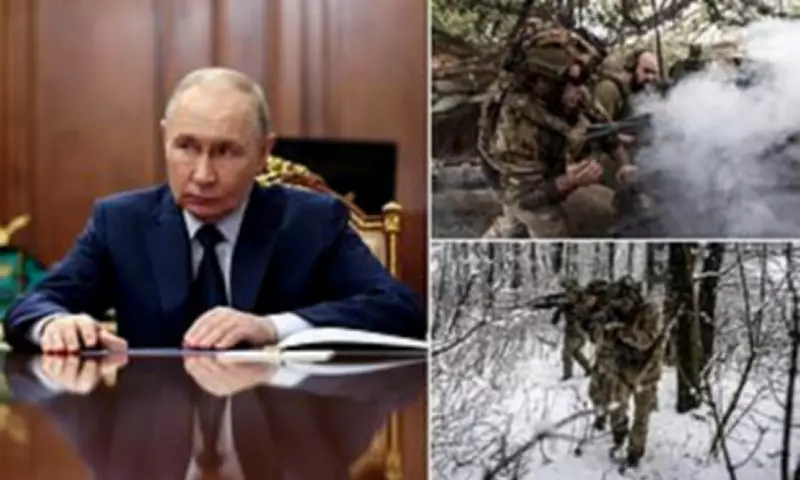
Putin Moves to Expand Legal Authority for Overseas Military Operations
Concerns are escalating regarding a potential Russian confrontation with NATO as Vladimir Putin advances legislation that would grant him new powers to launch military attacks beyond Russia's borders. The Russian President is strengthening his control over military authority through a contentious new law that could facilitate the deployment of troops overseas under broad pretexts.
Legislative Pathway and Expanded Powers
The proposed legislation, which has already cleared its first parliamentary reading in Moscow's largely compliant system, is expected to pass without significant opposition. It must still undergo two additional readings and approval from the upper house, but few anticipate any obstacles. The bill would authorize Putin to deploy forces abroad "in the event, detention or the criminal prosecution" of Russian citizens, significantly expanding his existing legal framework for military action.
This measure builds upon current laws that already provide Putin with considerable latitude to use military force in defense of Russia's interests—a justification he previously invoked during the 2022 invasion of Ukraine, claiming protection for ethnic Russians. Vyacheslav Volodin, the Russian parliamentary chairman, stated, "Western justice has effectively become an instrument of repression. Under these circumstances, it is important to do everything possible to protect our citizens," though he offered no further elaboration.

Potential Implications and International Concerns
Theoretically, this law could enable Moscow to dispatch troops to free Russians detained under orders from international bodies like the International Criminal Court (ICC), which issued arrest warrants for Putin and Kremlin official Maria Lvova-Belova in 2023 over the forced deportation of Ukrainian children. However, the ramifications extend much further.
Western officials are alarmed that the legislation might lay the groundwork for future military moves against NATO's eastern flank, potentially testing the alliance's Article 5 mutual defense pact. Co-authored by Deputy Defence Minister Anna Tsivileva, who is related to Putin, the bill emerges amid intelligence warnings that Russia could target another European country within the next few years, despite its forces being heavily engaged in Ukraine.
Historical Context and Strategic Timing
Putin, a former KGB officer, has a history of seeking legal cover for military actions. In 2014, he secured parliamentary approval before sending troops into Ukraine, leading to the annexation of Crimea and support for separatists in the east. In 2020, following an appeal from MP Valentina Tereshkova, he orchestrated a constitutional overhaul allowing him to remain in power until at least 2036.
The timing of this new bill is notable, as it was backed by MPs shortly after Kremlin spokesman Dmitry Peskov suggested Moscow might halt active fighting in Ukraine if Kyiv ceded the entire Donetsk region—despite Ukrainian forces still controlling about a fifth of it. Peskov made no mention of the Kherson and Zaporizhzhia regions, sparking anger among hardliners who accused him of readiness to "surrender" territory.
Regional Flashpoints and Escalating Tensions
Analysts point to Estonia, a NATO member since 2004, as a potential flashpoint, with Moscow possibly using its large Russian-speaking population as a pretext for intervention. Estonia regained independence as the Soviet Union collapsed, and recent incidents have heightened tensions. In May, Estonia accused Russia of sending a fighter jet into NATO airspace over the Baltic Sea to shield an unflagged tanker suspected of breaching sanctions.
Estonia has also pulled back from detaining suspected shadow fleet vessels—ageing oil tankers used to evade sanctions—due to fears of retaliation. Ivo Vark, Estonia's naval chief, told Reuters, "The risk of military escalation is just too high." Meanwhile, tensions at sea have risen, with British special forces authorized to halt and board ships aiding Russia's war effort, though reports indicate a Russian warship recently escorted two sanctioned tankers through the English Channel unchallenged.

Broader Strategic and Intimidation Tactics
Beyond direct military implications, the legislation may serve as a warning to Western nations targeting Russia's shadow fleet. European governments have increased efforts to seize such vessels, and Farida Rustamova, a Russian opposition journalist, wrote, "It seems that the purpose of the document is not to grant Putin additional powers (he has plenty of those), but to intimidate unfriendly countries with possible operations by Russian intelligence services and the military."
Internationally, the United States has its own controversial legal framework, with a 2002 law—often called the Hague Invasion Act—empowering the U.S. president to deploy troops to rescue American personnel detained by international courts like the ICC, whose authority Washington does not recognize. This parallel underscores the global complexities of military intervention and legal justifications.
As Putin's domestic support remains tied to narratives of Russia under siege from hostile powers, amplified by state media, this new law could further consolidate his grip while raising the stakes for NATO and international stability. The ongoing conflict in Ukraine continues to shape these dynamics, with fears that expanded legal powers might lead to broader military engagements beyond current battlefields.