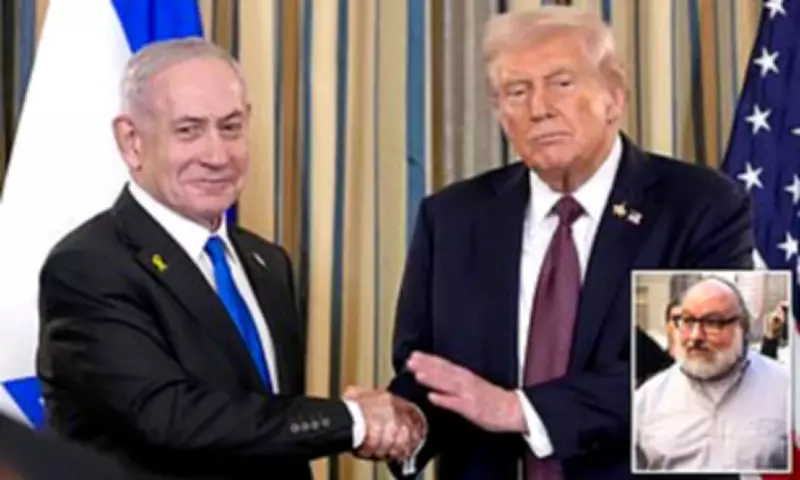
Former US Spy Pollard Accuses Israel of Misleading Trump Over Iran War Plans
In a remarkable development, Jonathan Pollard, the convicted former US Navy analyst who served 30 years for spying for Israel, has made explosive claims about Israeli intelligence assessments provided to President Donald Trump. Pollard alleges that Israel misled the American president about the consequences of potential military action against Iran.
Embassy Meeting and Controversial Claims
Just four months after assuming his role as America's ambassador to Israel, Mike Huckabee held a private meeting at the US Embassy in Jerusalem with Pollard. The convicted spy, now 71, described the encounter as 'personal,' thanking Huckabee for lobbying for his early release in 2015. The ambassador, a staunch pro-Israel advocate, had argued Pollard's life sentence was too severe for someone spying on behalf of an American ally.
Now Pollard finds himself at the center of another diplomatic controversy. In an exclusive interview with the Daily Mail, he claims his adopted country provided President Trump with misleading intelligence about what would happen if America went to war with Iran.

Questionable Intelligence Assessments
'President Trump was sold a bill of goods by Bibi Netanyahu and the Mossad,' Pollard stated, referring to a reported classified White House briefing on February 11. According to the New York Times, Israeli Prime Minister Benjamin Netanyahu and Mossad director David Barnea told Trump that American aerial attacks on Iran would likely spark a popular uprising that could overthrow the Islamic regime.
The Israeli officials reportedly also suggested US strikes might encourage Kurdish fighters in Iraq to attack Iran from the northwest, further straining the regime's defenses. These assessments were immediately questioned by American intelligence agencies, with the CIA reportedly calling them 'farcical' and Secretary of State Marco Rubio dismissing them as 'bulls**t.'
Intelligence Failure or Wishful Thinking?
Pollard, who claims to advise decision-makers within the Israeli government, expressed disbelief that any credible intelligence agency could endorse such scenarios. 'There was no chance in the world that a popular uprising was going to occur,' he told the Daily Mail. He pointed to the Iranian Revolutionary Guard's brutal crackdown on protests in January, where at least 30,000 demonstrators were reportedly killed.
'The president should have listened to the CIA, and he should have listened to Marco Rubio,' Pollard emphasized. 'Both of whom, basically, indicated that the chances of a popular uprising were slim to none.'
Broader Intelligence Concerns
Pollard does not attribute the faulty assessment to deliberate deception but rather to what he sees as a recurring pattern of intelligence failure. He compares it to the miscalculations that preceded the devastating Hamas attacks on southern Israel on October 7, 2023.
'It was a question of hope over reality... It's a misreading of the enemy,' Pollard explained. 'In the case of Hamas, we definitely should have known better. In the case of Iran, there was no way an aerial bombing campaign to prevent the Iranians from developing a nuclear weapon, or the means to deliver it, was going to succeed.'
Strategic Consequences and Regional Impact
Pollard believes Netanyahu's suggestion of a spontaneous uprising gave Trump a false sense of the Iranian regime's vulnerability. He argues the president should have been encouraged to launch more devastating attacks targeting Iran's infrastructure, including electrical generators, oil and gas export capabilities, transportation networks, and water distribution systems.
The former spy contends that Trump's failure to strike Iran with overwhelming force has contributed to the current standoff over the Strait of Hormuz, through which 20 percent of global oil supplies pass. Pollard suggests the US should have positioned at least 100,000 troops in the region to respond to potential Iranian attempts to close the critical waterway.

Damage to US-Israel Relations
As a result of what Pollard describes as misleading intelligence, he believes Israel's strategic position in the region has been compromised. 'In the case of October 7th, our miscalculation adversely impacted our national security,' he said. 'In this case, we did not do the United States a good service by providing them with a rationale for a short effective regime change.'
Despite these criticisms, Pollard insists Israel remains 'a reliable and very effective ally of the United States.'
Personal Reflections and Legacy
Reflecting on his own controversial past, Pollard remains deeply conflicted about his actions. 'I broke the law and I'm not going to plead innocence, because my motives were pure,' he told the Daily Mail. 'But I want people to understand that I was not a traitor to the United States.'
He emphasized that he was never accused or convicted of treason, which under the US Constitution involves aiding an enemy during wartime, nor was he accused of intending to harm the United States in his indictment.
The revelations from Pollard's interview raise serious questions about intelligence sharing between allies and the decision-making processes that led to America's approach to Iran during the Trump administration. As geopolitical tensions continue in the Middle East, these claims shed new light on the complex dynamics between the United States and one of its closest allies.