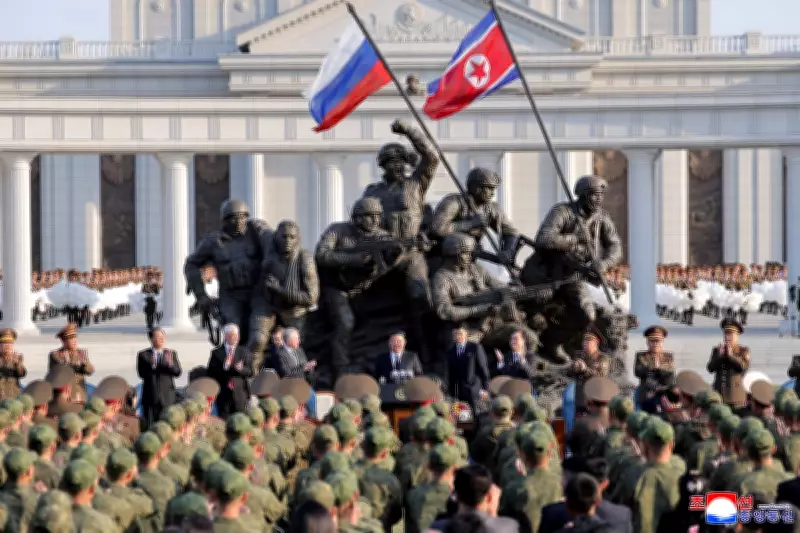
North Korea has opened a memorial museum for its soldiers who were killed while fighting for Russia against Ukraine, as top leaders from both countries vowed to strengthen their partnership. The announcement came on Monday via the North's Korean Central News Agency (KCNA), which reported that the museum's inaugural ceremony took place in Pyongyang on Sunday, marking the one-year anniversary of the conclusion of an operation to liberate the Kursk region.
Ceremony Details
North Korean leader Kim Jong Un attended the ceremony alongside high-ranking Russian officials, including Vyacheslav Volodin, speaker of the State Duma, and Defense Minister Andrei Beloussov. According to KCNA, Kim participated in a ritual where he threw dirt over the remains of a deceased soldier and laid flowers before other bodies already placed in a mortuary. He, Volodin, and Beloussov also left messages in the guest book.
In his speech, Kim declared that the spirits of the fallen North Korean soldiers would endure as "a symbol of the North Korean people's heroism" and support "a victorious march by the Korean and Russian people." He praised the joint forces for thwarting what he termed a U.S.-led Western "hegemonic plot and military adventurism" on the Russian-Ukraine front.

Military Cooperation
During a separate meeting with Beloussov, Kim affirmed North Korea's full support for Russian policies aimed at defending its sovereignty and security interests, as reported by KCNA. Russia's state news agency, Tass, quoted Beloussov as telling Kim that Russia was prepared to sign a bilateral military cooperation plan covering the 2027-2031 period.
Russian President Vladimir Putin, in a letter read by Volodin during the ceremony, stated that the museum "will undoubtedly be a clear symbol of the friendship and solidarity" between the two nations. Putin expressed confidence that the comprehensive strategic partnership would continue to strengthen, according to KCNA.
Background and Concerns
Since Russia's invasion of Ukraine, Kim has prioritized Moscow in his foreign policy, supplying troops and conventional weapons. In return, North Korea is believed to have received economic and other assistance from Russia. South Korea, the United States, and their allies worry that Russia may transfer high-tech technologies that could enhance North Korea's nuclear and missile programs.
In April 2025, North Korea and Russia announced that their soldiers had fought together to repel a Ukrainian incursion into Russia's Kursk border region. Neither country has disclosed the exact number of North Korean troops deployed, but South Korea's intelligence service estimated that about 15,000 soldiers were sent, with around 2,000 killed.
Experts note that North Korean troops initially became easy targets for drone and artillery attacks due to their lack of combat experience and unfamiliarity with the terrain. However, Ukrainian military and intelligence officials have assessed that the North Koreans gained crucial battlefield experience and were key to Russia's strategy of overwhelming Ukraine by deploying large numbers of soldiers in the battle for Kursk.