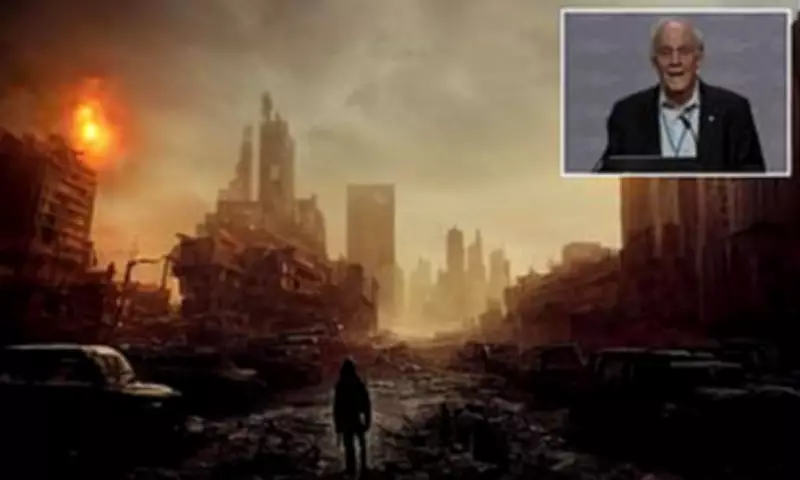
Nobel Laureate Delivers Dire Warning on Humanity's Survival Timeline
David Gross, the distinguished physicist who shared the 2004 Nobel Prize in Physics, has issued a chilling assessment of humanity's future, suggesting our civilization could face an existential catastrophe within approximately 35 years. The Nobel laureate's warning centers primarily on the escalating dangers of nuclear conflict in an increasingly unstable global landscape.
The Mathematics of Catastrophe: A Two Percent Annual Probability
Gross explained his alarming timeline using probability calculations similar to those employed in radioactive decay modeling. "Even after the Cold War ended, when we had strategic arms control treaties, all of which have disappeared, there were estimates that there was a one percent chance of nuclear war every year," he revealed in an interview with Live Science. "I feel it's not a rigorous estimate that the chances are more likely two percent. So that's a one-in-50 chance every year."
The physicist elaborated that with a two percent annual probability, the expected lifetime before such a catastrophic event occurs mathematically calculates to about 35 years. This sobering assessment comes from the same scientific mind that earned the Nobel Prize for discovering "asymptotic freedom" - the groundbreaking principle explaining how the strong nuclear force binding atomic nuclei weakens as subatomic particles called quarks move closer together.

Deteriorating Global Security Landscape
Gross pointed to multiple alarming developments that have worsened global security over recent decades. "Things have gotten so much worse in the last 30 years, as you can see every time you read the newspaper," he observed, specifically highlighting:
- Renewed nuclear threats from multiple nations
- The ongoing war in Europe with nuclear implications
- Escalating tensions involving Iran's nuclear program
- Recent near-war conditions between nuclear-armed India and Pakistan
The physicist emphasized the critical deterioration of international arms control mechanisms, noting that "there have been no major nuclear arms-control treaties signed in the past 10 years." He added with concern: "There are now nine nuclear powers. Even three is infinitely more complicated than two."
The Expiration of Critical Nuclear Agreements
A particularly troubling development Gross highlighted is the expiration of the last surviving US-Russia nuclear treaty. The New Strategic Arms Reduction Treaty (New START), originally signed in 2010, represents the eighth agreement between the two nuclear superpowers since the 1963 treaty banning atmospheric, outer space, and underwater nuclear tests. With this critical agreement ending, the world faces unprecedented nuclear uncertainty.
Artificial Intelligence: The New Frontier of Existential Risk
Beyond nuclear threats, Gross expressed profound concern about emerging technologies, particularly artificial intelligence. "The agreements, the norms between countries, are all falling apart," he warned. "Weapons are getting crazier. Automation, and perhaps even AI, will be in control of those instruments pretty soon."
The Nobel laureate specifically cautioned about the increasing role of automation and artificial intelligence in military decision-making systems. "It's going to be very hard to resist making AI make decisions because it acts so fast," he explained, noting that military leaders facing extremely short decision windows may become increasingly tempted to rely on automated systems.
However, Gross emphasized that artificial intelligence systems are far from foolproof. "If you play with AI, you know that it sometimes hallucinates," he said, referring to the technology's documented tendency to generate inaccurate or fabricated outputs that could have catastrophic consequences in military contexts.
The Fermi Paradox and Civilizational Survival
Gross referenced the famous question posed by physicist Enrico Fermi, often summarized as "Where are all the civilizations?" This philosophical inquiry suggests that advanced societies may ultimately destroy themselves before achieving long-term survival - a possibility that weighs heavily on Gross's assessment of humanity's current trajectory.

"You asked me to think about the future, and I am obsessed the last few years, thinking about that, not the future of ideas and understanding nature, but of the survival of humanity," the physicist confessed, revealing the personal urgency behind his warnings.
A Glimmer of Hope Amidst the Gloom
Despite the dire assessment, Gross pointed to historical examples where scientific warnings and public awareness have catalyzed meaningful change. He specifically referenced the global response to climate change as evidence that humanity can mobilize against existential threats when properly informed and motivated.
"We made them; we can stop them," Gross declared regarding nuclear weapons, suggesting that the same human ingenuity that created these destructive technologies could potentially develop solutions to control and eventually eliminate them.
The Nobel laureate's comprehensive warning serves as both a scientific assessment and a moral call to action, urging global leaders and citizens alike to confront the converging threats that could determine whether human civilization survives beyond the mid-21st century.