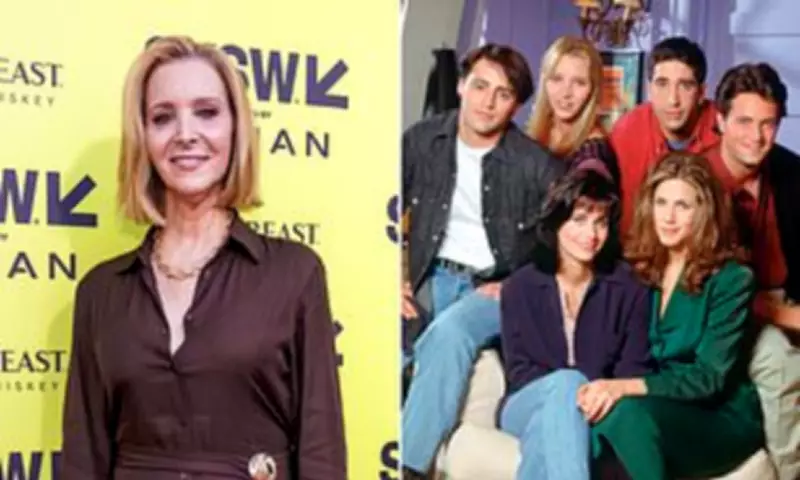
In a candid new interview, Lisa Kudrow has revealed the stark reality of being treated as an afterthought compared to her more famous Friends co-stars during the show's peak. Speaking with the Independent, the actress shared that while Jennifer Aniston, Courteney Cox, Matt LeBlanc, the late Matthew Perry, and David Schwimmer basked in the spotlight, she felt invisible even to her own representation.
'Nobody Cared About Me'
Kudrow claimed that her talent agency, which she was paying to secure choice roles, often referred to her dismissively as "the sixth Friend." This label underscored a broader lack of vision for her career beyond the iconic sitcom, which aired from 1994 to 2004. "There was no vision for me, and no expectations about the kind of career I could have," she lamented. "There was just, like, 'Boy, is she lucky she got on that show.'"
Struggles Amidst Success
As Friends became a global phenomenon from its second season onward, several of her co-stars leveraged their fame into lucrative film deals. Kudrow, however, found herself struggling to land comparable opportunities. She was mostly offered low-budget independent films, such as 1997's Clockwatchers, or small supporting roles, like in Albert Brooks's 1996 comedy Mother. Despite this, she cherished working with talents like Parker Posey, Toni Collette, and Brooks himself.

It wasn't until her role in the 1999 comedy Analyze This, starring alongside Robert De Niro and Billy Crystal, that more compelling offers began to surface. "That’s when the agents and business people started circling, wanting to put me in romantic comedies and things," Kudrow recalled, though she doubted the strategy due to not seeing herself as "adorable" enough for such parts.
Emmy Win and Collective Bargaining Rumors
Michael Patrick King, her co-creator on The Comeback who joined the interview, expressed astonishment at Kudrow's lack of offers during Friends' heyday. He pointed out that she was the first cast member to win an Emmy, securing the Outstanding Supporting Actress in a Comedy Series award in 1998.
Kudrow also addressed persistent rumors that she led the cast's collective bargaining efforts ahead of season three, which resulted in equal salaries skyrocketing from $125,000 to $750,000 per episode in later seasons, and eventually $1 million per episode for the final two seasons. She firmly denied being the ringleader, stating, "I absolutely was not the ringleader. And that was reported, and it wasn’t true."
Her talent agency was reportedly angered by these reports, viewing them as a warning to other clients. "My team were like, 'No, this is not good! We’re furious that they’re saying this about you,'" Kudrow shared, noting the irony that her agents stood to gain financially from her increased earnings.
Beyond Phoebe Buffay
In a separate conversation with Lily Tomlin for Interview Magazine, Kudrow clarified that her iconic character Phoebe Buffay was initially very different from her real self. "At first, Phoebe was very, very far from me," she explained. "It took a lot of work to justify the things she would say and do." Over the show's decade-long run, she gradually embraced some of Phoebe's traits, exploring spirituality to better understand the role.
Kudrow also pushed back against the notion that she only plays "ditzes," arguing that Phoebe wouldn't be labeled as such by today's standards. "In 1994, it was like, 'I love her. She’s such a ditz.' And it’s like, yeah, OK, that was what a ditz was to us. Someone who wasn’t toeing the line," she reflected.
Enduring Success with The Comeback
Despite earlier struggles, Kudrow has found lasting success beyond Friends, notably with her HBO series The Comeback. She stars as Valerie Cherish, a B-list actress battling to revive her career in a cutthroat industry. The mockumentary premiered in 2005, with a second season arriving in 2014 after a long hiatus, and a third and final season now airing after another decade-long gap.
This project highlights Kudrow's resilience and talent, proving that her career has flourished well past the days of being dubbed "the sixth Friend." Her journey from feeling overlooked to achieving critical acclaim serves as a testament to her perseverance in Hollywood.