Lebanon Buries 13 Officers Killed in Israeli Strike Amid Rising Anger Before US Talks
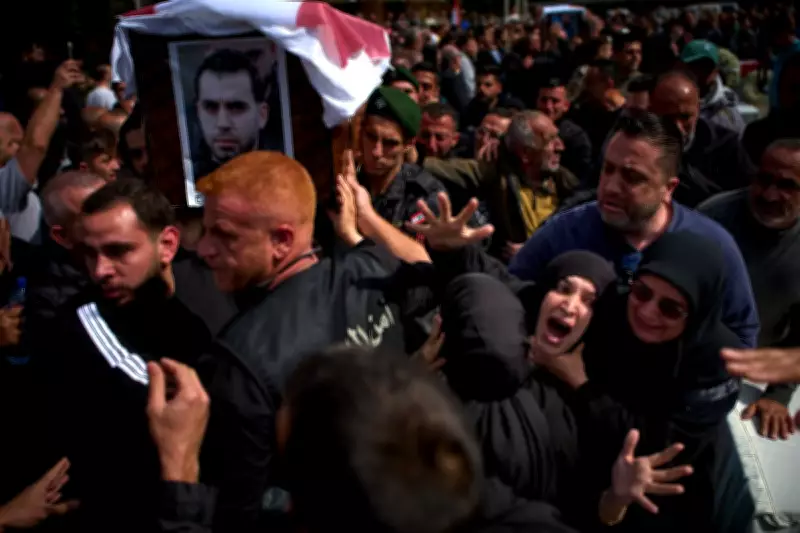
Mourners in Lebanon are burying 13 state security officers killed when Israeli airstrikes hit their office headquarters in the southern Lebanese town of Nabatiyeh. The funerals on Saturday were marked by intense grief and rising public anger, coming just days before historic direct talks between Lebanon and Israel are set to begin in the United States.
Scenes of Grief and Loss
Women dressed in black screamed in anguish while toddlers sobbed uncontrollably, calling out for their dead fathers and uncles. Men in uniforms, with pistols strapped to their belts, wept openly for their fallen comrades. These funeral scenes have become tragically common across Lebanon in recent weeks as Israel has intensified attacks against what it describes as Iran-backed Hezbollah infrastructure and militants.
The Israel-Hezbollah conflict, raging in the shadow of the larger U.S.-Israeli confrontation with Iran, has so far claimed more than 2,000 lives in Lebanon and left thousands more wounded. However, Friday's strike that killed so many state security personnel at once has struck a particularly raw nerve. This attack came just two days after Israeli strikes on Beirut and other areas killed over 350 people in one of the deadliest single bombing campaigns in Lebanon's crisis-wracked history.

"We just want protection," said Adam Tarhini, a 20-year-old computer science student whose father, Hassan Tarhini, was among the 13 killed in Friday's attack. "Israel wants to take our land and everything we have."
Historic Negotiations at a Sensitive Time
Grief and rage are soaring as Lebanon and Israel, which do not maintain diplomatic relations, prepare to start direct talks next week in the United States for the first time in decades. The prospect of these Washington negotiations has sent anti-government protesters into the streets and piled pressure on Lebanese Prime Minister Nawaf Salam, who has demanded a truce as a condition for negotiations.
Israel insists the talks will focus on the disarmament of the Lebanese militant Hezbollah group and will not lead to a ceasefire. On Saturday, Salam announced he has postponed his planned trip to Washington, citing "the current internal situation." While Salam's absence should not affect the upcoming talks—the first round next week is expected to be at the ambassadorial level—his decision to stay in Beirut to "preserve the security and unity of the Lebanese people" highlights the difficult position the Lebanese government faces.
"This leaves the Lebanese government in a very difficult position," said David Wood, a senior analyst for the International Crisis Group. "It will want to strike some kind of new arrangement with Israel to bring an end to this round of conflict, but at the same time not make such sweeping political concessions as to potentially provoke internal trouble in Lebanon."
A Deadly Strike Reverberates
The fatal strike crashed into the state security headquarters just minutes after 14 officers returned from what would be their last mission—transferring detainees from the southern town to a safer facility in the coastal city of Sidon, further north. The one surviving officer is being treated for severe burns.
Among the youngest victims was 25-year-old Khalil al-Miqdad, who had celebrated his wedding just three days before his death. His bride, Amani, staggered through the crowds of mourners in a daze, clutching a smiling photo from their wedding day. "They killed Khalil. They killed my love," she said, her anguish erupting into a shriek.
In response to a request for comment on the attack, the Israeli military stated it had struck Hezbollah militant infrastructure in Nabatiyeh on Friday and was "aware of reports regarding harm to Lebanese security personnel." The military added it was investigating the incident.

Displacement and Temporary Burials
On Saturday, families of the buried officers flung themselves onto temporary cinder block gravesites on a hill overlooking the Shiite village of Haret Saida, neighboring Sidon. Several mourners who collapsed, overcome with grief, were carried away on stretchers. Like most of their fellow villagers, they were too frightened to return home to bury their dead as Israeli forces pushed deeper into Lebanese territory.
Israeli attacks and blanket evacuation orders have uprooted more than 1 million people across Lebanon. Even the main cemetery in Nabatiyeh came under attack a few weeks ago, residents reported, forcing them to resort to temporary graves in cities like Sidon where many of the displaced have taken refuge.
Anger Rises Ahead of the Talks
Both the mourners in Sidon and protesters in Beirut on Saturday blame the government almost as much as Israel for the recent deaths of so many civilians and state workers. They cite the state's failure to protect its people as the reason Lebanon needed Hezbollah to resist Israel's invasion and what they fear are plans for a longer-term Israeli occupation of Lebanese territory.
The underfunded Lebanese army, maintaining a position of neutrality in the Israeli-Hezbollah war, has withdrawn from several southern positions as Israel accelerates its invasion. Still, Israeli strikes killed four Lebanese soldiers this week.
As Ali Akbar Velayati, a top Iranian official, warned against the dangers of "ignoring the unparalleled role" of Hezbollah's armed wing, protesters burned the prime minister's portrait in downtown Beirut.
"No one wants negotiations with people who killed our friends, our colleagues, our family," said Abbas Saleh, a 26-year-old rescue worker from Nabatiyeh who attended the officers' funerals. He balked at the idea of the Lebanese government normalizing relations with Israel or negotiating to disarm Hezbollah.
The Israeli army is being "held back by people who are defending the land," he said—meaning Hezbollah.