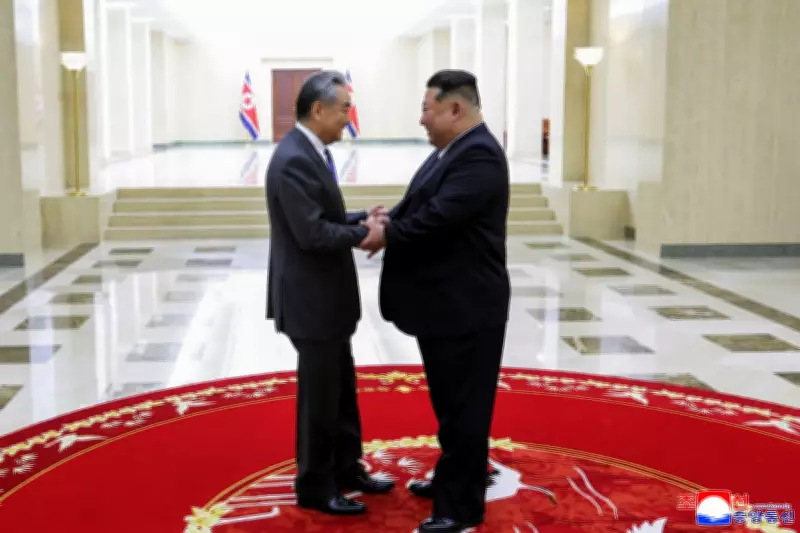
North Korean leader Kim Jong Un has voiced strong support for China's strategic push to establish a "multipolar world" and advocated for deeper bilateral ties between the long-standing allies during high-level talks with Chinese Foreign Minister Wang Yi. The meeting, held on Friday in Pyongyang, was reported by North Korea's state media on Saturday, highlighting a significant diplomatic engagement between the two nations.
Strategic Alignment on Global Issues
According to the Korean Central News Agency (KCNA), Kim explicitly endorsed China's efforts to uphold territorial integrity based on the "one-China principle," which asserts Beijing's claim over Taiwan as an inseparable part of its territory. This declaration underscores the political solidarity between North Korea and China amid ongoing regional tensions.
Kim also discussed North Korea's stance on various regional and international matters of mutual concern, emphasizing that the sustained development of relations between Pyongyang and Beijing has become increasingly vital in the current geopolitical landscape. The North Korean leader's remarks reflect a concerted effort to align with China's foreign policy objectives, particularly in countering Western influence.

A New Phase in Bilateral Relations
Wang Yi, who embarked on a two-day visit to North Korea, noted that the relationship between the two countries is entering a "new phase" following last year's summit between Kim and Chinese President Xi Jinping. This visit marks Wang's first trip to North Korea in seven years, signaling a reinvigoration of diplomatic exchanges that had been hampered by the COVID-19 pandemic.
During his stay, Wang met with North Korean Foreign Minister Choe Sun Hui, where both sides explored avenues to enhance cooperation and exchanges. They engaged in in-depth discussions on international issues, though state media reports from both nations did not specify whether topics such as U.S. relations or the Middle East conflict were addressed.
Breaking International Isolation
Kim Jong Un's embrace of concepts like a "new Cold War" and a "multipolarized world" is part of a broader strategy to break out of international isolation and pursue a more assertive foreign policy. By strengthening alliances with nations in confrontation with the United States, North Korea aims to position itself as a key player in a global coalition opposing Washington's dominance.
While Russia has been a primary focus of Kim's foreign policy in recent years, with substantial military support for its war in Ukraine, China remains North Korea's traditional main ally and crucial economic lifeline. Kim's participation in a World War II ceremony in Beijing alongside Russian President Vladimir Putin last September, coupled with his first summit with Xi Jinping in six years, illustrates efforts to portray North Korea as part of a united front against the U.S.
Resuming Connections and Diplomatic Timing
In a practical step towards normalization, North Korea and China resumed direct flight and passenger train services last month, ending a suspension that began at the onset of the COVID-19 pandemic in 2020. This move facilitates greater connectivity and underscores the thaw in bilateral interactions.
Wang's visit to Pyongyang precedes a rescheduled summit between U.S. President Donald Trump and Xi Jinping in May, prompting speculation among some South Korean officials about potential diplomatic openings with North Korea. However, Kim has maintained a hard-line stance, suspending meaningful dialogue with the U.S. and South Korea since the collapse of talks with Trump in 2019.
Kim now defines South Korea as his "most hostile" adversary and has rejected U.S. offers to resume negotiations, insisting that Washington abandon its demand for North Korea's denuclearization as a precondition. This position highlights the ongoing challenges in engaging Pyongyang on the international stage, even as it seeks to bolster ties with allies like China.