US Vice President JD Vance Arrives in Pakistan for Critical Iran Peace Talks
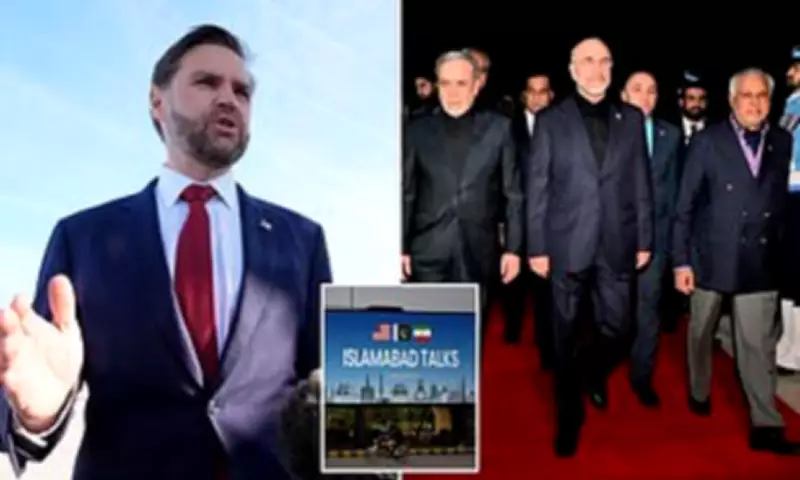
Vice President JD Vance has touched down in Pakistan, facing what many consider the most significant challenge of his political career to date. He is leading the United States delegation into high-stakes peace negotiations with Iran, a mission personally assigned by President Donald Trump.
Speaking to reporters shortly before his departure from Joint Base Andrews in Maryland, Vance issued a firm warning to the Iranian delegation. "If they're gonna try to play us, they're gonna find the negotiating team is not going to be that receptive," he stated. "The president gave us some pretty clear guidelines."
The US Delegation and Iranian Counterparts
Vance is not alone in this diplomatic endeavor. He is accompanied by special envoy Steve Witkoff and senior advisor Jared Kushner, whom President Trump described as the "good team" dispatched to Islamabad. The talks are scheduled to commence on Saturday.

The Iranian delegation arrived in the Pakistani capital several hours ahead of Vance. Their team includes several high-profile figures:
- Foreign Minister Abbas Araghchi
- Ali Akbar Ahmadian, Secretary of the Supreme National Defense Council
- Parliament Speaker Mohammad Bagher Qalibaf
- Central Bank Governor Abdolnasser Hemmati
- Several additional lawmakers
Upon arrival, the Iranian officials were received at the airport by Pakistan's Foreign Minister Ishaq Dar and other senior government representatives, underscoring the regional significance of these negotiations.
A Precarious Diplomatic Moment
Vance's mission comes at an exceptionally delicate time. A temporary ceasefire between the involved parties appears to be on the verge of collapse, with the fundamental demands of Iran and the US-Israel alliance seeming irreconcilable. Domestically, Vance faces growing political and economic pressure to achieve a resolution, particularly as he may seek the presidency in the coming election cycle.
In a social media statement that complicated the pre-negotiation atmosphere, Iranian Parliament Speaker Mohammad Bagher Qalibaf declared that a ceasefire in Lebanon—where Israel is targeting Iran-backed Hezbollah militants—and the release of frozen Iranian assets "must be fulfilled before negotiations begin." He provided no further details on these preconditions.
President Trump's Comments and the Strait of Hormuz
Before Vance's departure, President Trump offered his vice president a brief send-off. "I wished him luck. He's got a big thing. We'll find out what's going on," Trump remarked to the press as he boarded Air Force One.
The president also addressed the critical issue of the Strait of Hormuz, a vital global trade route that has seen severely restricted traffic since the temporary ceasefire was declared earlier in the week. "It's international water. If they're doing that, nobody knows if they're doing that, but if they're doing that, we're not going to let that happen," Trump asserted, referring to potential Iranian tolls on the strait.
Trump expressed confidence that the strait would "open up automatically" and "fairly soon," despite current data suggesting otherwise. According to a statement from Athens-based Marine Traffic on social media platform X, only 14 vessels have crossed the Strait of Hormuz since the April 8 ceasefire, with half of them carrying cargo. Before the conflict, over 100 ships typically passed through daily, many transporting oil to Asian markets.
Vance's Stance and the Road Ahead
Vance, who has historically expressed skepticism about prolonged foreign military engagements, struck a balanced tone before the talks. "If the Iranians are willing to negotiate in good faith, we're certainly willing to extend the open hand," he told reporters before boarding Air Force Two. However, he reiterated his warning about Iranian tactics, emphasizing that the US team would not be receptive to manipulation.
President Trump concluded with cautious optimism about his chosen negotiators. "We'll see how it turns out. So it's JD and Steve and Jared. We have a good team, and they meet tomorrow. We'll see how it all works out." He acknowledged the difficulty of the task ahead but maintained that progress would be made swiftly.

The success or failure of these talks in Islamabad will not only impact regional stability but also significantly shape Vice President Vance's political future and legacy.