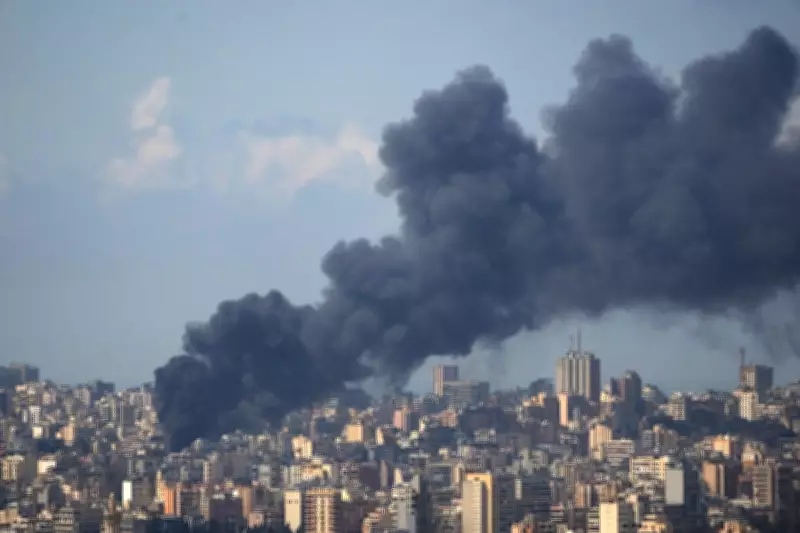
Israeli Military Launches Major Strikes on Central Beirut, Ignoring Ceasefire Announcement
Israeli forces have conducted a series of devastating strikes on central Beirut without any prior warning, plunging the Lebanese capital into chaos and panic. This aggressive military action occurred mere hours after a ceasefire was formally announced in the ongoing conflict between the United States, Israel, and Iran. The Israeli government has explicitly stated that this ceasefire agreement does not extend to its separate war with the Iran-backed militant group Hezbollah in Lebanon, a position contested by mediator Pakistan.
Unprecedented Coordinated Assault on Lebanese Capital
The Israeli military has described this operation as the largest coordinated strike in the current conflict, targeting over one hundred Hezbollah positions within a ten-minute window. The strikes were concentrated in central Beirut, southern Lebanon, and the eastern Bekaa valley. In Beirut, several dense commercial and residential districts were hit, sending towering plumes of black smoke into the sky and disrupting the bustling afternoon traffic with thunderous explosions.
Emergency services raced to the scenes, where open flames engulfed buildings and charred vehicles littered the streets. At least one apartment building suffered a direct hit, and responders worked frantically to search for casualties. The exact number of killed or wounded remains unclear, but the strikes in busy commercial areas have undoubtedly caused significant civilian distress and panic.

Military Justification and Hezbollah's Stance
In an official statement, the Israeli military justified the strikes by claiming they targeted critical Hezbollah infrastructure, including missile launchers, command centers, and intelligence facilities. The military accused Hezbollah of deliberately using civilians as human shields and called on the Lebanese state and its citizens to reject the militant group's entrenchment in populated areas.
Prior to this wave of strikes, a Hezbollah official, speaking anonymously to The Associated Press, indicated that the group was allowing mediators an opportunity to secure a ceasefire in Lebanon. However, he clarified that Hezbollah had not formally committed to the ceasefire, citing Israeli non-adherence. The official emphasized that Hezbollah would not accept a return to the pre-war status quo, where Israel conducted near-daily strikes in Lebanon despite a nominal ceasefire in place since November 2024.
"We will not accept for the Israelis to continue behaving as they did before this war with regards to attacks," the official stated. "We do not want this phase to continue."Context of the Broader Regional Conflict
This latest escalation follows Hezbollah's missile attacks across the Israeli border, which were launched days after the U.S. and Israel initiated strikes against Iran, sparking a wider regional war. Israel responded with extensive bombardment of Lebanon and a subsequent ground invasion. The human cost has been severe, with Israeli airstrikes reportedly killing more than 1,530 people in Lebanon, including over 100 women and 130 children. The Israeli military claims to have eliminated hundreds of Hezbollah fighters, and the conflict has displaced more than one million Lebanese citizens.
Earlier on Wednesday, following the announcement of the Iran ceasefire, many displaced individuals in Beirut and the coastal city of Sidon began packing their belongings, hopeful of returning to their homes. This optimism was swiftly dashed by Israeli Prime Minister Benjamin Netanyahu's vow to continue military operations in Lebanon.
Human Toll and Civilian Despair
At a sprawling displacement camp on Beirut's waterfront, families expressed profound confusion and despair, caught between conflicting statements and the relentless violence. "We can't take this anymore, sleeping in a tent, not showering, the uncertainty," said Fadi Zaydan, a 35-year-old displaced person. He and his parents had prepared to return to their home in Nabatieh before Netanyahu's comments halted their plans.

"But we'll be targeted if we go home," Zaydan lamented. His family ultimately decided to remain in Sidon, closer to home but still in a state of precarious limbo, awaiting a resolution that seems increasingly elusive as the strikes on central Beirut mark a significant and dangerous escalation in the conflict.