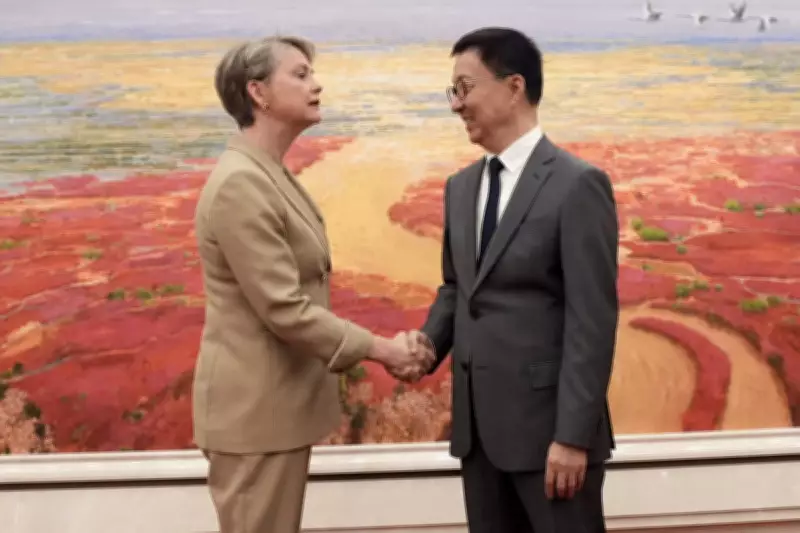
Foreign Secretary Yvette Cooper has stated that the rules-based international order is in the "shared interest" of both Britain and China, during a three-day visit to Asia. She met China's vice-president Han Zheng in Beijing for talks on global security, acknowledging "areas of disagreement" but stressing the importance of approaching discussions with "candour and respect" to enhance mutual understanding.
Talks in the Great Hall of the People
Greeting Ms Cooper in the capital's Great Hall of the People on Tuesday, Mr Han hailed a "new chapter in bilateral ties" opened during Sir Keir Starmer's visit to China in January. Ms Cooper, on her first visit to the country, emphasised that as two permanent members of the UN Security Council, the UK and China must collaborate to address global challenges, including wars in Ukraine and Iran, and health crises like the Ebola outbreak in the Democratic Republic of the Congo.
"It is in our shared interest to have a rules-based international order and to find ways to reduce rising geoeconomic tensions," she said. China's relationship with Russia, which has endured since Moscow's full-scale invasion of Ukraine in 2022, is expected to be a topic during the bilateral talks lasting several hours.

Approach with Candour and Respect
Addressing Mr Han, the Foreign Secretary said: "I'm very pleased to be here in China, thank you for welcoming me. We will have important issues of shared interest and cooperation and also areas of disagreement, but as the Prime Minister and President Xi have demonstrated, we increase our understanding of one another when we approach these conversations with candour and respect." She added that "those frank and constructive discussions can help us make meaningful progress for the benefit of our two countries and the wider world."
Welcoming her, the Chinese vice-president noted that an "important consensus" had been reached during Sir Keir's visit earlier this year, with both leaders agreeing to advance a "comprehensive strategic dialogue" to deepen cooperation amid geopolitical volatility. "Their important consensus has opened a new chapter for bilateral ties," Mr Han said. "We need to intensify interactions and strengthen dialogue and cooperation for the sake of world peace and stability and for the growth of our respective economies." He stressed that "shouldering our responsibilities as major countries" together would bring "great benefits to our two countries as well as the entire world."
Pressure and Security Concerns
Critics have urged Labour to take a harder line on Beijing over issues such as the treatment of the Uighur population and the imprisonment of British citizen Jimmy Lai, which the Foreign Secretary is likely to raise during her visit. However, the Government views engagement with major economies like China as vital for protecting Britain's security amid global instability, insisting the UK will cooperate where possible and challenge where necessary.
Despite efforts to thaw what Sir Keir has termed a diplomatic "ice age" between the two countries, the Foreign Office delegation is travelling with "burner" phones throughout the trip, reflecting ongoing concerns about Chinese espionage. Ms Cooper later made a cultural visit to the Forbidden City, guided through the world's largest imperial palace complex, before meeting her counterpart Wang Yi for further talks at Diaoyutai State Guest House.
Future Plans: Shenzhen and Delhi
She will then travel to Shenzhen, a major technology hub, where she plans to discuss potential trade links and "the challenges of the future of AI as it rapidly changes our world." After concluding her China visit on Wednesday, the Foreign Secretary will head to Delhi to meet Indian counterpart Subrahmanyam Jaishankar on Thursday. Those talks are also expected to cover the Middle East, focusing on maritime security as Iran maintains control over the Strait of Hormuz amid ongoing escalation around key global shipping lanes.