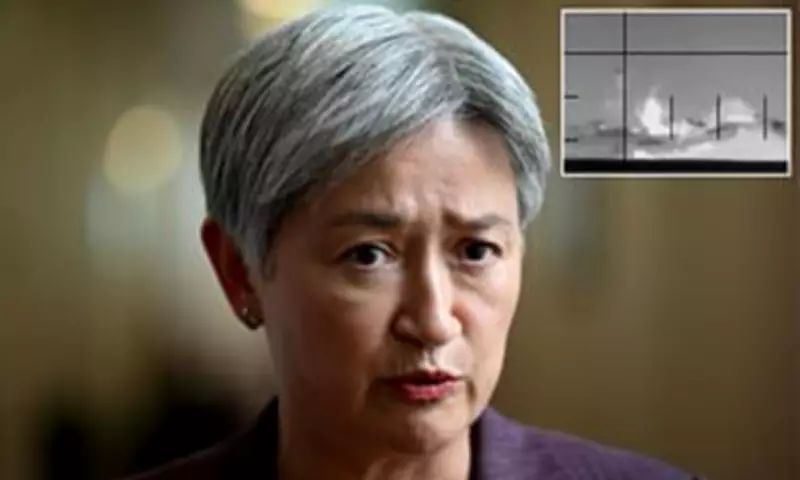
Foreign Minister Evades Questions on Australian Sailors in US Submarine Attack
Foreign Affairs Minister Penny Wong has steadfastly refused to confirm or deny explosive reports that two Australian Defence Force personnel were aboard a United States nuclear-powered submarine when it launched a torpedo attack on an Iranian warship, resulting in the deaths of eighty-seven Iranian sailors. The incident, which represents a significant escalation in regional tensions, occurred in international waters off the southwestern coast of Sri Lanka during the early hours of Wednesday morning, Australian Eastern Daylight Time.
Details of the Naval Engagement and Aftermath
The targeted vessel was the IRIS Dena, one of Iran's newest and most capable frigates, which was returning to its home port after participating in joint military exercises near India's eastern coastline. According to statements from the Sri Lankan navy, the warship issued a distress signal approximately seventy-five kilometres from the port city of Galle before being struck by a Mark-48 torpedo fired from the American submarine.
Sri Lankan naval Commander Buddhika Sampath provided a harrowing account of the scene, stating that by the time rescue vessels arrived, there was no sign of the frigate itself. "Only some oil patches and life rafts... and people floating on the water," Sampath reported. The Sri Lankan authorities confirmed the recovery of eighty-seven bodies from the wreckage, with thirty-two Iranian sailors successfully rescued. The frigate had been carrying an estimated one hundred and eighty personnel at the time of the attack.

AUKUS Training Rotation at the Centre of Controversy
The presence of Australian sailors aboard the American submarine is reported to be part of the ongoing AUKUS alliance training rotations. These rotations are designed to prepare Australian naval personnel for the eventual operation of their own nuclear-powered submarines, which Australia is set to acquire under the trilateral security pact with the United States and the United Kingdom. Media reports indicate that up to one hundred Australian personnel are scheduled for deployment on US submarines by the year 2026 as this program expands.
When directly questioned in the Senate by Greens senator David Shoebridge regarding the potential involvement of Australian Defence Force members in the incident, Minister Wong offered a carefully worded deflection. "US submarine operations are a matter for the United States," Wong stated. She further emphasised that, "for operational and security reasons, we do not disclose specific information regarding Australian personnel." This position was echoed by a spokesperson for the Defence Department, who cited long-standing arrangements for third-country deployments but declined to provide any specifics on ranks or numbers.
Broader Context of Secrecy and Military Cooperation
This incident has ignited a fierce debate over governmental transparency and Australia's role in international military actions. Senator Shoebridge has accused the Australian government of maintaining a "wall of secrecy" around defence matters that he claims exceeds even that of the United States. The controversy extends beyond this single event, with Wong also recently refusing to answer parliamentary questions on whether the joint Australian-US intelligence facility at Pine Gap assisted American strikes against Iran, and the purpose of visits by two US P-8 Poseidon aircraft to RAAF Base Pearce near Perth.
In the United States, Secretary of War Pete Hegseth described the attack on the IRIS Dena—which he labelled Iran's "prize ship"—as a "quiet death." American authorities have asserted that this engagement marks the first instance since the Second World War that a US submarine has fired upon an enemy warship. The United States and Israel have officially stated that the military strikes were initiated and conducted solely by their forces, explicitly noting that Australia was not a participant in the offensive actions.

The Australian Defence Force and Defence Minister Richard Marles have been approached for further comment on the matter, but no additional statements have been released at this time. The episode underscores the complex and often opaque nature of modern military alliances and the challenges of parliamentary oversight in an era of heightened global security concerns.