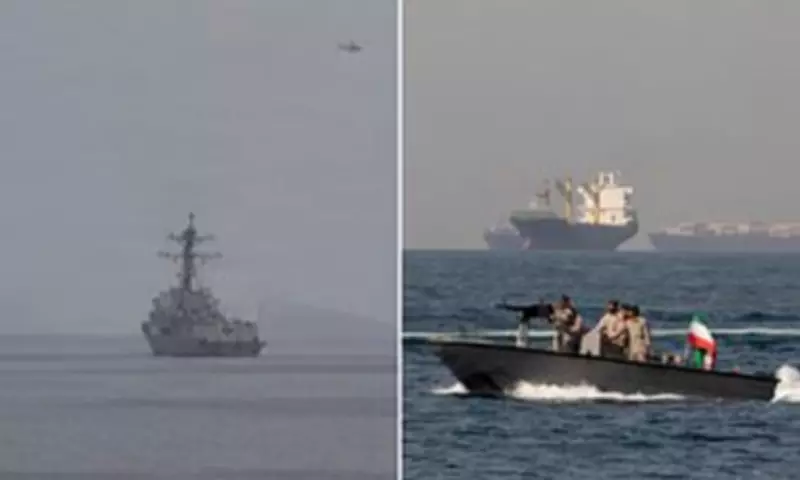
US Military Actions Cripple Iran's Conventional Naval Forces
Washington has delivered a devastating blow to Iran's conventional navy during the ongoing Middle East conflict, with a series of strikes destroying substantial portions of its fleet. However, the paramilitary force Tehran relies upon to control the strategically crucial Strait of Hormuz remains largely intact. This development comes as former President Donald Trump has vowed to initiate a blockade of Iranian ports following ceasefire negotiations that concluded over the weekend without any agreement.
Asymmetric Naval Doctrine Preserves Iranian Influence
Iran's traditional navy, which operates larger warships and frigates, has historically served a more symbolic role focused on prestige and occasional long-range missions. In contrast, the Islamic Revolutionary Guard Corps maintains a separate fleet specifically designed for speed and flexibility to dominate the narrow passage. This arsenal includes nimble boats equipped with missiles, mines, and drones, enabling Tehran to threaten and disrupt commercial shipping through methods that prove considerably more challenging to counter effectively.
Footage released by Iranian state media during the conflict's early stages revealed extensive underground tunnel networks packed with naval drones, anti-ship missiles, and sea mines. A temporary pause in hostilities occurred after President Trump negotiated a two-week arrangement with Tehran in exchange for reopening the strait. Nevertheless, Iran issued a stark warning via marine radio, declaring that any vessel attempting passage without Revolutionary Guard authorization risked destruction.

Heightened Tensions and Maritime Confrontations
US Central Command confirmed on Saturday that two navy guided-missile destroyers—the USS Frank E. Petersen and the USS Michael Murphy—transited the waterway as part of an American mission to ensure the strait remained fully clear of sea mines. Maritime traffic plummeted immediately, with only four ships crossing during the ceasefire's first day compared to more than one hundred daily crossings before the conflict. Iranian officials subsequently informed mediators they would restrict crossings to approximately twelve ships daily.
Iranian state media released purported recordings showing Revolutionary Guard personnel threatening a US Navy destroyer entering the Strait of Hormuz. In the exchange, an IRGC serviceman warned the USS Frank E. Petersen to alter course immediately or face targeting, while an American voice responded that the vessel was engaged in lawful transit passage. The recording continued with the Iranian officer issuing a "last warning" three times before alerting nearby ships to maintain distance due to imminent attack readiness.
Economic Consequences and Strategic Implications
Concerns have escalated further as Iran warned of anti-ship mines in the main channel, advising vessels to consult the Revolutionary Guard for safe passage along alternative coastal routes. While mine presence remains unconfirmed, the warning marked the first indication Tehran might have deployed them—a possibility previously raised by US officials. The United States has actively challenged Iran's grip on the waterway, with the two guided missile destroyers' Saturday transit representing the first such movement during the conflict.
Approximately one-fifth of global oil supply typically passes through the strait, and the disruption has driven prices above $100 per barrel for the first time since 2022. Benchmark crude oil prices surged more than seven percent in Monday morning Asian trading, while the dollar strengthened and US stock futures declined following Trump's blockade announcement. Iran has already attacked over two dozen commercial ships in the Persian Gulf, demonstrating its ability to disrupt traffic without relying on large naval vessels.

Significant Naval Losses Documented
According to US Central Command, American forces had sunk more than 155 Iranian vessels by April 6. Satellite imagery and military footage reveal widespread destruction, including some of Iran's most advanced ships such as the IRIS Dena—a warship torpedoed by a US submarine near Sri Lanka, resulting in at least 87 casualties among approximately 180 personnel aboard. Other strikes targeted minelayers, frigates, and sophisticated platforms like the IRIS Shahid Sayyad Shirazi, a stealth catamaran capable of launching anti-ship and surface-to-air missiles.
The Revolutionary Guard's largest drone carrier in the Persian Gulf, the Shahid Bagheri, was also struck. By early March, four of Iran's primary surface combatants were likely sunk or crippled, with Iran losing six of its seven frigates, both corvettes, and one of three ocean-going submarines. Yet these substantial losses have minimally diminished Tehran's ability to threaten the strait, as the Revolutionary Guard retains an extensive fleet of small, fast attack craft specifically designed for operations in confined waters.
Historical Context and Ongoing Threats
These vessels prove more difficult to detect and can be launched from hidden coastal bases carved into rocky terrain, according to military experts. Iran's strategy has developed over decades following America's destruction of much of its fleet during a one-day naval battle in April 1988, prompting Tehran to shift toward an asymmetrical doctrine focused on controlling commercial shipping rather than directly confronting larger naval forces.
Since February 28, at least fifty strikes have been carried out against shipping in the Gulf and strait according to conflict tracking data. The Revolutionary Guard has deployed waterborne drones, with some striking the Safesea Vishnu tanker in an Iraqi port on March 11 while other vessels near Oman and Iraq were also hit. Naval drones were first showcased by the Revolutionary Guard approximately one year ago, with similar technology employed by Iran-backed Houthi forces in Yemen.
Blockade Announcement and Diplomatic Fallout
Iran is believed to possess thousands of mines deployable from small boats or fishing vessels. Although their use in the strait remains unconfirmed, the threat alone has created a chilling effect on shipping, with captains refusing orders to transit the waterway. Following unsuccessful weekend peace talks in Islamabad between Washington and Tehran negotiators, President Trump declared the US Navy would begin blockading any ships attempting to enter or leave the Strait of Hormuz.
Central Command later clarified the blockade would apply exclusively to ships traveling to or from Iran, including all Iranian ports on the Gulf and Gulf of Oman, with enforcement commencing Monday at 10am Eastern Time. US forces would not impede freedom of navigation for vessels transiting the strait to and from non-Iranian ports, with additional information to be provided. The Revolutionary Guard responded by warning that military vessels approaching the strait would be considered a ceasefire breach dealt with harshly and decisively.
Political Reactions and Regional Ramifications
Retired Admiral Gary Roughead, former chief of US naval operations, cautioned that Iran could fire on ships in the Gulf or attack infrastructure of Gulf states hosting US forces. Senator Mark Warner of Virginia, ranking Democrat on the Senate Intelligence Committee, questioned the blockade's effectiveness during a CNN appearance, while Republican Congressman Mike Turner of Ohio, former House Intelligence Committee chair, described it as a means to force resolution in the vital oil passage.
Trump stated US forces would intercept every vessel in international waters that had paid tolls to Iran, following reports the regime had begun demanding two million dollars in transit fees for strait passage. The former president emphasized that no one paying illegal tolls would have safe passage, adding that any Iranian firing at US or peaceful vessels would be destroyed. Dana Stroul, former senior Pentagon official during the Biden administration, noted the mission's difficulty and likely unsustainability over medium to long terms.
International Dimensions and Economic Projections
Earlier on Saturday, Trump announced American military forces had started clearing the strait, claiming all Iranian minelaying ships had been sunk. Central Command Admiral Brad Cooper stated establishment of a new passage would begin, with safe pathways shared with the maritime industry to encourage commerce flow. Following Islamabad peace talks, Tehran rejected Washington's demands regarding uranium enrichment, facility dismantling, and highly enriched uranium transfer.
Iran also refused US demands to cease funding for Hamas, Hezbollah, and Houthis while fully opening the Strait of Hormuz. Iranian Foreign Minister Abbas Araqchi criticized what he described as maximalism, shifting goalposts, and blockade when nearing agreement. Many analysts anticipate that even if ceasefire holds, energy flows through the Gulf will require time to normalize, meaning higher fuel prices and stronger inflation for the global economy.
Trump acknowledged oil and gasoline prices may remain elevated through November's midterm elections, while Iran's parliamentary speaker posted Washington-area gasoline prices with commentary about impending increases. Meanwhile, China finds itself embroiled in the intensifying conflict as Trump threatened Beijing with substantial new tariffs if providing military assistance to Tehran. US intelligence reportedly indicates China might deliver new air defence systems to Iran, though Beijing denies these allegations while emphasizing responsible military export controls.