US Military Assets Deploy to Middle East Amid Iran Tensions
The Pentagon has been actively deploying substantial United States military assets into the Middle East this week, including a formidable aircraft carrier group accompanied by thousands of troops. This strategic movement occurs as President Donald Trump continues to signal that he is preserving the option for potential strikes against Iran, amidst Tehran's severe crackdown on widespread domestic protests.
Trump's Statements and Military Posturing
"We have a massive fleet heading in that direction, and maybe we won't have to use it," President Trump informed reporters on Thursday, characterising the deployment as a precautionary measure. The President has previously threatened military action should Iran proceed with mass executions of prisoners or the killing of peaceful demonstrators. However, he recently appeared to step back from this stance, asserting that Iran had halted plans to execute 800 detained protesters. Trump has not provided further details on the source of this claim, which Iran's top prosecutor has vehemently denied as "completely false."
Despite this, President Trump seems intent on keeping all options available. Speaking aboard Air Force One on Thursday, he warned that any threatened military action would make last year's U.S. strikes on Iranian nuclear facilities "look like peanuts" if the Iranian government moved forward with planned executions of protesters.

Naval Movements and Regional Buildup
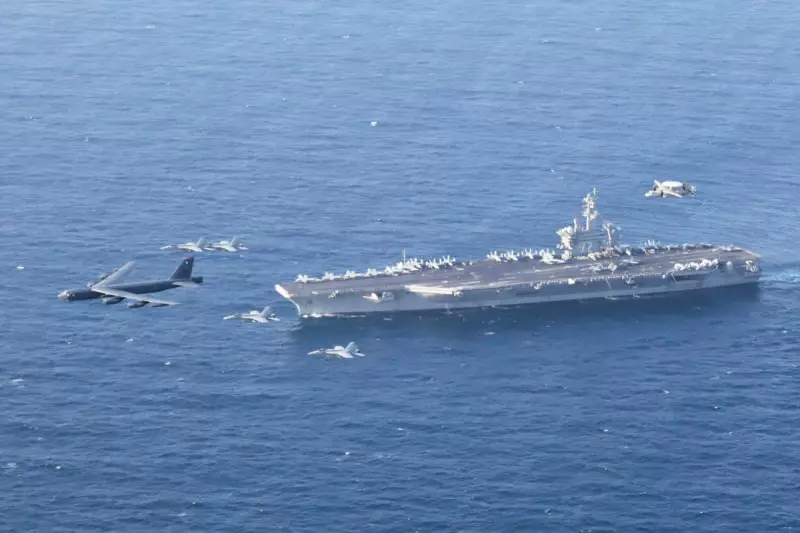
The aircraft carrier USS Abraham Lincoln, along with three accompanying destroyers, departed the South China Sea earlier this week and began heading westward, according to a U.S. Navy official. This official, who spoke on condition of anonymity to discuss sensitive military movements, confirmed on Friday that the Lincoln strike group had reached the Indian Ocean.
Upon arrival in the region, these warships are set to join three littoral combat ships currently stationed in port at Bahrain, as well as two other U.S. Navy destroyers operating in the Persian Gulf. The introduction of the carrier strike group will bring approximately 5,700 additional service members to the area. The United States maintains several key bases across the Middle East, including the significant Al Udeid Air Base in Qatar, which hosts thousands of American troops and serves as the forward headquarters for U.S. Central Command.
This redeployment of naval power follows a period where the Trump administration had shifted some military resources from the Middle East to the Caribbean Sea as part of a pressure campaign targeting former Venezuelan President Nicolás Maduro. Notably, the world's largest aircraft carrier, the USS Gerald R. Ford, was ordered in October to sail from the Mediterranean to the Caribbean alongside several destroyers. The carrier USS Nimitz, which participated in the June strikes on Iran's nuclear sites, also left the region in October.
Enhanced Air Power and Allied Support
In addition to naval forces, U.S. Central Command announced via social media that the Air Force has deployed F-15E Strike Eagle fighter jets to the Middle East, noting that their presence "enhances combat readiness and promotes regional security and stability." Similarly, the United Kingdom's Ministry of Defence confirmed on Thursday that it had deployed its Typhoon fighter jets to Qatar "in a defensive capacity."
Analysts monitoring flight-tracking data have also observed dozens of U.S. military cargo planes heading towards the region. This military activity mirrors movements from the previous year when the U.S. prepositioned air defence systems, such as Patriot missile batteries, in anticipation of potential Iranian retaliation following the bombing of key nuclear sites. Iran did launch over a dozen missiles at Al Udeid Air Base in the days after those strikes.
Context: The Situation in Iran
Iran has been engulfed by nationwide protests and demonstrations since late December, primarily ignited by the Islamic Republic's struggling economy. These protests have applied significant new pressure on the theocratic regime, which has responded with a deadly crackdown and widespread internet shutdowns.

Human rights activists report that the overall death toll from the government's suppression has risen to at least 5,032 people, with more than 27,600 individuals detained in an expanding arrest campaign. The official Iranian government death toll remains substantially lower, citing only 3,117 fatalities.
Iranian officials indicated last week that suspects detained during the protests would face expedited trials and potential executions, while also promising a "decisive response" should the United States or Israel choose to intervene militarily.