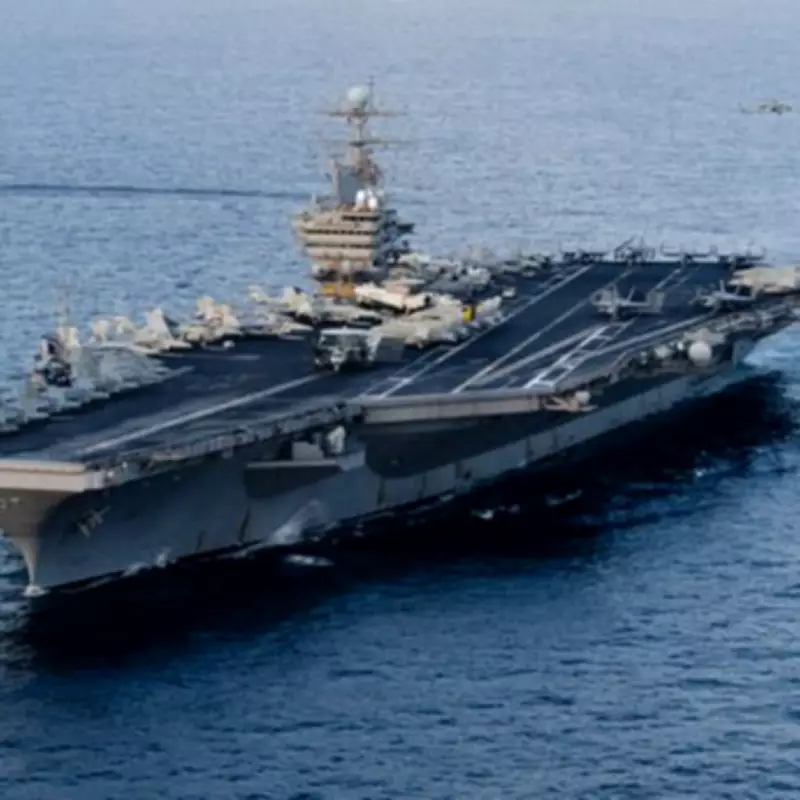
US Military Armada Braces for Iran Strikes as 'Five to Midnight' Warning Sounds
American and Iranian forces are on high alert for potential conflict today, even as crucial indirect talks aimed at averting a major war unfold in Oman. The situation has been described by a former British commander as a chilling "five to midnight moment" for Iran, with strikes deemed "highly likely" in the near future.
Military Buildup Amid Diplomatic Efforts
While US envoys engaged in tentative morning meetings with Omani counterparts in the same venue as Iranian officials, the American war machine continues to gear up for potential action. The aircraft carrier USS Abraham Lincoln is leading a formidable strike force in the region, supported by additional warships and fighter jets, providing the US with significant military firepower to launch an attack if deemed necessary.
Simultaneously, Tehran's Islamic Revolutionary Guard Corps appears to be preparing for war, with roadblocks emerging throughout Tehran and other locations. Reports indicate Iran is preparing mass executions, defying US demands regarding protester welfare, as tensions reach a boiling point.

Key Demands and Iranian Responses
Washington has presented several non-negotiable demands to Iran, including:
- An immediate end to Iran's nuclear programme
- A winding down of ballistic missile production
- Improved treatment of protesters within the country
In response, Iranian officials have stated that while they are willing to discuss nuclear and other aspects of these demands, any talk of degrading Iran's ballistic weapons capability is firmly "off the table." Iran maintains that its nuclear programme relates solely to atomic power and energy generation, not missile development.
Expert Analysis of the Crisis
Colonel Richard Kemp, a former British commander and adviser to the UK government on counter-terrorism, provided exclusive insight into the escalating situation. "President Trump is unpredictable," Kemp noted. "But I would say it is a 'five to midnight' moment for Iran. You don't build such a massive military force in a region and then go away and not use it."
Kemp elaborated on potential US strategies, suggesting that "the primary objective of a United States strike would be to end this regime in Tehran." This could be achieved through:
- Pinpoint attacks targeting key individuals
- Aerial strikes or special forces operations on the ground
- Cyber attacks to prevent the IRGC from attacking its own people
- Strikes on Iranian commercial facilities like oil depots
The former commander emphasized the critical importance of avoiding civilian casualties while neutralizing Iran's air defence capabilities, much of which was reportedly compromised during the 12-day war in June.
Regional Implications and Israeli Concerns
The crisis has significant implications for regional stability, particularly concerning Israel. Kemp noted that "ballistic missiles are a fundamental element of what Iran sees as its defensive capability and offensive too," with Israel having experienced attacks twice in the past year.
"If there was an attack by the US or Israel or both," Kemp warned, "I think Israel would be obliged to go in hard against Hezbollah in Lebanon, who are depleted but still represent a threat."
Diplomatic Developments and Internal Unrest
US envoy Steve Witkoff and Jared Kushner held meetings with local diplomats in Oman, occurring in the same venue where Iranian Foreign Minister Abbas Araghchi met with Omani counterpart Badr al-Busaidi. Meanwhile, reports suggest Iran's leadership is siphoning off hundreds of millions of pounds from Tehran, potentially preparing to flee as pressure mounts.
One American official described the situation starkly: "They are taking the money out of the country like crazy. The rats are abandoning the ship...they know the end is near." The US has issued a major alert urging all citizens to flee Iran immediately.

Human Rights Concerns and Escalating Violence
The tension coincides with disturbing reports of human rights violations within Iran. The regime is believed to have executed 15 prisoners in Mashhad, Bushehr, Sari, and Mahshahr on Thursday, claiming the dead were drug dealers or murderers. This comes amid escalating regional tension and reports that Iran has continued killing protesters rallying against the regime.
More than 7,000 protesters have reportedly died, with at least 17,000 more deaths under investigation. Recent protests have become the greatest challenge to 86-year-old Supreme Leader Ayatollah Ali Khamenei's rule since the 1979 Islamic Revolution, prompting a severe crackdown that has killed thousands and seen tens of thousands arrested.
Military Capabilities and Recent History
The US bombed Iranian nuclear sites during the so-called 12-day war in June, reportedly destroying many centrifuges that spun uranium to near weapons-grade purity. Similar attacks by Israel devastated Iran's air defenses and targeted its ballistic missile arsenal.
Like Colonel Kemp, US officials including Secretary of State Marco Rubio believe Iran's theocracy is now at its weakest point since the revolution. The combination of internal unrest and external military pressure has created what experts describe as a perfect storm of geopolitical tension.
Diplomatic Statements and Future Prospects
Oman issued a statement following the indirect meeting between the two sides, noting that "the consultations focused on preparing the appropriate circumstances for resuming the diplomatic and technical negotiations by ensuring the importance of these negotiations, in light of the parties' determination to ensure their success in achieving sustainable security and stability."
Before the meeting, Iranian Foreign Minister Abbas Araghchi wrote on social media that "Iran enters diplomacy with open eyes and a steady memory of the past year. Commitments need to be honored. Equal standing, mutual respect and mutual interest are not rhetoric - they are a must and are the pillars of a durable agreement."
As the world watches this dangerous standoff unfold, the combination of military preparedness, diplomatic efforts, and internal Iranian unrest creates what experts describe as one of the most volatile geopolitical situations in recent memory.