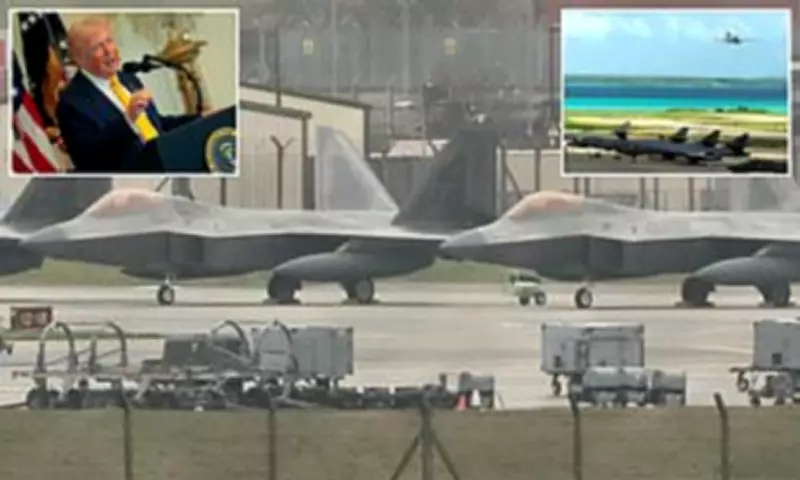
The United Kingdom has formally denied the United States permission to launch military strikes against Iran from British-controlled bases, including RAF Fairford in Gloucestershire and the strategically vital Diego Garcia in the Indian Ocean. This refusal has ignited a furious response from former US President Donald Trump, who has publicly withdrawn his backing for Prime Minister Sir Keir Starmer's proposed deal to transfer sovereignty of the Chagos Islands to Mauritius.
Military Plans and Legal Constraints
According to detailed reports, the White House has been actively preparing a comprehensive military blueprint for an assault on Iran, which explicitly involves utilising both Diego Garcia and RAF Fairford. The latter serves as the primary European base for America's fleet of heavy bombers. Defence officials have briefed that, following a significant recent build-up of aircraft and naval assets in the Middle East, the United States could be operationally ready to commence airstrikes as early as this weekend.
However, longstanding bilateral agreements strictly mandate that British military installations can only be employed for operations that have received prior, explicit approval from the UK government in Number 10. Crucially, the United Kingdom has not granted this authorisation, primarily due to substantial concerns that any pre-emptive strike on Tehran would constitute a clear breach of international law.

Trump's Social Media Outburst and Chagos Link
The diplomatic rift escalated dramatically when Donald Trump took to his Truth Social platform to lambast the British government. In a lengthy post, he criticised the proposed 100-year lease agreement for Diego Garcia with Mauritius, warning it was a "big mistake." Trump explicitly linked the basing issue to the potential Iran conflict, stating that should Iran refuse a nuclear deal, the US might need to use Diego Garcia and RAF Fairford "to eradicate a potential attack."
He further argued that UK support for such a strike would be legally justified under international law if Iran posed a threat to the UK and other allied nations. Trump concluded his message with a stark warning: "DO NOT GIVE AWAY DIEGO GARCIA!"
Historical Precedent and Political Reactions
Britain's cautious stance on pre-emptive military action has strong historical foundations. In the lead-up to the Iraq War, the then Attorney General, Lord Goldsmith, advised that international law only permits the use of force in self-defence against an actual or imminent attack. This legal principle continues to inform current UK policy.
The political fallout within the UK has been immediate. Shadow Foreign Secretary Dame Priti Patel called for Starmer to "U-turn and scrap this appalling deal altogether," while Liberal Democrat leader Sir Ed Davey suggested Trump's "endless flip-flopping" demonstrated why the government's approach was flawed. A UK government spokesperson declined to comment on operational specifics but reaffirmed support for the US-Iran political process and the imperative that "Iran must never be able to develop a nuclear weapon."
Escalating Military Posture and Regional Drills
The geopolitical tensions are unfolding against a backdrop of formidable US military mobilisation. A second aircraft carrier strike group, led by the USS Gerald R. Ford, is en route to the eastern Mediterranean. This armada, combined with existing assets, grants the US a capacity for sustained, overwhelming aerial bombardment of Iran for weeks, should the order be given.
Simultaneously, Iran has conducted provocative military exercises, including temporarily closing the Strait of Hormuz and firing cruise missiles—a stark warning of the potential global economic disruption. Tehran also held joint naval drills with Russia in the Gulf of Oman and Indian Ocean, described as aimed at "upgrading operational coordination."
Analytical Perspectives and Broader Implications
Analysts suggest any US campaign could aim beyond nuclear facilities, potentially targeting Iran's leadership and command structures to foment regime change. Sascha Bruchmann of the International Institute for Strategic Studies noted that strikes might seek to cripple the regime's communications, "levelling the playing field" for internal opposition forces.

Israel has reportedly begun its own preparations, bringing forward a key security cabinet meeting. Meanwhile, nations like Poland have issued urgent travel warnings, advising all citizens to evacuate Iran immediately due to the rapidly deteriorating security situation. The UK's firm stance, rooted in legal scrutiny, has placed it at the centre of an international crisis, balancing its special relationship with Washington against its commitments to international law and regional stability.