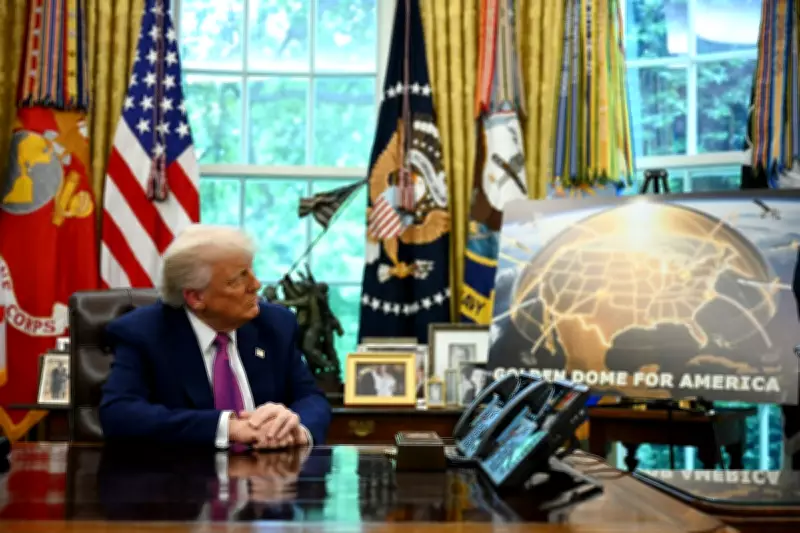
Trump's Golden Dome Defence Initiative Faces Major Setbacks and Industry Skepticism
President Donald Trump's ambitious Golden Dome missile defence programme, announced with great fanfare in May 2025, has encountered substantial obstacles and delays in its implementation. The proposed next-generation system, designed to create a comprehensive national shield using advanced space-based sensors and interceptors, has struggled to gain momentum nearly a year after its unveiling.
Funding Freeze Creates Implementation Paralysis
Despite congressional approval for substantial funding, the White House has held back billions of dollars allocated for the defensive architecture. This financial impasse has prevented industry leaders from scaling up their work on the project, according to multiple insiders and former defence department officials who spoke to Politico. "The whole thing is at risk," a former Pentagon official stated bluntly, highlighting the precarious position of the initiative.
Instead of accessing the full $23 billion in approved funds, the Pentagon has resorted to issuing piecemeal contracts to begin developing the space-based interceptors. The U.S. Space Force awarded multiple small contracts to unnamed firms for prototype development, with each contract valued at less than $9 million. This fragmented approach has created significant frustration within the defence industry.

Industry Reluctance and Technological Uncertainty
Defence companies have demonstrated marked reluctance to invest their own capital in the Golden Dome project, primarily due to concerns about its longevity beyond the current administration. The complex and unproven nature of the technology, combined with political uncertainty, has made industry leaders cautious about substantial financial commitments.
"I don't think anyone in industry is banking on [space-based interceptors] surviving into the next admin," one industry representative revealed. Another anonymous industry source expressed frustration with the current approach: "Setting up a prize mechanism instead of putting companies on contract when there are billions appropriated is frustrating."
Structural Confusion and Implementation Challenges
Elaine McCusker, a former Pentagon comptroller, highlighted fundamental questions about how the various components would integrate into a functional system. "They don't necessarily understand how it's all going to come together into a workable system," McCusker told Politico. "There's all these lines of effort, and some of them are out for industry competition, and some of them the government plans on doing itself. And so it's kind of like, how are they going to do that?"
Official Optimism Amid Growing Concerns
Despite these challenges, the Trump administration continues to project confidence about the project's progress. The Pentagon issued a statement asserting that the Golden Dome office "continues to meet the goals" outlined in Trump's executive order, describing the implementation as "dynamic" while claiming foundational elements are now firmly established.
Space Force General Michael Guetlein announced plans to test a space-based interceptor within two years, though details about this proposed demonstration remain scarce. The administration has cited security concerns as justification for the project's secrecy, with Guetlein noting attempts to hack into the "defence industrial base."
Congressional Frustration and Diplomatic Complications
Members of Congress have expressed growing dissatisfaction with the slow progress. Lawmakers have not yet received detailed plans from the Defence Department regarding how the allocated $23 billion will be spent this summer. Representative Jeff Crank, a Colorado Republican, acknowledged the frustration among supporters of the president's goal, stating they await "that sign off from the White House" before funds can be properly allocated.
Further complicating matters has been President Trump's controversial statements regarding Greenland, a semi-autonomous territory of Denmark that could play a crucial role in the Golden Dome project's infrastructure. These diplomatic tensions add another layer of uncertainty to an already complex international defence initiative.

The White House did not immediately respond to requests for comment from media outlets about the current status and challenges facing the Golden Dome programme, leaving many questions unanswered about the future of this ambitious defence project.